
You did everything right. Injections, scans, egg retrieval, embryo transfer, the two-week wait. And still, no pregnancy. After one failed IVF cycle, hope holds. After two or three, doubt creeps in, and questions like “is something wrong with my eggs?” become impossible to ignore.
For couples facing repeated IVF failure, the idea of using donor eggs comes up, and it deserves an honest, case-based discussion rather than a rushed answer. Whether donor eggs after repeated IVF failure in Vapi make sense depends entirely on why the cycles failed, and that is exactly what we will work through here.
Key Takeaways
- IVF failure has more than one cause. Egg quality, embryo quality, implantation issues, sperm factors, and uterine problems can each play a role, so donor eggs are only discussed when evidence points to the eggs.
- Age is the strongest driver of egg quality. IVF success with own eggs falls from roughly 35% per embryo transfer in women under 35 to about 5% at ages 43 to 44.
- Using young donor eggs removes the age barrier. Live birth rates with donor eggs stay above 30% even for women in their 40s, according to the same HFEA national data.
- No fixed number of failed cycles automatically triggers donor eggs. The decision comes from your IVF history, ovarian reserve testing, and embryo records.
- A proper review comes first: uterine evaluation, sperm assessment, and cycle analysis should be done before anyone talks about donor oocyte treatment.
Why IVF Fails: It Is Rarely Just One Thing
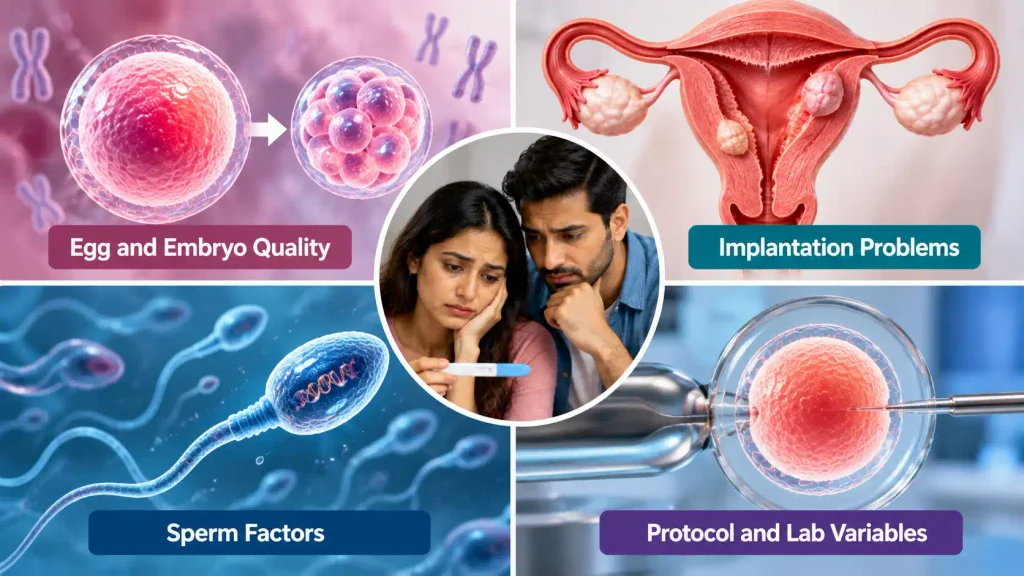
Repeated IVF failure does not have a single explanation. In clinical practice, the usual suspects fall into four groups:
- Egg and embryo quality. Chromosomally abnormal embryos (aneuploidy) are the leading cause of failed implantation, and this risk rises sharply with age-related fertility decline.
- Implantation problems. Polyps, fibroids, adhesions, hydrosalpinx, chronic endometritis, or a displaced implantation window can stop even a healthy embryo.
- Sperm factors. DNA damage in sperm can produce embryos that look fine on day 3 but stall later.
- Protocol and lab variables. Stimulation response, timing, and lab handling all influence outcomes.
This matters because donor eggs only fix one of these four. If the problem is the uterus or sperm, donor eggs will not solve it. That is why a structured review of your IVF history always comes before any conversation about donor egg IVF.
“When a couple tells me their IVF failed, my first job is not to recommend a new treatment. My first job is to find out why. Guessing wastes cycles, money, and emotional energy.” – Dr. Kaushal Patel
How Doctors Tell If Poor Egg Quality Is Driving the Failures
So how do we know? Poor egg quality IVF patterns leave fingerprints. An experienced IVF specialist in Vapi will look at:
- Low egg count at retrieval, even with strong stimulation doses
- Fewer fertilised eggs than expected after standard ICSI
- Poor embryo development, meaning few embryos reaching the blastocyst stage
- Embryos that arrest early or look fragmented under the microscope
- Repeated chromosomal abnormalities if PGT testing was done
- Rising FSH or falling AMH, which reflect declining ovarian reserve
Compare that with a different picture: healthy blastocysts created every cycle, but implantation never happens. In that case, the eggs are probably not the bottleneck. The search shifts to the uterus, the immune environment, or sperm DNA.
“Egg quality shows itself in the lab, not in a blood test alone. I always ask to see the embryology records, because the story of your failed cycle is written there in numbers.” – Dr. Kaushal Patel
If you have been told you have low AMH or a low egg count, it helps to read what that actually means for your chances in our detailed low AMH and low egg count. Low reserve reduces quantity, but it does not automatically mean donor eggs are your only path.
How Many Failed IVF Cycles Before Donor Eggs Are Considered?
There is no magic number, and any doctor who quotes one without seeing your records is guessing. That said, here is how the thinking generally works:
| Situation | What it usually suggests |
|---|---|
| Very few eggs retrieved, poor embryo growth, age over 38 | Egg quality or reserve may be limiting; donor eggs may be discussed sooner |
| Good number of embryos, but repeated implantation failure | Uterine, sperm, or immune evaluation comes first; eggs may not be the problem |
| Aneuploid embryos on PGT testing across cycles | Strong evidence of an egg-related issue; donor oocyte discussion is reasonable |
| First failed cycle with healthy blastocysts | Usually no reason to jump to donor eggs; review and retry often advised |
| Failed cycles plus significant fibroids, hydrosalpinx, or adenomyosis | Surgical or corrective treatment may change the picture entirely |
Most fertility specialists agree that after two to three well-executed cycles with documented poor embryo quality, the discussion becomes genuinely appropriate. After one failed cycle with good embryos, it usually is not.
Can Good Embryos Fail and Still Point Away From Donor Eggs?
Yes, and this is the point most online articles get wrong. When good-quality embryos repeatedly fail to implant, the problem is often the receiving environment, not the eggs. In these cases, an IVF specialist will typically investigate:
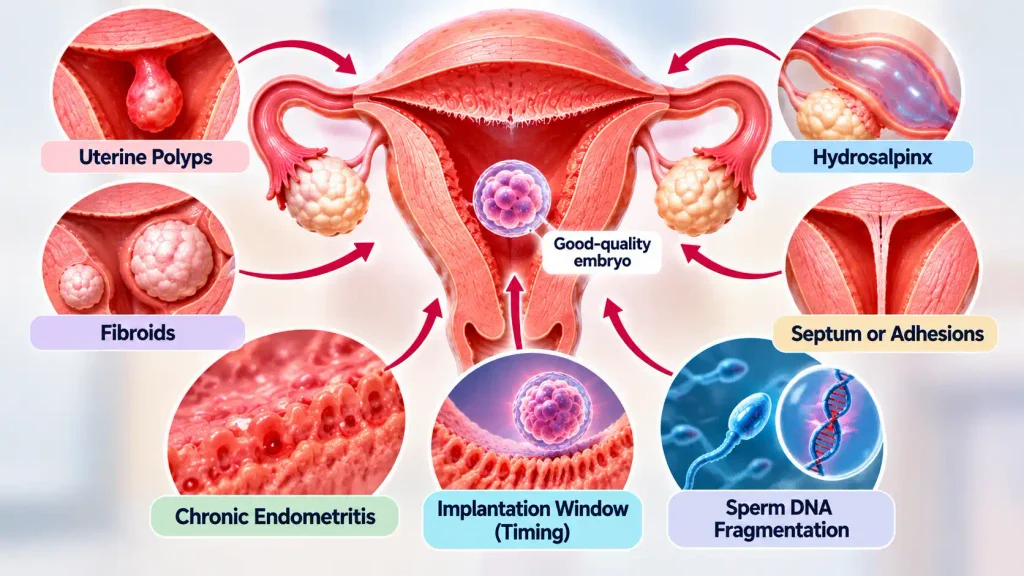
- Hysteroscopy for polyps, adhesions, or a septum
- Hydrosalpinx (a fluid-filled damaged tube that poisons implantation)
- Chronic endometritis, confirmed with an endometrial biopsy
- The timing of embryo transfer relative to the implantation window
- Sperm DNA fragmentation testing
Treating one of these can convert repeated failure into success without donor eggs at all. If your journey started with IUI that did not work, our study on failed IUI and what to do next explains how we escalate investigations step by step rather than jumping treatments.
What Donor Egg IVF Actually Involves
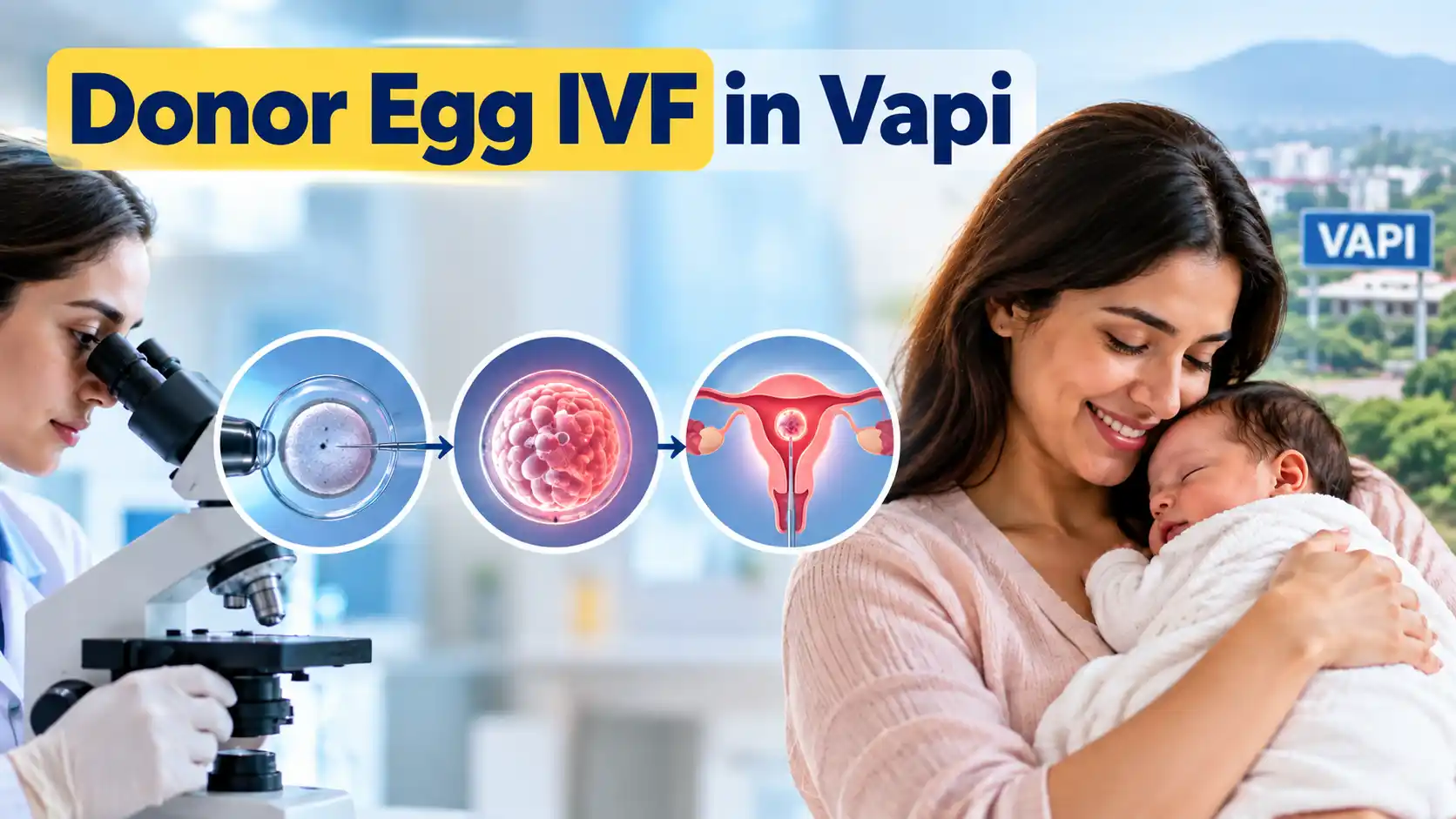
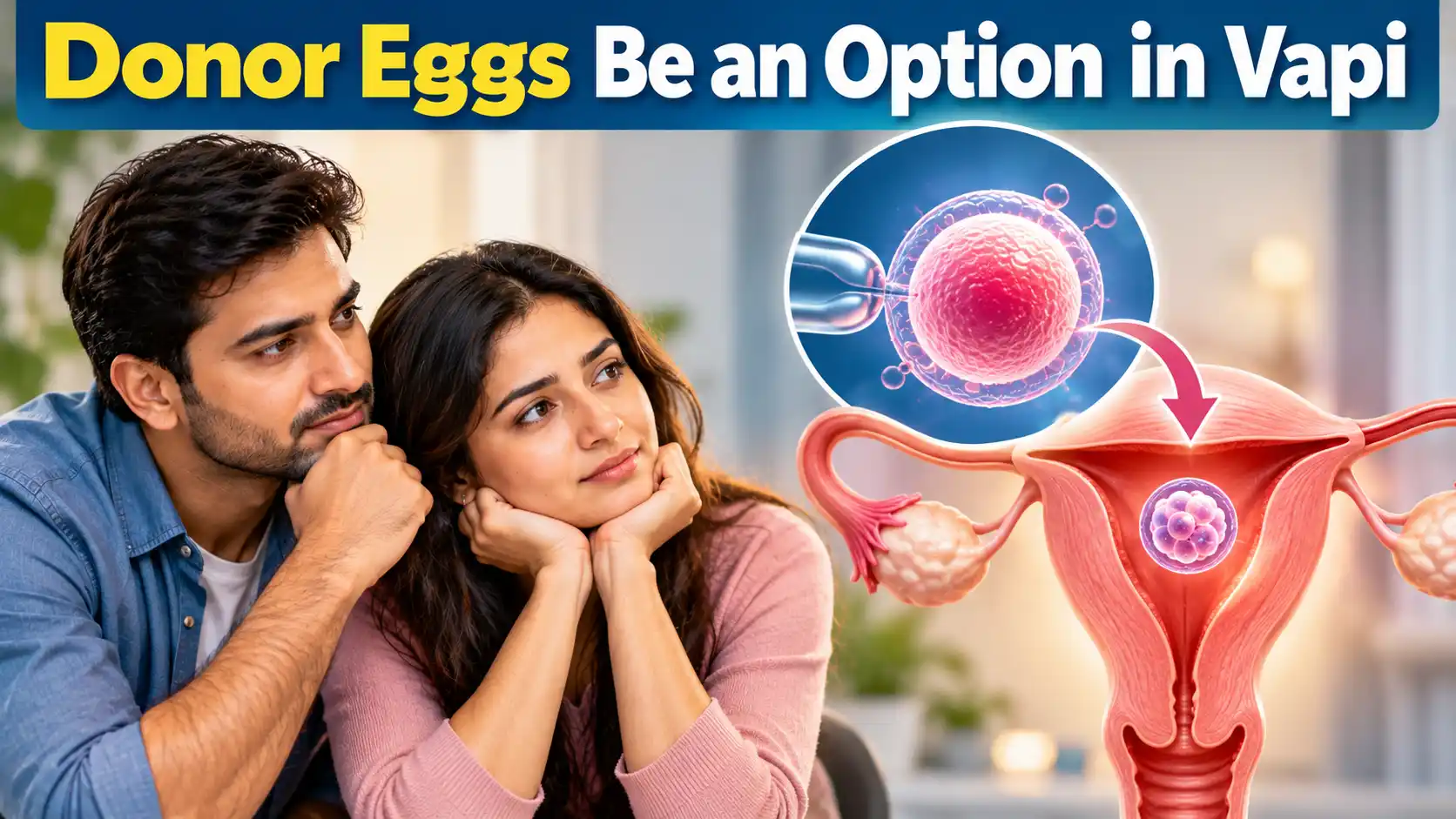
Donor egg IVF, sometimes called donor oocyte treatment, uses eggs from a healthy, screened donor, usually a young woman. The eggs are fertilised with the partner’s sperm (or donor sperm), and the resulting embryos are transferred into your uterus after preparing your lining with medication.
Key differences from a standard IVF cycle:
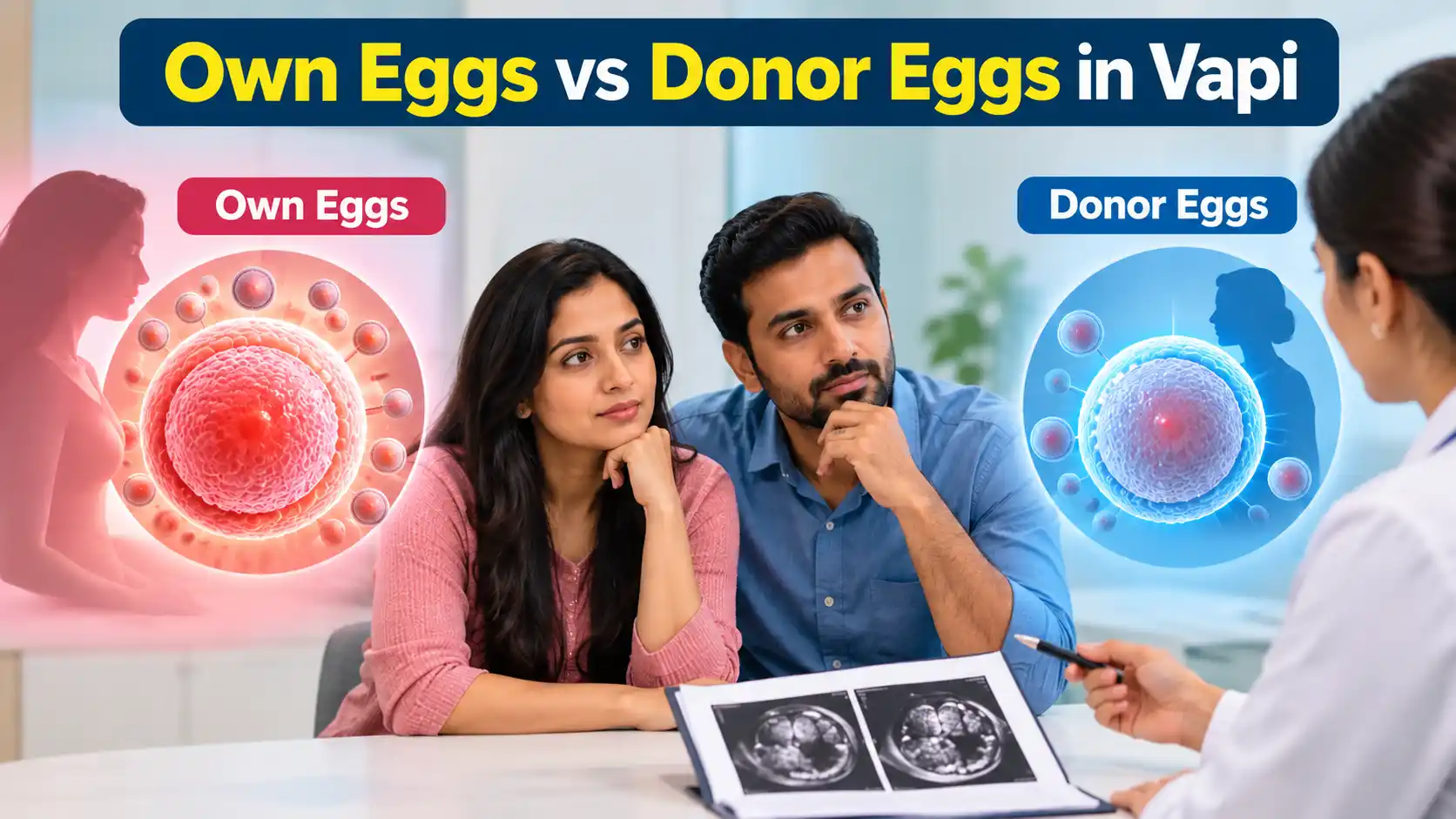
| Aspect | IVF With Your Own Eggs | Donor Egg IVF |
|---|---|---|
| Ovarian stimulation | Required for you | Not needed; the donor is stimulated |
| Embryo quality link to your age | Strong | Removed; donor age matters instead |
| Genetic link to mother | Yes | No |
| Pregnancy carried by | You | You |
| Success driver | Your egg quality, your age | Donor age, uterine health, sperm quality |
| Medical workup | Standard IVF | Uterine and lining preparation, cycle matching |
Because the mother still carries the pregnancy, the uterus must be fully evaluated and ready. This is why donor eggs after IVF failure are never a blind reset. Every prior failure cause still needs to be ruled out first.
What Happens to Embryo Quality When Donor Eggs Are Used
Embryo quality with donor eggs usually improves, and the reason is simple: donor age. Eggs from women in their twenties carry chromosomal abnormalities far less often than eggs from women in their late thirties and forties. Better eggs mean more blastocysts, more genetically normal embryos, and fewer early arrests.
But improvement is not a guarantee. Donor egg embryos can still fail to implant if a uterine or sperm problem was never addressed. National data shows donor egg cycles achieve live birth rates of roughly 30% to 50% per transfer depending on the setting and embryo stage CDC ART data. Strong, yes, but not certain, which is exactly why the pre-cycle workup matters so much.
“Donor eggs raise the ceiling, but they do not remove the floor. The uterus, the sperm, and the preparation still decide whether that ceiling is reached.” – Dr. Kaushal Patel
What Tests Are Needed Before Deciding on Donor Egg IVF?
A responsible clinic will review all of the following before recommending donor eggs after repeated IVF failure:
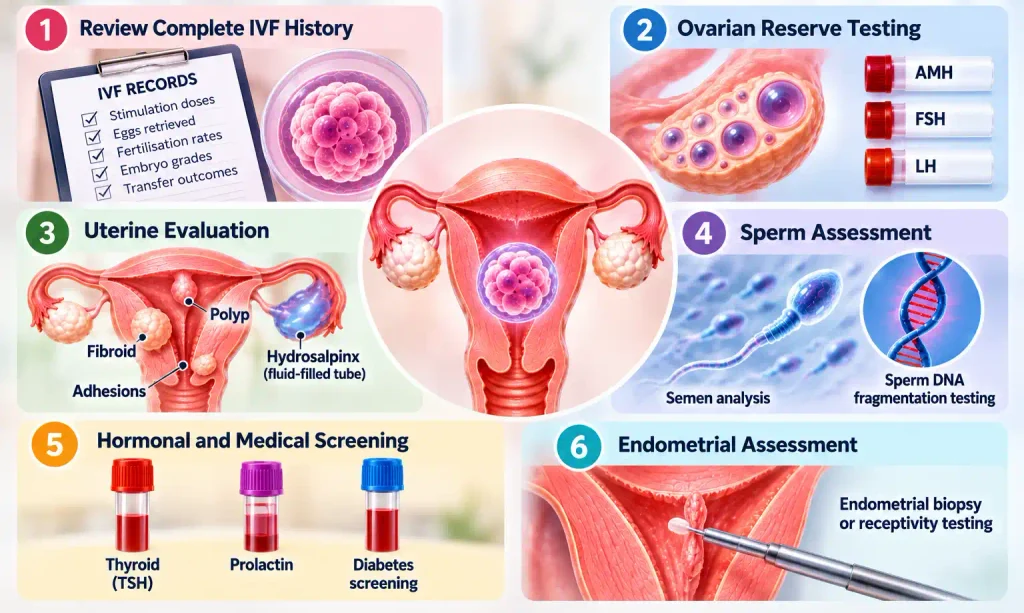
- Complete IVF history. Stimulation doses, eggs retrieved, fertilisation rates, embryo grades, and transfer outcomes from every cycle
- Ovarian reserve testing. AMH, antral follicle count, and baseline FSH
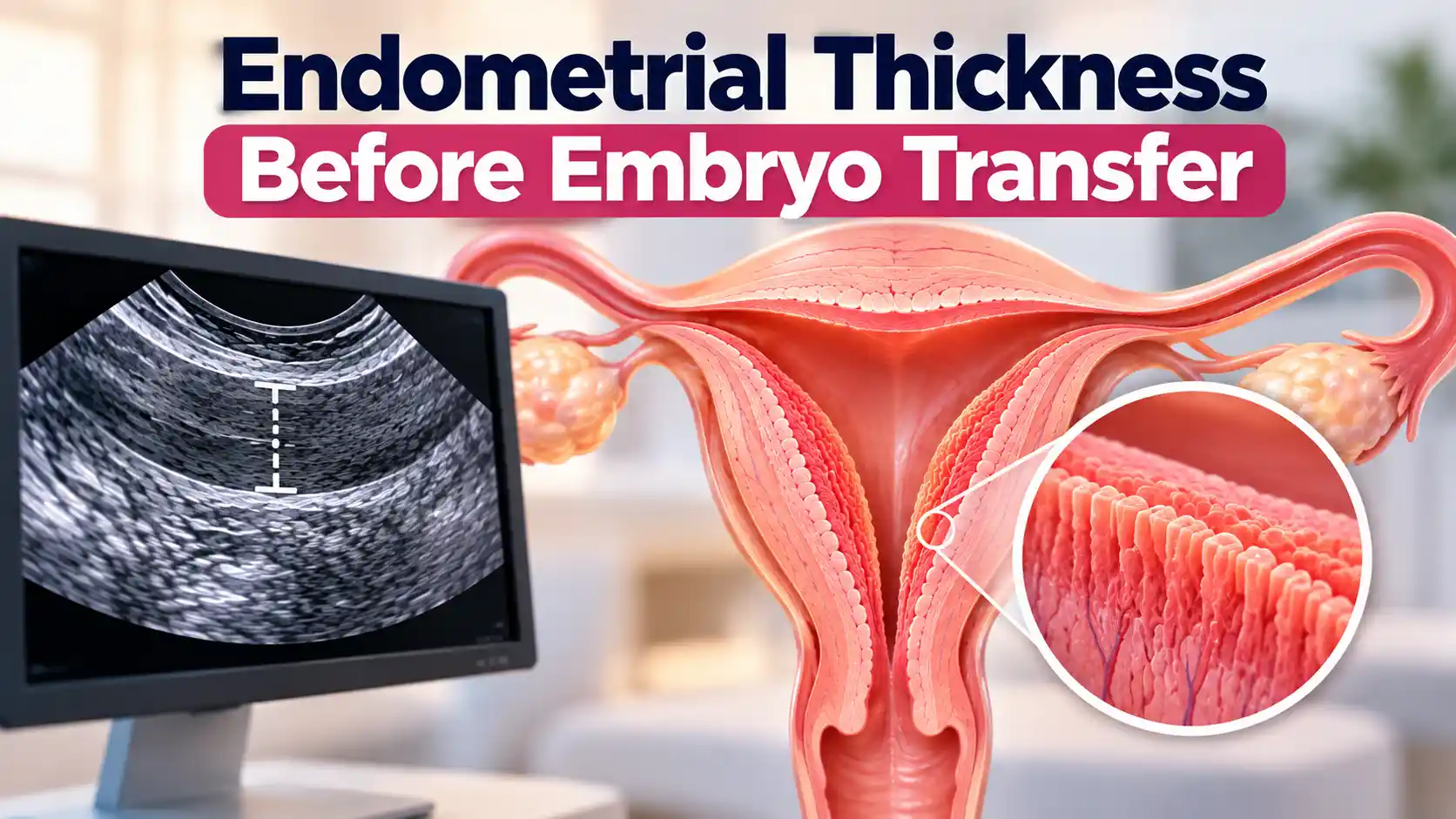
- Uterine evaluation. 3D ultrasound or hysteroscopy to rule out polyps, fibroids, adhesions, and hydrosalpinx
- Sperm assessment. Standard semen analysis plus DNA fragmentation if embryo quality was unexplained
- Hormonal and medical screening. Thyroid, prolactin, and diabetes screening where relevant
- Endometrial assessment. Biopsy or receptivity testing in selected recurrent implantation failure cases
Can You Try IVF Again With Your Own Eggs Instead?
In many cases, yes. Options short of donor eggs include:
- Changing the stimulation protocol to improve egg yield
- ICSI or other lab techniques to improve fertilisation
- PGT-A testing to select chromosomally normal embryos
- Treating uterine or tubal problems found on review
- Lifestyle and weight optimisation where relevant
Age changes the math, though. At 42 with an AMH of 0.4 and two failed cycles producing a single poor blastocyst each, another own-egg attempt may offer less than a 10% chance. At 32 with good embryo quality and one failed transfer, retrying with your own eggs is often very reasonable. This is why the decision is case-based, never automatic.
Does Age Affect the Decision to Use Donor Eggs?
Strongly. Age-related fertility decline affects both the number and quality of eggs. Women under 35 typically produce better embryos and have higher implantation rates, so failed cycles at a younger age push doctors to look harder at non-egg causes first. Women over 40 face the opposite: chromosomally abnormal eggs become the dominant explanation for failure, and the case for donor eggs becomes more persuasive with each cycle.
Considering Donor Eggs Is an Emotional Decision Too
Most couples describe the donor egg conversation as the hardest moment of their fertility journey. Grieving the genetic connection is normal, and no couple should rush it. Good clinics build counselling and family-building counselling into the process, not as a formality, but as genuine support.
Also worth knowing: under Indian law, egg donation is regulated, anonymous, and consent-driven, with defined rights and responsibilities for everyone involved. A clear legal and emotional framework exists before you commit to anything.
Repeated IVF Failure in Vapi: What a Local Review Looks Like
For couples searching for answers about repeated IVF failure in Vapi, a structured second-opinion review usually takes one or two visits:
- A detailed review of all previous cycle records and embryology reports
- Repeat or updated ovarian reserve and hormone testing
- Uterine and tubal imaging
- Sperm re-evaluation
- An honest discussion of own-egg versus donor egg IVF odds, with numbers specific to your case
Book a Fertility Consultation in Vapi
If you have experienced repeated IVF failure and want clarity on your next step, book a fertility consultation in Vapi with Dr. Kaushal Patel. Bring your previous IVF cycle reports, and we will review every cycle in detail before discussing whether your own eggs or donor eggs offer you the better chance.
Final Thoughts
Repeated IVF failure is exhausting, and the question “should we use donor eggs?” deserves a better answer than a guess. The honest answer is that donor eggs are a powerful, evidence-supported option when the evidence points to eggs. They are the wrong tool when the problem lies in the uterus, the sperm, or an untreated medical issue. Start with a proper review of your IVF history. The records you already have contain most of the answer.
Frequently Asked Questions
1. When might donor eggs be considered after repeated IVF failure in Vapi?
Donor eggs are discussed when cycles consistently show poor egg or embryo quality, very low egg retrieval numbers, or repeated chromosomally abnormal embryos. They are also considered when age-related egg decline makes further own-egg attempts unlikely to succeed.
2. How many failed IVF cycles before considering donor eggs?
There is no fixed number. After two to three failed cycles with documented poor embryo quality, the discussion becomes reasonable, while a single failed cycle with good blastocysts usually does not justify it. Your specific IVF history decides, not a count.
3. Can poor egg quality cause repeated IVF failure?
Yes. Eggs with chromosomal abnormalities create embryos that fail to implant or stop developing early, and this is the single most common cause of IVF failure in women over 38. Embryo development patterns in the lab usually reveal it.
4. Does low ovarian reserve mean I need donor eggs after IVF failure?
Not necessarily. Low reserve means fewer eggs, but if those eggs produce good-quality blastocysts, own-egg IVF can still work. Donor eggs enter the discussion only when reserve is low and the few eggs retrieved are repeatedly of poor quality.
5. Can donor eggs improve IVF chances after repeated failed cycles?
Yes, when egg quality was the limiting factor, because donor eggs come from young screened women and carry fewer chromosomal abnormalities. Live birth rates with donor eggs typically range from about 30% to 50% per transfer in national data.
6. How can doctors tell if egg quality is contributing to repeated IVF failure?
Doctors review the embryology records: egg numbers, fertilisation rates, how far embryos developed, and their grades. Low retrieval counts, early embryo arrest, and few blastocysts point toward egg quality, while good blastocysts that never implant point elsewhere.
7. Can donor eggs be considered if good-quality embryos repeatedly fail to implant?
Possibly, but the uterus and sperm must be investigated first, because good embryos failing to implant often signals a uterine, hormonal, or sperm DNA issue. Using donor eggs without finding that cause can lead to another failed cycle.
8. Does age affect the decision to use donor eggs after IVF failure?
Age is one of the strongest factors. In women over 40, abnormal eggs are the most common cause of failure, so donor eggs become a more logical discussion earlier, whereas in younger women doctors search harder for other causes first.
9. What tests are needed before deciding on donor egg IVF in Vapi?
Expect a review of all previous IVF records, ovarian reserve testing (AMH and antral follicle count), uterine evaluation with 3D ultrasound or hysteroscopy, sperm analysis, and general health screening. These confirm whether eggs were truly the problem.
10. Can I have another IVF cycle with my own eggs instead of using donor eggs?
Often yes, especially if previous cycles produced good embryos or if an adjustable factor like the stimulation protocol was suboptimal. Changing protocols, adding PGT-A testing, or treating a uterine issue can all make another own-egg attempt worthwhile.
11. What are the main reasons to consider donor eggs after repeated IVF failure?
The main reasons are persistently poor embryo quality, very few eggs despite strong stimulation, repeated aneuploid embryos on testing, advanced age with declining ovarian reserve, and inherited genetic conditions the couple wants to avoid passing on.
12. Does my previous IVF history affect whether donor eggs may be recommended?
Your IVF history is the most important piece of evidence. It shows whether embryos developed well, how many eggs were retrieved, and whether transfers produced implantation, and each of these patterns points to a different next step.
13. How is donor egg IVF different from IVF using my own eggs?
You skip ovarian stimulation entirely, since the donor’s eggs are used, and your uterus is prepared with medication to receive the embryo. The baby develops in your womb, but the eggs come from a screened, usually young donor.
14. What happens to embryo quality when donor eggs are used?
Embryo quality generally improves because donor eggs have far fewer chromosomal abnormalities than eggs from older women. More embryos reach the blastocyst stage, and genetically normal embryos are more common, though uterine and sperm factors still influence results.
15. What should I expect during a donor egg IVF cycle in Vapi?
The donor undergoes screening, stimulation, and egg retrieval while your uterus is prepared with hormone medication over several weeks. Fertilisation happens with your partner’s sperm, embryos develop in the lab, and one or two are transferred into your prepared uterus.