
Scan day brings a quiet ritual to every IVF journey. You change into a gown, the sonographer checks the screen, and then someone calls out a number. From that moment, endometrial thickness before embryo transfer becomes the number many patients live by.
That number deserves attention, just not fear. Your lining is the inner layer of the uterus where an embryo settles, and its thickness shows how well your uterus is responding to treatment. A lining that looks thin on one scan often changes within days. The sections below explain the numbers, the pattern, the causes of a thin lining, and the practical steps that follow.
Key Takeaways
- There is no single ideal endometrial thickness before embryo transfer. Many clinics feel comfortable once the lining reaches roughly 7 to 8 mm with a healthy pattern, and pregnancies still happen outside that range.
- In a large IVF study, live birth rates in fresh cycles fell step by step as the lining thinned: 33.7% at 8 mm or more, 25.5% at 7 to 7.9 mm, and 18.1% at 5 to 5.9 mm.
- In frozen embryo transfer cycles, results stayed close to fresh cycles until the lining dropped below about 7 mm, so the same cutoff does not apply everywhere.
- Thin lining is not rare. Published reviews place its frequency between 1.5% and 9.1% of IVF cycles.
- Thickness is one signal among many. Pattern, hormone timing, embryo quality, and overall endometrial receptivity shape the result together.
- A postponed transfer because of a thin lining is a common, protective decision. It protects your best embryos, it does not punish you.
What Your Endometrial Lining Actually Does
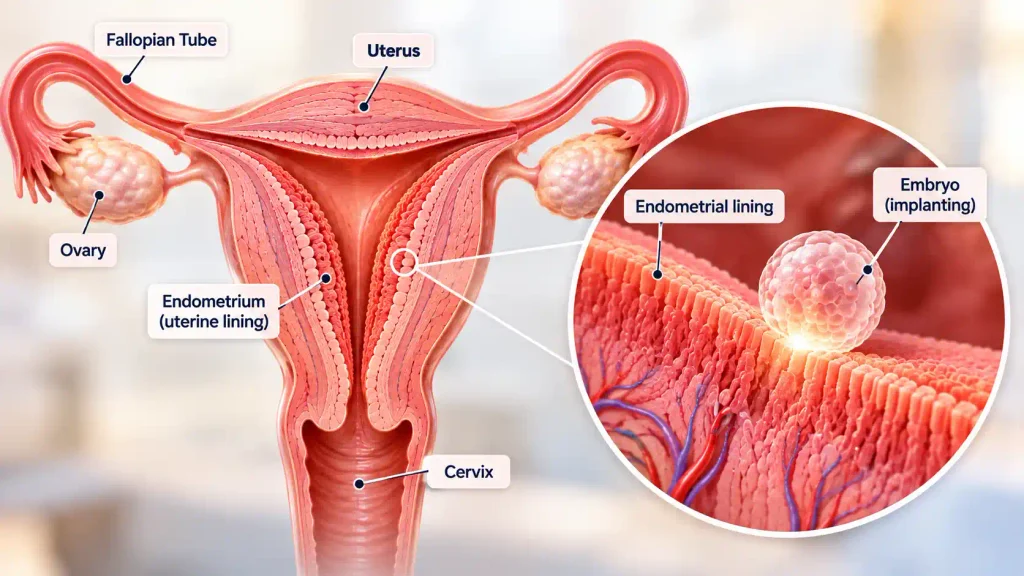
The endometrium is the inner lining of the uterus. It thickens every cycle under the influence of estrogen, and it is the layer an embryo must attach to for pregnancy to begin. The Cleveland Clinic describes it as the membrane that lines the inside of the uterus and is essential for maintaining a pregnancy.
In IVF, we watch this layer for two reasons. A lining that grows well suggests the uterus is receiving and using hormones properly. Its texture also hints at how receptive it may be during the short implantation window.
“Think of the lining as soil and the embryo as a seed. The seed matters enormously, but even the healthiest seed struggles in soil that is not ready. When I scan you, I am judging readiness, not just one measurement.” Dr. Kaushal Patel
Implantation is a two-way conversation between embryo and uterus. The embryo sends signals, the lining answers, and both need to be in sync. Thickness is the part of that conversation we can measure, which is why it gets so much attention.
What Does Endometrial Thickness Before Embryo Transfer Really Mean?
Ask three clinics for the ideal number and you may get three slightly different answers. That is not confusion. It reflects real evidence that success falls along a range, and each clinic sets its own comfort zone based on its protocols and patient population.
Most teams feel reassured when the lining crosses 7 mm, and happiest between 8 and 12 mm. Readings above 14 mm are less studied, though many transfers still succeed there. The table below shows how doctors commonly read the numbers.
| Lining reading | What it often suggests | What many teams do next |
|---|---|---|
| Under 6 mm | Implantation chances drop in most studies | Review causes, adjust medicines, often wait |
| 6 to 7 mm | Below the usual comfort zone, but possible | Re-scan in a few days, tweak the protocol |
| 7 to 8 mm | Acceptable for many clinics | Often fine to plan the transfer |
| Above 8 mm | The range most teams aim for | Usually cleared for transfer |
| Above 14 mm | Very thick linings are less researched | Assessed case by case |
The strongest data on this comes from a large IVF study of over 20,000 fresh transfers, where live birth fell from 33.7% at 8 mm or more to 18.1% at 5 to 5.9 mm. Notice what that table does not say. It does not say a 6 mm lining cannot work, because transfers at that thickness produced pregnancies too.
“I have seen women conceive with a 6 mm lining and women with a picture-perfect 10 mm lining need answers after a failed cycle. The number guides my decisions, it never decides them for me.” Dr. Kaushal Patel
How Is Endometrial Thickness Before Embryo Transfer Checked?
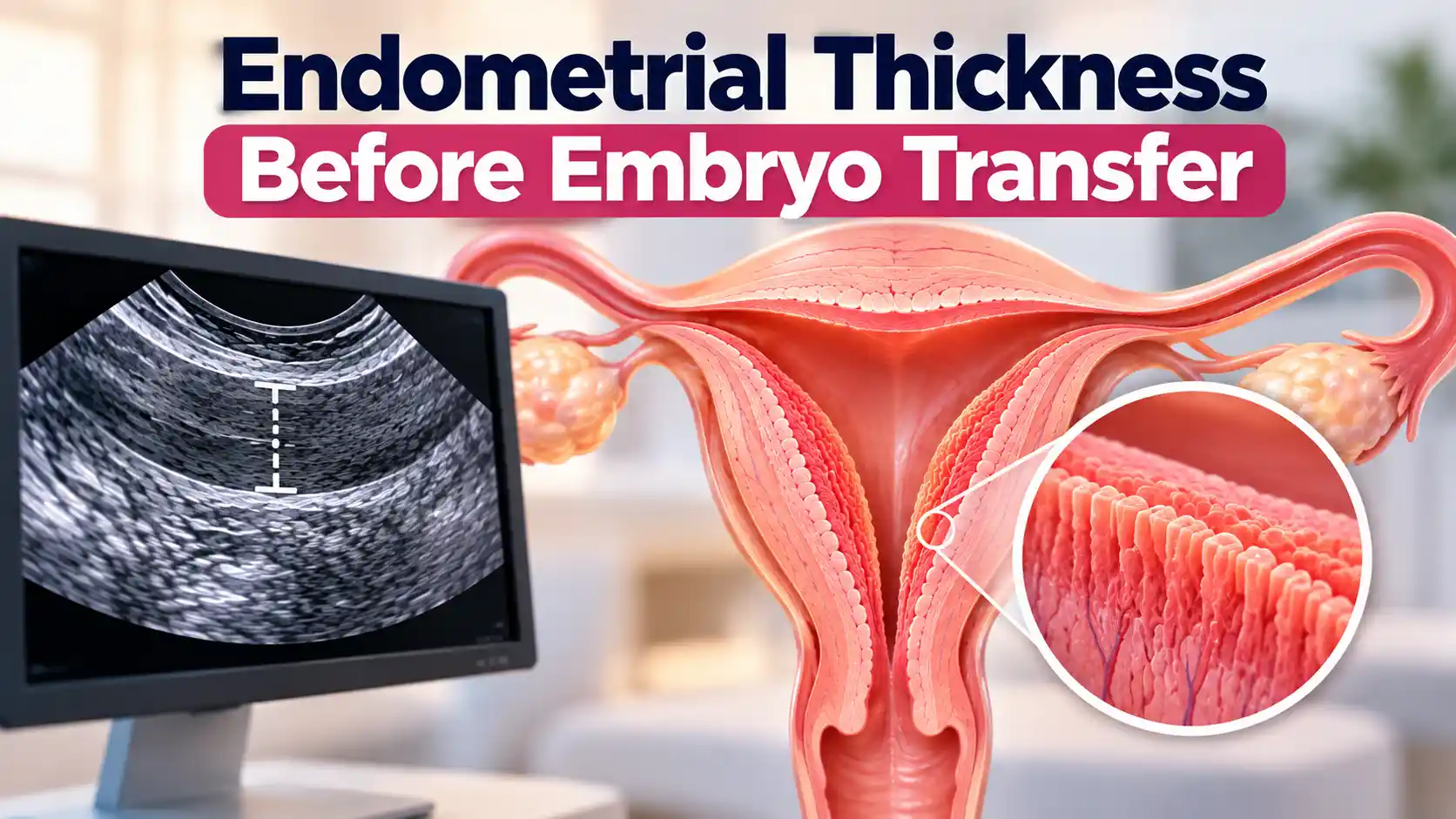
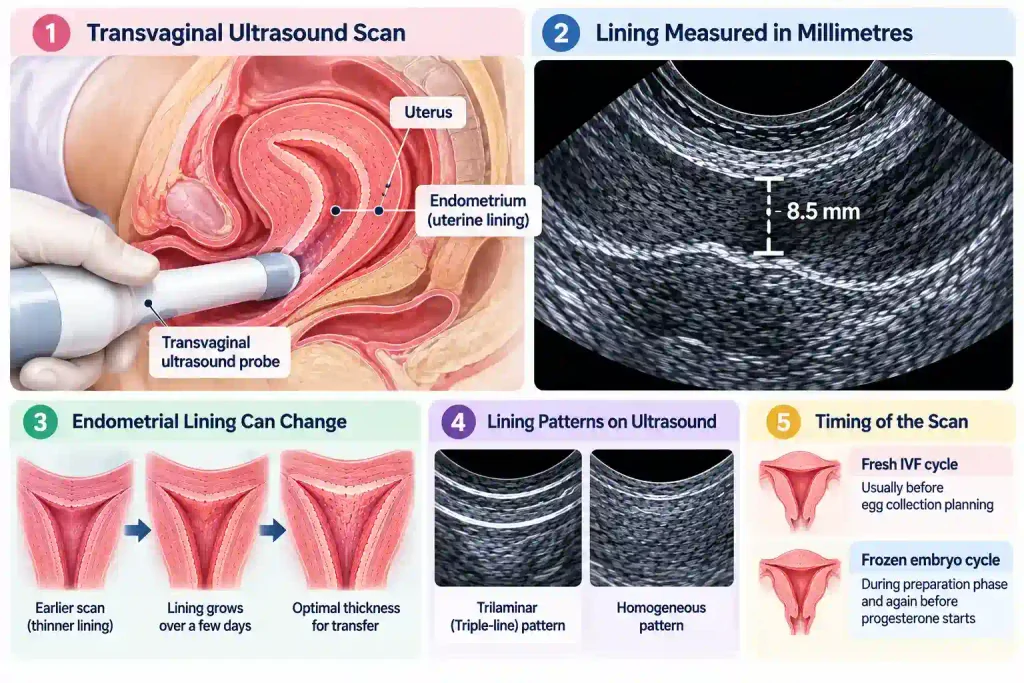
A transvaginal ultrasound measures the lining in millimetres. The scan takes the thickest part of the front and back layers and reports the double thickness. It is painless, takes a few minutes, and is usually repeated every few days as the lining grows.
Timing matters as much as the number itself. In a fresh IVF cycle, the check usually happens just before egg collection planning. In a frozen cycle, your team scans during the preparation phase and again before progesterone starts, because progesterone locks the lining into its receptive state.
1. Can the lining change after the scan?
Yes, and this surprises many patients. The lining can grow a little more in the final days. Occasionally it holds a little fluid, which your doctor will want to resolve first. This is why the final check sits close to progesterone start or transfer day.
2. Does the pattern matter as much as the thickness?
It matters, in a supporting role. A trilaminar, or triple-line, pattern looks like three bright stripes on the scan and suggests the lining is responding well to estrogen. A homogeneous pattern is not automatically bad, especially later in the cycle, but your doctor reads thickness and pattern together before calling the lining ready.
When the Lining Is Thin: Causes and What They Mean
Most clinics describe the lining as thin when it stays under about 7 mm despite preparation. It is uncommon but far from unusual. One research review places the rate between 1.5% and 9.1% of ART cycles, which means a thin lining shows up in clinics everywhere, every month.
Common reasons a lining struggles to grow include:
- Low estrogen levels or a dose your body is not using well
- Intrauterine adhesions, often after a previous curettage or infection
- Fibroids and fertility issues, especially fibroids that press into the uterine cavity
- Polyps or a thin, scarred basal layer after uterine surgery
- Medicines such as clomiphene, which can thin the lining in some women
- Smoking, reduced blood flow to the uterus, and thyroid or prolactin problems
- Sometimes no clear reason at all, which is more common than patients expect
If you have been told you have a thin uterine lining, the detailed causes and natural options sit in our thin uterine lining article. The key point here is simpler. A thin lining is a signal to investigate, not a verdict on your fertility.
“A thin lining slows the calendar, it does not end the journey. In my practice, most women who needed a small protocol change went on to have their transfer in the same cycle or the next one.” Dr. Kaushal Patel
Can Endometrial Thickness Improve Before a Planned Transfer?
In many cases, yes. The lining responds to time and to hormone adjustments, which is why doctors rarely cancel on the first slow reading. Small changes often make a real difference before your embryo transfer preparation ends.
What teams commonly adjust:
- A few extra days of estrogen before the next scan
- A higher dose, or a different route such as vaginal or injectable estrogen
- Treating a thyroid or prolactin problem found on blood tests
- Adding exercises and habits that support pelvic blood flow, alongside medical care
- Pausing the cycle and replanning, when the lining simply refuses to respond
Self-approved supplements are the one thing to avoid. Some so-called lining boosters interfere with fertility medicines, and none replace a proper dose review with your doctor.
What If the Lining Is Still Too Thin on Transfer Day?
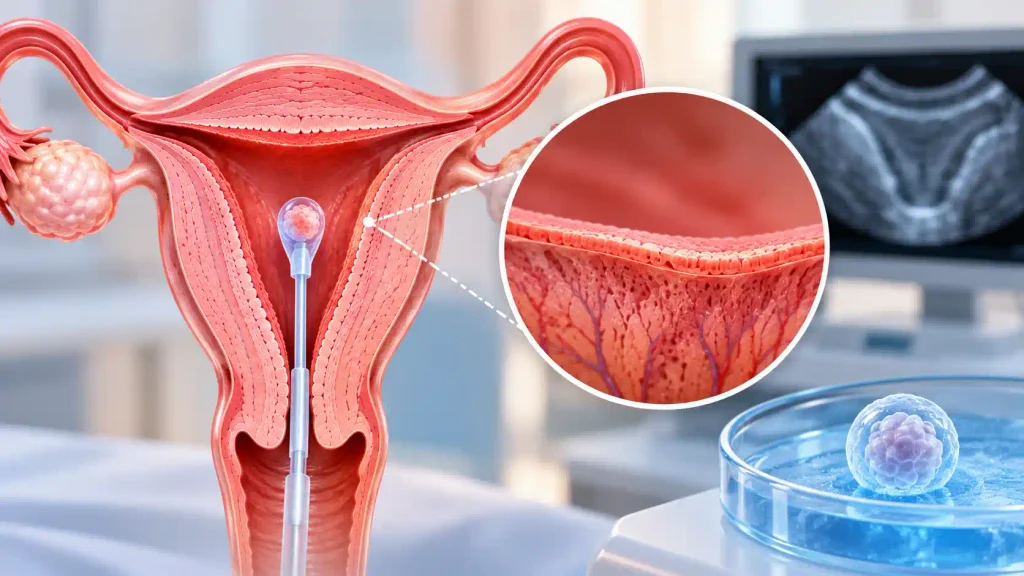
Postponing a transfer is a hard conversation, and a sensible one. A frozen embryo gives you the luxury of time. Your team can pause, improve the lining, and transfer later without wasting the embryo, because a good embryo deserves its best chance.
Typical next steps look like this:
- Delay the transfer by days or to the next cycle
- Recheck hormones and adjust the protocol
- Arrange a hysteroscopy when adhesions, polyps, or scarring are suspected, since fixing these often changes the lining response
- Discuss add-ons such as sildenafil or G-CSF honestly, because evidence for them remains limited
Ask your doctor two questions before any decision. What do you think is holding my lining back, and what would you do if I were your family? Clear answers beat anxious googling every time.
Frozen Embryo Transfer and Your Lining
Frozen cycles change the conversation in your favour. There is no stimulation rush, so the lining grows on a calm, planned schedule with scans until it is ready. Once it reaches the target with a good pattern, progesterone begins and the transfer follows within a few days.
The data backs this calm approach. In the same frozen cycles analysis, live birth rates held steady between 8 mm and 7 mm, and only fell clearly below that point. Research on IVF treatment overall has also shifted towards frozen transfers in many situations. If you want the step-by-step version of how the whole cycle fits together, our IVF process guide walks through it.
A Good Lining but No Implantation?
Sometimes every number looks perfect and pregnancy still does not come. It is painful, and it is not your fault. Embryo genetics, the implantation window, thyroid function, and the immune environment all play roles that no scan can fully capture.
Implantation problems that repeat themselves deserve a structured review rather than guesswork. Recurring losses share some of the same roots, which we cover in our recurrent pregnancy loss article. One failed transfer with a good lining is far more common than most patients realise.
“When a good-looking lining meets a good embryo and pregnancy still does not happen, resist the blame game. Implantation is a dance between two living tissues, and sometimes the reasons sit beyond what any scan can show.” Dr. Kaushal Patel
About the Author
Dr. Kaushal Patel is an IVF specialist and gynecologist at Isha Women’s Hospital, Vapi, where he treats couples from Vapi, Gujarat, and surrounding districts for infertility, implantation problems, and complex gynecological conditions. He has published research in a reputed international journal and writes patient education in plain language, because he believes informed patients make calmer decisions.
Final Thoughts
Endometrial thickness before embryo transfer is information, not a verdict. The number earns its place on your chart, alongside the pattern, your hormones, your embryo, and your history. No single millimetre decides your story.
If your lining has been slow, ask your doctor what the plan is, what would change it, and what the realistic timeline looks like. If your numbers were good and the cycle still failed, ask for a structured review rather than a repeat of the same plan. Either way, you deserve answers in plain words, and a team that treats a postponed transfer as protection, not defeat.
Frequently Asked Questions
1. What does endometrial thickness mean before embryo transfer?
It is the millimetre measurement of your uterine lining on a transvaginal scan, taken close to transfer day. The number shows how well your uterus has responded to hormones. It signals readiness, but it does not guarantee implantation on its own.
2. Is there one ideal endometrial thickness for embryo transfer?
No single number works for every woman, which is why good doctors talk in ranges. Many clinics aim for 7 to 8 mm or more with a triple-line pattern. Pregnancies happen both above and below those figures, so your doctor weighs the whole picture.
3. Why does the uterine lining matter for embryo implantation?
The embryo physically burrows into this lining, so it needs enough depth and blood supply to support attachment. A very thin lining offers less surface and poorer nourishment. Even then, embryo quality and hormone timing matter just as much.
4. What does a thin endometrium mean before embryo transfer?
It usually means the lining stayed under about 7 mm despite preparation. That finding prompts a review of your doses, timing, and possible causes. It often leads to a delay or a protocol change rather than an automatic cancellation.
5. Can a thin uterine lining reduce the chances of implantation?
Yes, large studies show outcomes decline step by step as the lining thins, especially under 7 mm. Reduced is not the same as impossible, because pregnancies still occur with thin linings. Your team will weigh your history before deciding how to proceed.
6. What can cause the endometrial lining to remain thin during IVF?
Common causes include low estrogen response, scar tissue inside the uterus, cavity-distorting fibroids or polyps, smoking, and some fertility medicines. Thyroid and prolactin problems can contribute. A fair share of cases stay unexplained even after full evaluation.
7. Can endometrial thickness improve before a planned embryo transfer?
Frequently, yes. Extra days of estrogen, a dose change, or a different route of administration often nudges the lining upward. Some cycles still need pausing, and the same improvement work continues into the replanned cycle.
8. What can be done if the endometrial lining is too thin for embryo transfer?
Doctors typically delay the transfer, adjust estrogen, and investigate causes such as adhesions with a scan or hysteroscopy. Treating a found cause, like removing polyps, often fixes the response. Newer add-ons exist, but their evidence is still limited and your doctor should explain that honestly.
9. Does the endometrial lining pattern matter as well as its thickness?
Yes. The triple-line pattern suggests the lining is maturing well under estrogen, while a uniform pattern can look less receptive. Pattern supports the thickness number, it does not replace it, and doctors read both together.
10. How do doctors check whether the endometrium is ready for embryo transfer?
They combine the scan measurement, the pattern, and the timing of your hormone medicines. Blood estradiol levels sometimes add context. In repeated difficult cycles, specialised receptivity tests exist, though doctors reserve them for specific situations.
11. Does endometrial thickness affect frozen embryo transfer differently?
Frozen cycles give the lining an unhurried, monitored runway, which many linings respond to well. Research suggests the concern zone in frozen cycles sits slightly lower, near 7 mm rather than 8 mm. The scanning method itself stays the same.
12. Can endometrial thickness change between the ultrasound scan and embryo transfer?
It can. Linings often grow a little more in the final days, and occasionally fluid collects where it should not. That is exactly why the final scan sits close to progesterone start or the transfer itself.
13. Can a good endometrial thickness still result in failed implantation?
Yes. A good lining is necessary but not sufficient, because embryo chromosome quality, the implantation window, and other factors decide the outcome together. One failed cycle with good numbers is common and does not mean the next one will fail.
14. What does endometrial receptivity mean before embryo transfer?
It describes the short window when your lining can actually accept an embryo. Thickness and pattern are its visible markers, while genes and hormones run the deeper machinery. Receptivity testing exists, mainly for patients with repeated well-explained failures.
15. When might an embryo transfer be postponed because of the endometrial lining?
Postponement usually follows a lining below your clinic’s threshold, fluid in the cavity, or an immature pattern. It can also follow protocol timing issues. The goal is always the same, giving your embryo its strongest possible conditions.