


If you just read the words “low AMH” and “low egg count” on a lab report, one question is probably racing through your mind. Low AMH, low egg count, can I still become a mother? For most women, the honest answer is yes, though it means moving with purpose instead of waiting.
A low AMH (Anti-Mullerian Hormone) result tells you about the number of eggs remaining in your ovaries, called your ovarian reserve. It does not mean pregnancy is off the table. Many women with low AMH conceive naturally, and many more become mothers through fertility treatment, sometimes with donor eggs when needed. The number on your report is information, not a verdict.
Key Takeaways
- A low AMH result reflects egg quantity, not egg quality, and does not by itself predict whether you can conceive.
- Normal AMH levels for women of reproductive age generally fall between 1.0 and 4.0 ng/mL, and levels naturally decline with age.
- A peer-reviewed IVF study of women with low and extremely low AMH found cumulative pregnancy rates of 20% after five treatment cycles, showing that low AMH does not rule out pregnancy through fertility treatment.
- Egg quantity naturally drops with age, but AMH alone cannot predict the exact age of menopause or confirm infertility.
- Earlier action, meaning testing and treatment planning done sooner rather than later, generally improves the chances of a successful pregnancy with low AMH.
- Women across Vapi, Daman, Silvassa, and Valsad can now access accurate AMH testing and complete fertility care without travelling to a metro city.
What Does a Low AMH Report Actually Mean?
AMH is a hormone made by the small, fluid-filled sacs in your ovaries called follicles. Each follicle holds an immature egg. The more follicles you have, the higher your AMH tends to be.
A low result simply means fewer follicles are active right now compared to what is typical for your age group. It does not measure how healthy those remaining eggs are, and it does not diagnose infertility on its own.
“A low AMH number scares women because it sounds final. In reality, it is just one data point. I have helped women with very low AMH carry healthy pregnancies, some naturally and some with IVF. What matters most is what we do next, and how quickly we do it.” — Dr. Kaushal Patel
What Is an AMH Test and What Does It Measure?
An AMH test is a simple blood draw. Unlike some hormone tests, it can be done on any day of your cycle. The lab measures Anti-Mullerian Hormone in your blood, and your doctor compares it against typical ranges for your age.
The test is often paired with a follicle count test, also called an antral follicle count (AFC), which uses a vaginal ultrasound to physically count the visible follicles in your ovaries. Together, AMH and AFC give your fertility specialist a clearer picture of your ovarian reserve than either test alone.
What Is Considered a Normal AMH Range?
There is no single universal cutoff, since labs and clinics use slightly different reference points. Broadly, doctors use ranges like these to guide the conversation:
| Age Group | Typical AMH Range | What It Generally Suggests |
|---|---|---|
| 25–30 years | 2.5–3.0+ ng/mL | Healthy ovarian reserve for age |
| 31–35 years | 1.5–2.5 ng/mL | Normal, gradual age-related decline |
| 36–40 years | 1.0–1.5 ng/mL | Reserve narrowing, worth monitoring |
| Over 40 years | Below 1.0 ng/mL | Lower reserve, treatment window matters more |
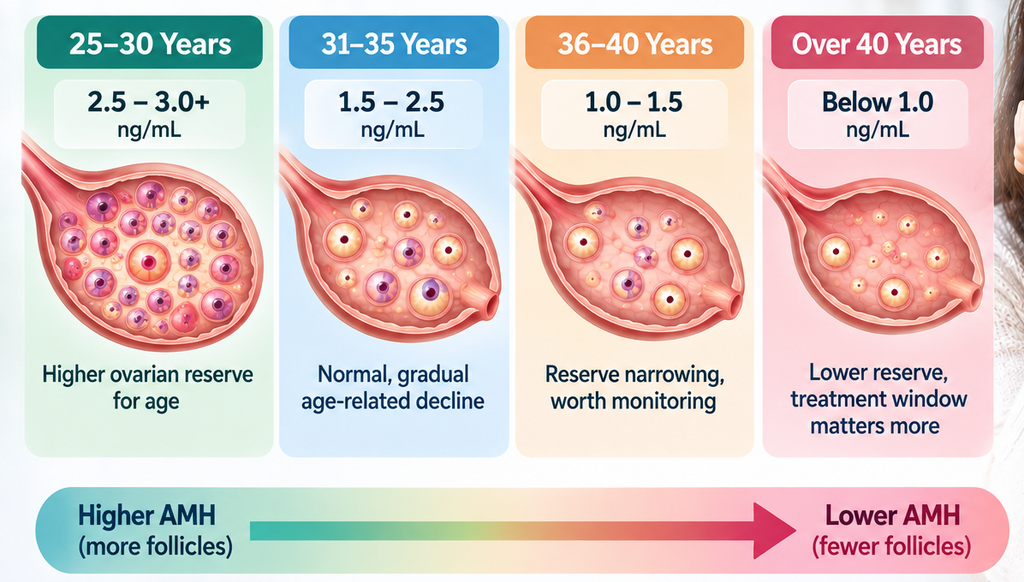
These figures are guidelines, not fixed rules. A 32-year-old with an AMH of 0.9 ng/mL is not in the same situation as a 42-year-old with the same number, because age itself changes egg quality and treatment response.
What Does Ovarian Reserve Mean, and How Is AMH Related to Age?
Ovarian reserve is the term doctors use for the number of eggs you have left. Every woman is born with all the eggs she will ever have, roughly one to two million at birth. That number falls steadily, faster after your mid-thirties, and it cannot be refilled.
AMH is one of the best available markers of that decline. As reserve drops, AMH drops with it. This is why age and AMH are so closely linked, and why a low AMH result at 28 carries a different urgency than the same result at 41.
In rare cases, low AMH at a young age can point to premature ovarian failure (primary ovarian insufficiency), where the ovaries stop working normally well before typical menopause age. This is uncommon, but it is why doctors take a low AMH report seriously at any age.
What Does Low AMH Mean for Pregnancy?
Low AMH does not mean you are infertile. It means your body may respond differently to fertility treatment, and your natural conception window may be shorter than average.
According to Cleveland Clinic guidance on ovarian reserve testing, this kind of testing helps predict your response to fertility treatment, but it cannot confirm whether or when you will get pregnant on your own. That distinction matters. Your fertility is influenced by egg quality, your partner’s sperm health, your uterus, and your overall health too, not AMH in isolation.
Can You Get Pregnant Naturally With Low AMH?
Yes, many women do. Natural conception is still possible with low AMH, especially if you are under 35, ovulating regularly, and have no other fertility-blocking conditions like blocked tubes or severe endometriosis.
That said, time works against you a little more with low AMH. Because your remaining egg supply is smaller, the practical window to conceive naturally, whether on your own or with simple treatments like ovulation induction, tends to be shorter than it would be with a normal reserve.
- Regular ovulation and low AMH together still allow for natural pregnancy in many cases.
- Age under 35 generally improves natural conception odds even with a low AMH result.
- Trying for six months without success at this stage is a reasonable point to see a fertility specialist rather than waiting a full year.
Is Low AMH the Same as a Low Egg Count?
Not exactly, though the two are closely related, and this confusion trips up a lot of patients.
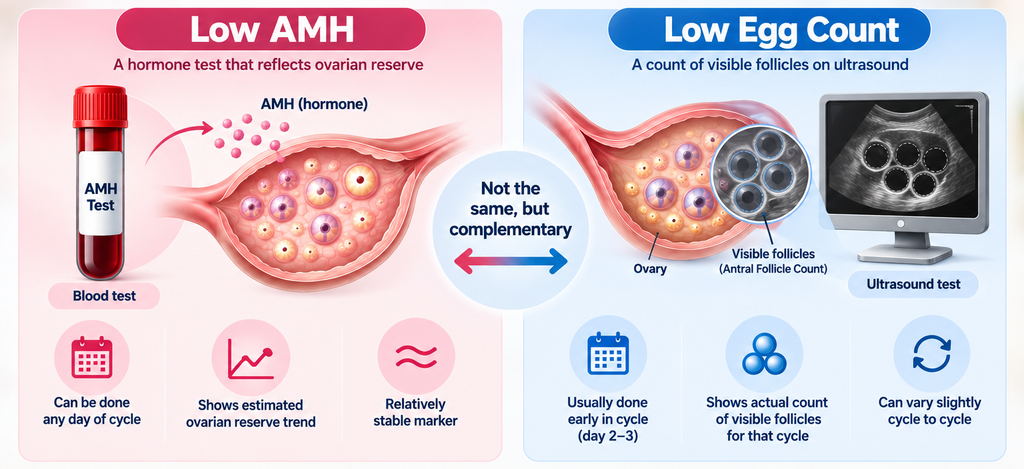
| Low AMH | Low Egg Count | |
|---|---|---|
| What it measures | Hormone level reflecting reserve | Actual follicle number seen on ultrasound |
| How it’s tested | Blood test, any cycle day | Vaginal ultrasound, early cycle |
| What it tells you | Estimated reserve trend | A physical count for that cycle |
| Can it change | Fairly stable marker | Can vary slightly cycle to cycle |
Doctors usually look at both together, since AMH gives a broader trend and the follicle count gives a real-time snapshot.
How Can a Woman Find Out Her Egg Count and Ovarian Reserve?
You do not need to guess. Finding out your ovarian reserve takes two simple, well-established steps.
- An AMH blood test, done at any point in your cycle, gives your hormone-based reserve estimate.
- A transvaginal ultrasound antral follicle count, usually done on day 2 or 3 of your period, physically counts visible follicles.
Both tests together, read by an experienced fertility specialist, give a far more reliable picture than either one alone.
What Treatment Options Exist for Low AMH and Poor Ovarian Reserve?
A low AMH treatment plan is never one-size-fits-all. It depends on your age, your partner’s fertility, how low the number actually is, and how much time you can realistically work with.
1. Can AMH Levels Be Improved?
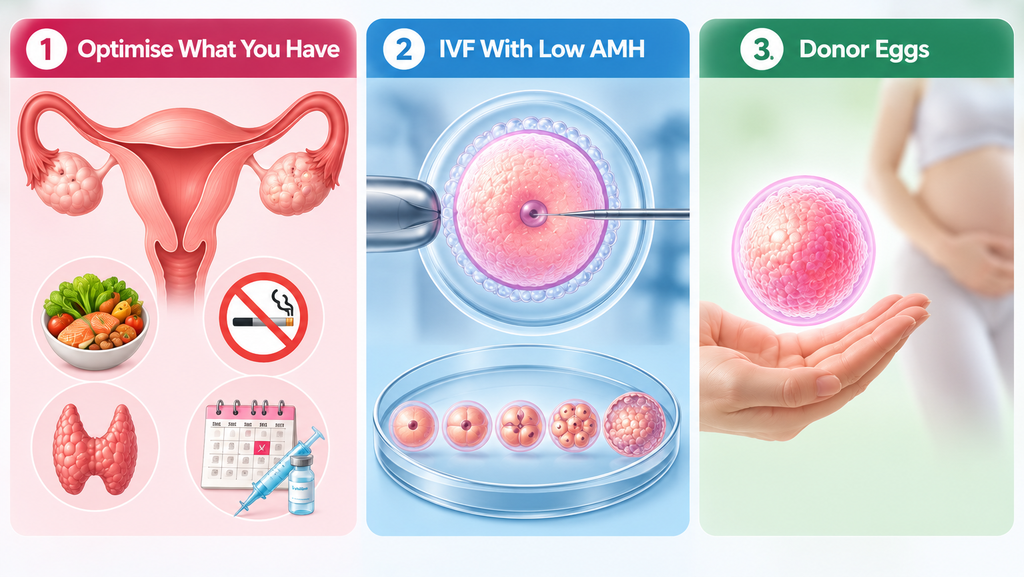
Honestly, no medicine reliably raises AMH itself. What treatment can do is help you make the most of the eggs you currently have, through carefully timed ovulation tracking, hormone support during stimulation, and protocols designed specifically for lower responders. Lifestyle steps like maintaining a healthy weight, not smoking, and managing conditions like thyroid disorders support overall fertility, even though they will not undo the AMH number itself.
2. What Is the IVF Success Rate With Low AMH?
IVF remains the most effective low AMH treatment option for most women who need help conceiving quickly. A peer-reviewed fertility study tracked women with low and extremely low AMH through IVF-ICSI treatment and found a cumulative pregnancy rate of 20% after five treatment cycles in both groups, meaning even very low AMH did not eliminate the chance of pregnancy through repeated, well-managed IVF attempts.
When Donor Eggs Enter the Conversation
For some women, particularly those over 40 or with extremely low reserve, using donor eggs offers the strongest chance of a successful pregnancy. This is not a failure of any kind, it is simply a way to keep the dream of motherhood realistic when your own egg supply is very limited.
Dr. Kaushal’s Advice: Why Starting Sooner Makes a Real Difference
“The single biggest mistake I see is delay. Women often spend months researching, worrying, and waiting for a ‘better time’ to start treatment. With low AMH, every few months can change your options. My advice is always the same, get tested properly, understand your real numbers, and start your treatment plan without unnecessary delay.” — Dr. Kaushal Patel
This is not about creating panic. It is about respecting biology honestly, so you can make an informed decision instead of a rushed one later.
Low AMH Treatment in Vapi and Nearby South Gujarat
Women searching for an AMH test in Vapi or a low AMH treatment in Vapi no longer need to plan a trip to Mumbai or Ahmedabad for accurate diagnosis and care.
At iSHA, we regularly see patients coming in for fertility testing in South Gujarat from Vapi itself, as well as from Daman, Silvassa, Valsad, Umargam, Navsari, and across Dadra and Nagar Haveli. Whether you need a straightforward egg count check-up in Valsad or a complete low ovarian reserve treatment in Daman and Silvassa, the diagnostic tools, lab accuracy, and treatment protocols used here match what you would find at any major metro fertility centre.
- AMH blood testing and antral follicle count ultrasound, both available on-site.
- IVF, IUI, and ICSI treatment tailored for low ovarian reserve cases.
- Donor egg programs for women who need that option.
- Consultations in Gujarati and Hindi, so nothing gets lost in translation during an already stressful time.
Why Choose iSHA Care for Low AMH Treatment
You genuinely do not need to travel to a metro clinic for expert-level fertility care anymore. The long drive and added stress of managing appointments away from home are not necessary when comparable expertise is available closer to Vapi.
Treatment plans here are built around your specific AMH number, age, and timeline, not a generic protocol, with direct access to your treating doctor at every step. Explore our IVF and ICSI programs if you’re moving to your next step.
Final Thought
A low AMH report is not the end of your motherhood journey, it is simply an earlier signal to act with focus. Some women conceive naturally, some need IUI or IVF, and some build their family using donor eggs. Every one of these paths leads to the same place, a healthy baby in your arms. What matters most is getting accurate information quickly and choosing a fertility team you trust to guide you through it. Book a consultation with our team in Vapi to understand your real numbers and your real options.
Frequently Asked Questions
1. Can I get pregnant with low AMH and few eggs?
Yes, pregnancy is often still possible. Many women with low AMH conceive naturally, especially under 35 with regular ovulation, while others succeed through IUI, IVF, or donor eggs.
2. Does low AMH mean I cannot become a mother?
No, it does not. It means your remaining egg supply is smaller than average for your age, which calls for earlier testing and a more focused treatment plan, not ruling out motherhood.
3. Is it possible to conceive naturally with diminished ovarian reserve?
Yes, this happens regularly, particularly in younger women with regular cycles and no other fertility issues. Chances are better the sooner you start trying, since the available window tends to be shorter.
4. Is low AMH the same as having a low egg count?
They are related but not identical. AMH is a blood test estimating your reserve trend, while egg count usually means the antral follicle count seen on ultrasound. Doctors often use both together.
5. What is an AMH test, and what does it actually measure?
An AMH test measures Anti-Mullerian Hormone, produced by small follicles in your ovaries. It estimates how many eggs remain in your ovarian reserve and can be done on any day of your cycle.
6. What is considered a normal AMH range, and when is AMH considered low?
Normal AMH generally falls between 1.0 and 4.0 ng/mL for women of reproductive age, though the expected number depends on age. It is usually considered low below 1.0 ng/mL, and very low below 0.5 ng/mL.
7. Does low AMH mean I have very few eggs left?
It suggests fewer eggs than typical for your age, but it does not give an exact count alone. Pairing AMH with an antral follicle count ultrasound gives a fuller picture.
8. How can a woman find out her egg count and ovarian reserve?
A blood test for AMH, combined with an early-cycle transvaginal ultrasound antral follicle count, gives a reliable picture of your reserve. Both tests are available at iSHA in a single short visit.
9. Can AMH levels improve with treatment, medicines, or lifestyle changes?
There is no proven treatment that meaningfully raises AMH itself, since it reflects a natural, ongoing decline. What helps is optimizing overall health and timing treatment to make the best use of the eggs you currently have.
10. What treatment options are available for low AMH and poor ovarian reserve?
Options range from ovulation tracking and IUI for milder cases to IVF with tailored protocols for lower responders, and donor eggs when reserve is very limited. Your specialist recommends the right path based on age and test results.
11. Can egg quality be improved when AMH is low?
Egg quality is influenced mainly by age and cannot be reversed, but supporting general health, managing thyroid or metabolic conditions, and avoiding smoking can help protect the eggs you do have.
12. What is the IVF success rate with low AMH and a low egg count?
Success rates are generally lower per cycle compared to normal reserve, but they are far from zero. Research on low and extremely low AMH found cumulative pregnancy rates near 20% after five IVF cycles, showing persistence matters.
13. Can IVF work when AMH is extremely low or only a few eggs are retrieved?
Yes, IVF can still work with extremely low AMH, though it usually takes more than one cycle and careful protocol adjustments. Some women succeed with just a handful of retrieved eggs.
14. How is AMH related to age, and does low AMH after 35 make pregnancy harder?
AMH naturally falls as you age because your total egg supply declines, so lower AMH after 35 adds difficulty. It does not make pregnancy impossible, but it makes timely testing and treatment more important.
15. Where can I get an AMH test or low AMH treatment in Vapi, Daman, Silvassa, or Valsad?
iSHA offers complete AMH testing and low AMH treatment in Vapi, with support for patients travelling from Daman, Silvassa, and Valsad. Book a consultation directly with our team for accurate results and a personalised plan, without visiting a metro city.