


A negative test after IUI feels different from an ordinary bad day. You counted the days, took the injections, timed everything perfectly, and still, no pregnancy. If you are searching for what to do when IUI failed, you are probably sitting with a mix of grief, confusion, and a stubborn need for a plan.
This is one of the most common questions we hear at our fertility clinic in Vapi. And the good news is, a failed cycle is rarely the end of the road. It is usually just information, information that helps decide the next step, whether that is another IUI attempt or a move toward IVF.
Key Takeaways
- Intrauterine insemination (IUI) has a per cycle success rate of roughly 10% to 20% for women under 35.
- Infertility affects around 1 in 6 people worldwide in their lifetime, so a failed cycle is common, not a personal failure.
- Most fertility specialists recommend 3 to 4 IUI cycles before reconsidering the approach.
- Age, sperm quality, ovarian reserve, and the health of the fallopian tubes are the biggest factors behind repeated IUI failure.
- Couples in Vapi, Daman, Silvassa, Valsad, Umargam, and Navsari can access the full IUI to IVF pathway without traveling to a metro city.
What a Failed IUI Cycle Actually Means
Nothing is broken just because one cycle did not work. IUI (intrauterine insemination) simply places washed, healthy sperm directly into the uterus around ovulation, giving them a shorter distance to travel to the egg.
A failed cycle means fertilization or implantation did not happen this particular month. It does not automatically mean your egg quality is poor or your partner’s sperm count is low. Many couples with completely normal reports still need more than one attempt.
According to Mayo Clinic, IUI outcomes depend on age, the reason for infertility, and whether fertility medication was used alongside the procedure. One cycle rarely tells the full story.
It Is Okay to Feel Exhausted
Repeated IUI failure feels exhausting because it is exhausting, physically, financially, and emotionally. The two week wait, the mood swings from hormone injections, and the disappointment that follows a negative test all add up.
Many patients tell us they feel guilty for being tired of trying, as if wanting a break makes them less committed to becoming parents. That is simply not true.
“I tell every couple the same thing after a failed cycle. Your body is not failing you. This process just needs patience, the right diagnosis, and sometimes a change in approach.” — Dr. Kaushal Patel
Give yourself permission to grieve each cycle before jumping straight into planning the next one. A short pause to process is not a delay in treatment, it is part of the treatment.
Common Reasons IUI Cycles Fail
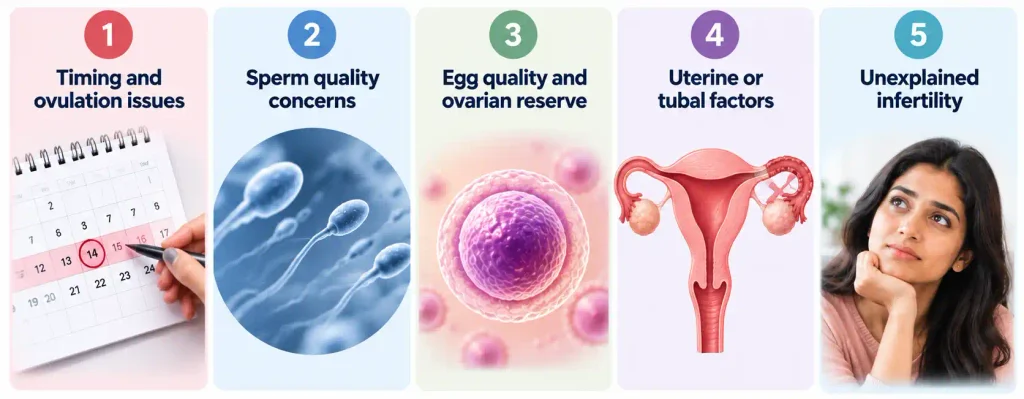
Understanding why cycles do not work helps you and your doctor decide what to adjust next.
- Timing and ovulation issues: IUI has to be done within a narrow window around ovulation. Even a few hours off can lower the chances.
- Sperm quality concerns: Low sperm count, poor motility, or abnormal shape (morphology) reduce the odds of fertilization. If reports show a low sperm count, IUI success drops sharply with each additional cycle.
- Egg quality and ovarian reserve: As women age, egg quality naturally declines. This is measured through AMH (Anti-Müllerian Hormone), a blood test that estimates how many eggs remain in the ovaries.
- Uterine or tubal factors: A thin endometrium (the uterine lining where the embryo implants) or blocked fallopian tubes can prevent pregnancy even with perfect timing.
- Unexplained infertility: Sometimes every test comes back normal, and the cycle still does not work. This is frustrating but common, and it is one reason doctors set a cycle limit before moving on.
Is It Worth Trying IUI a Second or Third Time?
In most cases, yes. Cumulative success improves with repeated attempts, especially if your doctor adjusts the protocol based on what was learned from the first cycle.
Trying again blindly, with no changes at all, rarely helps. Before your next attempt, your doctor should review the ovulation trigger timing, sperm preparation, hormone levels, and whether the uterine lining was thick enough on insemination day.
How Many IUI Cycles Should You Try?
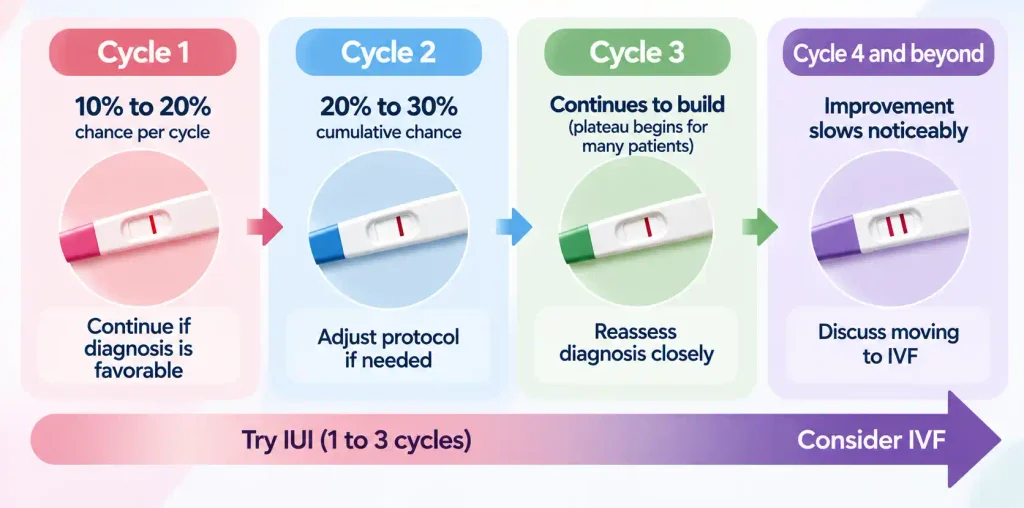
This is one of the questions couples ask most often, and the honest answer depends on age, diagnosis, and how the earlier cycles went. As a general rule, doctors do not recommend unlimited attempts.
| IUI Attempt | Typical Cumulative Chance | What Doctors Usually Suggest |
|---|---|---|
| Cycle 1 | 10% to 20% | Continue if diagnosis is favorable |
| Cycle 2 | Builds on cycle 1, roughly 20% to 30% cumulative | Adjust protocol if needed |
| Cycle 3 | Continues to build, plateau begins for many patients | Reassess diagnosis closely |
| Cycle 4 and beyond | Improvement slows noticeably | Discuss moving to IVF |
Most fertility societies, along with our own clinical experience, point to the same range, 3 to 4 well managed IUI cycles for couples with a reasonable diagnosis. Beyond that point, the additional benefit of repeating IUI usually gets smaller while the emotional and financial cost keeps climbing.
When to Move from IUI to IVF
There is no single number that applies to every couple, but a few situations make the case for moving faster.
- You have completed 3 to 4 IUI cycles without success
- Semen analysis shows a significantly low sperm count or poor motility
- You are above age 35, where egg quality declines more quickly
- Tests show blocked or damaged fallopian tubes
- AMH levels indicate a low ovarian reserve
In these situations, in vitro fertilization (IVF), where the egg and sperm are fertilized outside the body in a lab before the embryo is placed in the uterus, offers a meaningfully higher success rate per attempt. If you want a side-by-side look at how the two treatments compare, our IUI vs IVF comparison breaks down cost, invasiveness, and success rates in detail.
“Moving to IVF is not a failure of IUI. It is simply matching the treatment to what your body actually needs.” — Dr. Kaushal Patel
How the IUI to IVF Transition Works in Vapi
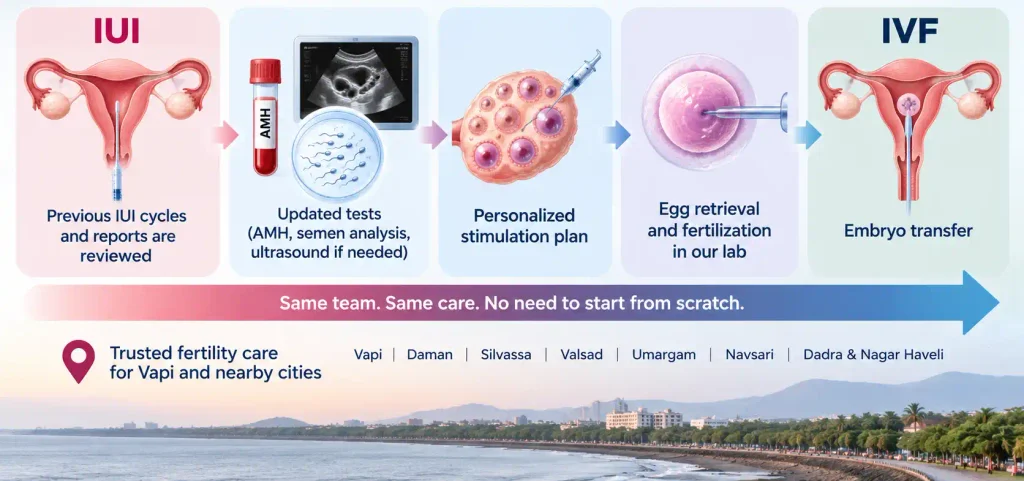
Women from Vapi, Daman, Silvassa, Valsad, Umargam, Navsari, and Dadra & Nagar Haveli often assume they will need to travel to Mumbai or Ahmedabad for advanced fertility care. That is not the case anymore.
At our center, the transition from IUI to IVF happens as one continuous journey rather than starting from scratch. Your existing test reports, ultrasound history, and hormone panels carry forward, so you are not repeating basic diagnostics unless something has genuinely changed.
The process typically includes a detailed review of your previous IUI cycles, updated ovarian reserve testing (AMH) and semen analysis if it has been more than 6 months, a customized stimulation plan based on how your body responded before, and finally egg retrieval, lab fertilization, and embryo transfer, all performed on site.
Couples from Daman and Silvassa frequently choose to stay locally for this stage because the reduced travel means fewer missed monitoring appointments, and monitoring during IVF matters far more than it did during IUI. For families in Valsad specifically searching for a fertility clinic for IUI to IVF transition, having a team that already understands your fertility history saves both time and repeated testing costs.
Dr. Kaushal’s Practical Advice
After years of guiding couples through this exact decision, here is what I tell patients directly, without sugarcoating it.
Do not repeat IUI more than 4 times without a serious conversation about IVF, especially if age or sperm quality are working against you. Every cycle has a cost beyond money, it costs time you cannot get back, particularly if you are past 35.
Ask your doctor to explain your specific numbers, not general statistics. Your AMH, your partner’s sperm count, and your uterine lining thickness matter more to your case than any average success rate you read online.
If a doctor tells you to keep repeating IUI cycle after cycle with no changes and no clear reasoning, get a second opinion. Treatment should be built around your test results, not around habit.
Ready to Talk About Your Next Step?
If you’ve had one or more failed IUI cycles and are unsure whether to try again or consider IVF, book a consultation with our fertility team in Vapi. We’ll review your reports and help you choose a realistic next step based on your individual situation.
Book your consultation or review our IVF success rates in Vapi to understand the factors that can influence IVF outcomes.
Final Thought
A failed IUI cycle is not a verdict on your ability to become a parent. It is one data point in a process that, for most couples, eventually leads somewhere good, whether that is a successful IUI cycle down the line or a well-timed move to IVF.
What matters most is not repeating the same approach out of habit or hope alone. Talk to your doctor honestly, ask for your specific numbers, and make the next decision based on facts rather than fear. That is the approach we follow with every couple who walks through our doors in Vapi, and it is the one that gives you the clearest path forward.
Frequently Asked Questions
1. What should we do after a failed IUI cycle?
Take a short break to process the disappointment, then schedule a follow-up with your fertility doctor to review the cycle in detail. Your doctor should check the timing, medication response, and sperm preparation before deciding whether to repeat IUI or consider other options.
2. Why did my IUI fail even though everything looked normal?
Normal test reports do not guarantee pregnancy because fertilization and implantation depend on many small factors that are hard to measure directly, like egg quality on that specific day. This is common and does not necessarily mean something new is wrong.
3. What are the most common reasons an IUI cycle does not work?
The leading reasons include poor timing around ovulation, reduced sperm quality, declining egg quality with age, a thin uterine lining, and unexplained infertility. Your doctor can usually narrow this down by reviewing your specific cycle details.
4. Should we try IUI again after the first failed attempt?
In most cases, yes, since success rates improve cumulatively over a few cycles. The key is making sure your doctor adjusts something, whether it is timing, medication dose, or sperm preparation, rather than repeating the exact same protocol.
5. How many IUI cycles should we try before moving to IVF?
Most fertility specialists recommend 3 to 4 well managed cycles before reconsidering the treatment plan. Beyond this point, the added benefit of another IUI cycle usually becomes smaller than the benefit of switching to IVF.
6. When is the right time to move from IUI to IVF?
The right time is usually after 3 to 4 failed cycles, or sooner if there is a significant sperm issue, blocked fallopian tubes, low ovarian reserve, or the woman is above 35. Age and diagnosis matter more than a fixed number of attempts.
7. What happens after 3 or 4 failed IUI cycles?
Your doctor will typically recommend a fresh set of tests, including updated hormone levels and a semen analysis, before discussing IVF. This helps confirm whether IUI still has a reasonable chance or whether IVF offers a meaningfully better path forward.
8. Can the chances of IUI success improve on the second or third attempt?
Yes, cumulative pregnancy rates generally rise with each additional cycle when the protocol is adjusted based on earlier results. However, the improvement usually slows down after the third or fourth attempt.
9. What tests should be done after repeated IUI failure?
Doctors typically recommend AMH testing for ovarian reserve, a repeat semen analysis, an ultrasound to check the uterine lining, and sometimes a hysteroscopy to look inside the uterus. These results guide whether to repeat IUI or move toward IVF.
10. Does a failed IUI mean there is a problem with egg quality or sperm quality?
Not necessarily, since IUI can fail even with normal egg and sperm parameters due to timing or implantation factors. Repeated failures across multiple cycles, though, do warrant a closer look at both partners’ fertility markers.
11. What is the typical success rate of IUI, and why can it fail?
IUI success rates generally range from 10% to 20% per cycle for women under 35, and lower for older women, according to the NHS. It can fail due to timing issues, sperm quality, egg quality, or simply because pregnancy involves multiple biological steps that all need to align.
12. How do doctors decide whether to repeat IUI or recommend IVF?
Doctors weigh the number of previous cycles, the woman’s age, sperm parameters, ovarian reserve, and whether the fallopian tubes are open and healthy. If these factors are favorable, another IUI cycle may be reasonable, but if any are significantly abnormal, IVF is usually recommended sooner.
13. Does low sperm count make IVF a better option after failed IUI?
Yes, when sperm count or motility is significantly low, IVF combined with ICSI (a technique where a single sperm is injected directly into the egg) usually offers better odds than repeating IUI.
14. What does the transition from IUI to IVF involve after a failed cycle?
The transition usually starts with a review of your previous cycles and updated testing, followed by a customized ovarian stimulation protocol for egg retrieval. From there, fertilization happens in the lab and a healthy embryo is transferred back into the uterus.
15. What are the next steps after IUI failure for couples in Vapi, Daman, Silvassa, or Valsad?
Couples in these areas can access the full diagnostic review and IVF transition locally, without needing to travel to a bigger city for basic fertility care. Our IVF centre in Valsad and Vapi facility both offer the same continuity of care, so your earlier IUI history carries forward into your treatment plan.