


The discharge summary lands in your hand, and the number near the bottom is smaller than you hoped. Three eggs. Maybe four. You took the injections, attended every scan, and followed the plan exactly, yet your ovaries gave only a few eggs after IVF stimulation. That moment carries a very specific worry, and it deserves a clear, honest answer.
A poor ovarian response in IVF means the ovaries produced fewer eggs than expected during stimulation. It is one of the most common reasons couples sit down with a fertility doctor for a careful second look. It is also one of the most misunderstood results in fertility care.
A low number on one cycle report is information, not a verdict. It tells your doctor what to review, what to retest, and what can be planned differently next time.
Key Takeaways
- Poor ovarian response in IVF means fewer eggs were collected than expected after stimulation. It reflects how the ovaries answered the medication, not anything a patient did wrong.
- Egg supply falls naturally with age. Ovaries hold 1 to 2 million eggs at birth, close to 25,000 by age 40, and far fewer after that.
- Reduced ovarian reserve sits behind roughly one in four IVF cycles in national IVF data published by the CDC.
- After a low retrieval, doctors review the dose used, the type of ovarian stimulation protocol, follicle growth on scans, trigger timing, and current reserve tests before planning again.
- A higher medication dose does not promise a higher egg count. Changes are planned around your age, reserve tests, and how your follicles behaved.
- One low retrieval does not decide the next cycle. Many patients go on to collect usable eggs and embryos with a revised plan.
What Poor Ovarian Response in IVF Actually Means
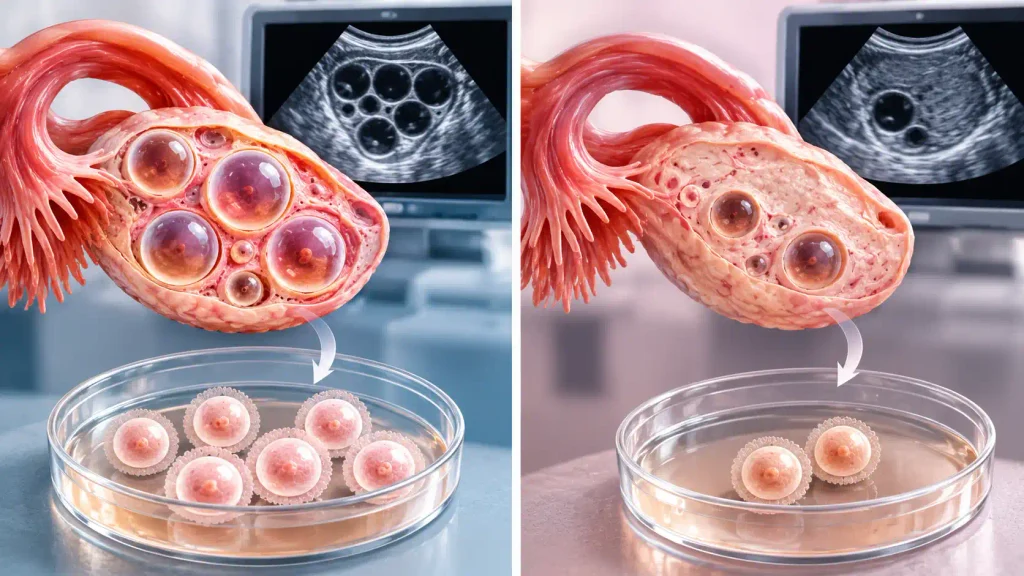
Every IVF cycle tries to grow several follicles at once, because each follicle holds one egg. When scans show fewer growing follicles than expected, or retrieval collects fewer eggs than hoped, doctors describe it as a poor or low response.
No single cut-off fits everyone. Many specialists use fewer than 5 collected eggs as a practical marker, and some older research definitions used 3 or fewer. The label matters less than the comparison behind it: your result against your age, your dose, and your reserve tests.
“A poor cycle tells us how your ovaries answered one plan, on one dose, in one month. It does not label your fertility for life.” Dr. Kaushal Patel
That distinction matters. Some patients respond poorly because their ovarian pool is small. Others respond poorly because the plan did not suit their ovaries that month. The next section separates the two.
Why Did I Produce Only a Few Eggs?
Two broad reasons explain a low egg retrieval. The first is a smaller starting pool. The second is something inside the cycle itself that held follicles back. Often, both play a part.
1. Ovarian reserve and IVF
Ovarian reserve describes the eggs still available in the ovaries. It falls with age, and faster after the mid-30s, as we explain in our study on fertility after 35. Blood tests such as AMH, along with ultrasound counts of resting follicles called the antral follicle count, estimate that pool before treatment.
When reserve is low, fewer follicles are available for stimulation, no matter how the medication is given. Patients with low AMH often fall into this group, and our low AMH and low egg count research covers it in depth.
2. Reasons that sit outside reserve
- A protocol that switched the ovaries down too strongly before stimulation began
- A starting dose that was too low, or increased too slowly
- Ovulation beginning before retrieval, which can quietly cost eggs
- A cyst or shifting hormones that unsettled the plan
- Follicles growing in scattered waves instead of together
- Plain biology, which sometimes responds less than tests predicted
Poor response to ovarian stimulation can also happen without any clear cause. Tests look for patterns, but ovaries are not machines. An unexplained low response still deserves a full review, because small, correctable details hide inside every cycle record.
What Your Doctor Reviews Before the Next Cycle
Poor ovarian response in IVF rarely has one single reason, so the review becomes a proper audit of the whole cycle. Think of it as reading the story backwards, from retrieval day to the first injection. Most of the answers already sit in your own charts, which is why this audit works best at a centre with complete lab and scan records, such as a dedicated IVF centre in Gujarat.
| Review area | What the doctor looks at | What it can reveal |
|---|---|---|
| Medication dose | Total daily dose and how quickly it rose | Whether the ovaries were under-stimulated or already at their limit |
| Protocol type | Agonist, antagonist, or mild stimulation | Whether the plan suppressed the ovaries more than needed |
| Scan pattern | Number, size, and growth speed of follicles | Whether follicles grew together or in scattered waves |
| Hormone levels | How estrogen rose through stimulation | A flat rise suggests the ovaries struggled; a strong rise with few eggs points elsewhere |
| Trigger and timing | The trigger injection and the hours before retrieval | Timing errors can quietly cost eggs |
| Reserve tests | Current AMH and antral follicle count | Whether the ovarian pool has changed since your last workup |
| Lab results | Egg maturity and fertilization rates | Whether the problem was egg number, egg quality, or both |
1. Should AMH and antral follicle count be checked again?
Usually yes, if the last tests are more than a year old, or if the cycle result was much worse than those tests predicted. Reserve levels drift over time. Fresh numbers set honest expectations and guide the dose discussion.
2. Reviewing the ovarian stimulation protocol
Doctors compare the protocol used against alternatives, such as switching between agonist and antagonist plans or adjusting the trigger. Protocol review matters most when the poor ovarian response in IVF was unexpected, meaning reserve tests looked healthy. Sometimes a change makes sense. Sometimes the plan actually matched your ovaries, and repeating a similar approach is the honest call.
Understanding the IVF process step by step makes these conversations much easier to follow.
“Before we plan another cycle, I look at three things: what the follicles did, what the eggs did, and what we can change safely. Most of the answers are already inside your own cycle record.” Dr. Kaushal Patel
Does More Medication Always Mean More Eggs?
No, and this surprises many patients. In a genuine poor ovarian response in IVF, raising the dose often changes the cost more than the egg count. Research and daily practice both show that the response reaches a plateau, where extra injections add very little.
Higher doses can also bring downsides: more injections, higher expenses, and occasional side effects. For some patients, a gentler plan that respects the ovarian pool is the smarter choice.
“Raising the dose does not multiply eggs beyond what the ovaries can offer. We aim for the right dose for your ovaries, not the highest dose we can give.” Dr. Kaushal Patel
What Can Change Before IVF After a Poor Response
IVF after poor response works best when the revision is deliberate. Every change depends on the review above, but these are the conversations worth expecting. Treat them as options your doctor weighs, not promises.

- Dose and timing adjustments based on how follicles actually grew
- A different stimulation approach, when the old one suppressed the ovaries
- A changed or doubled trigger, when timing looked doubtful
- A freeze-all plan, so the uterine lining gets a calm month before transfer
- Collecting eggs across two smaller cycles, which some clinics discuss for very low responders
- Simple basics, such as stopping smoking, steadying weight, and protecting sleep
Couples often ask about supplements and add-ons. Evidence for most of them is thin, so treat anything beyond standard care with healthy caution, and always ask for the reasoning. What moves outcomes most is a plan matched to your reserve, not a longer list of pills.
Should You Wait Before the Next IVF Cycle?
Physically, most patients can start again after one natural cycle, once the ovaries have settled. Research has not shown that long breaks improve the response, so waiting many months rarely rescues a cycle.
Emotional readiness is different. A low retrieval is disappointing, and starting again while exhausted rarely helps anyone. Discuss timing openly, and include your partner in the decision. The right gap is the one that lets you return with a clear head.
Questions Worth Asking at Your Next Appointment
- What did my follicles and hormone levels actually do during the cycle?
- Was my dose right for my age and reserve tests?
- Would a different ovarian stimulation protocol suit me better?
- Should we repeat my AMH and antral follicle count first?
- How many eggs would count as a reasonable result for my situation?
- At what point should we discuss other paths, including donor eggs?
Bring written notes to that meeting. A short list of questions keeps the review focused, and doctors genuinely appreciate prepared patients.
When a Low Retrieval Happens Again
A repeated poor ovarian response in IVF usually points to the ovarian pool itself rather than to the plan. If reserve tests have also fallen, your doctor may talk honestly about next-level options: repeating a gentler cycle, collecting eggs over several attempts, or considering donor eggs at some point.
None of these conversations means giving up. They mean matching the effort to your biology. Egg count and egg quality are related but separate matters, and quality sometimes surprises everyone in a good way. Keep the discussion open and unhurried.
About the Author
Dr. Kaushal Patel is an IVF and fertility specialist at Isha Women’s Hospital in Vapi, with over a decade of experience in reproductive medicine and published research in a reputed international journal. Couples across Vapi and South Gujarat know his consultations for plain talk and unhurried explanations.
“Every review ends with one question: what gives this patient the best chance with the least strain? Sometimes the answer is a revised stimulation plan, and sometimes it is an honest conversation about every path available.” Dr. Kaushal Patel
Final Thought
A poor ovarian response in IVF is a hard result to read, but it is also a map. It shows your doctor exactly where to look before the next attempt. Review the cycle, retest what has aged, and adjust what can be adjusted. Careful IVF cycle planning after a disappointing cycle is not starting over. It is starting smarter.
Frequently Asked Questions
1. What does poor ovarian response in IVF mean?
It means the ovaries produced fewer eggs than expected during stimulation, judged against your age, dose, and reserve tests. Many specialists use fewer than 5 collected eggs as a practical marker. The term describes one cycle’s response, not your overall fertility.
2. Why did I produce only a few eggs during my IVF cycle?
The most common reason is a smaller ovarian pool, especially with age or low AMH. Sometimes the protocol, the dose, or the trigger timing held follicles back. A full cycle review separates these causes.
3. What should my doctor review after a poor response to ovarian stimulation?
Dose, protocol type, follicle growth on scans, hormone rise, trigger timing, and egg maturity in the lab. Together, they show whether the plan or the ovarian pool caused the result. Each finding points to a specific change or a sensible repeat.
4. Can ovarian reserve tests explain why I had a low egg retrieval?
Often, yes. AMH and antral follicle count estimate the available pool and usually match a genuinely low response. When the results clash with the cycle outcome, the cycle details matter more.
5. Should AMH and antral follicle count be checked before another IVF cycle?
It is recommended when the last tests are over a year old, or when the response was much worse than predicted. Reserve drifts over time. Fresh numbers set honest expectations and guide dosing.
6. Does a poor response in one IVF cycle mean the next cycle will also have a low follicle response?
Not necessarily. Correctable issues, better timing, or a revised plan can change the result. When reserve itself is low, responses tend to stay modest, and your doctor should say so plainly.
7. What can be changed before trying IVF after poor ovarian response?
Dose, protocol, trigger, and freeze-all timing are the usual levers. Lifestyle basics like quitting smoking and steadying weight support general health too. The right mix depends on your own cycle data.
8. Can the ovarian stimulation protocol be reviewed after retrieving few eggs?
Absolutely, and it should be. Comparing agonist, antagonist, and mild approaches against your scan pattern is a standard part of the audit. Sometimes the review ends with keeping the same plan, and for good reasons.
9. Is IVF after poor response still worth considering?
In most cases, yes, with adjusted expectations and a revised plan. Many patients with a previous low retrieval go on to create usable embryos. Your doctor can outline what a realistic next step looks like for you.
10. Does increasing fertility medication always improve the number of eggs retrieved?
No. The response plateaus beyond a point, so higher doses often add cost and injections without adding eggs. Dose changes are individual decisions, not automatic upgrades.
11. Can age affect poor ovarian response and the number of eggs retrieved?
Strongly. Egg numbers decline with age, and faster after 35, which is why age sits at the centre of every review after a low retrieval. It also influences how doctors interpret your reserve tests.
12. Are there tests that can show why my ovaries responded poorly to IVF stimulation?
AMH, antral follicle count, and sometimes baseline hormones help explain the picture. No single test explains every poor response. The cycle record itself is often the most telling evidence.
13. Should I wait before starting another IVF cycle after a low egg retrieval?
Usually one natural cycle is enough for physical recovery. Long waits have not been shown to improve the response. Emotional readiness deserves as much weight as the calendar.
14. What questions should I ask my IVF doctor before planning another cycle?
Ask what your follicles and hormones actually did, whether the dose matched your reserve, and which protocol changes are on the table. Also ask what result would count as reasonable next time. Write the answers down.
15. Can poor ovarian response in IVF affect my chances of pregnancy?
Fewer eggs can mean fewer embryos and fewer transfers, which can lower per-cycle chances. It does not remove them. With careful planning, many patients still reach a healthy pregnancy, and your doctor can estimate the chances for your specific situation.