
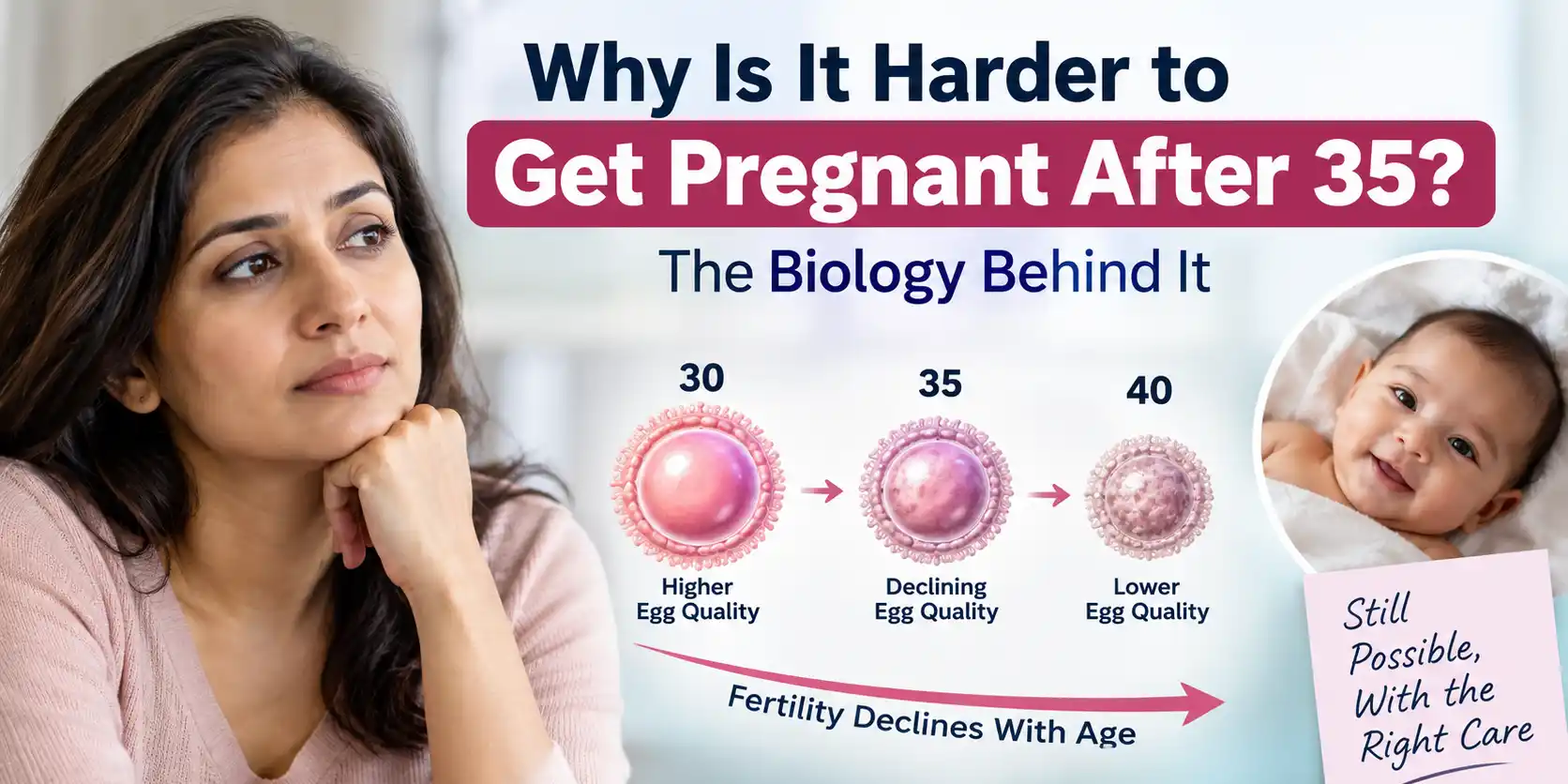
A patient sat across from me last month and asked the question I hear almost every week: “Doctor, why is it harder to get pregnant after 35? I feel healthy, my periods are regular, so why is this happening to me?”
It is a fair question, and it deserves a real answer, not a scary one. Female fertility depends heavily on egg number and egg quality, and both change with age. This is biology, not a personal failing, and understanding it early gives you far more control over your timeline.
Below, we walk through exactly what changes in your body, what the numbers really mean, and what your options look like today, including for women living in Vapi, Daman, Silvassa, and Valsad.
Key Takeaways
- Female fertility declines gradually from the early 30s and speeds up after 35, mainly due to falling egg quantity and quality.
- A healthy 30-year-old has about a 20% chance of conceiving each cycle, dropping to roughly 5% by age 40.
- IVF live birth rates fall with age too, from around 55% per cycle under 35 to single digits after 42.
- An AMH blood test measures ovarian reserve, or your remaining egg supply, but not egg quality.
- Pregnancy after 40 is still possible, though it usually takes longer and benefits from earlier testing and, sometimes, assisted reproduction.
- Women across Vapi, Daman, Silvassa, Valsad, Umargam, and Navsari can access fertility testing, AMH testing, and IVF care without traveling to a metro city.
The Modern Reality: Careers, Later Marriage, and a Ticking Clock
Nobody plans a career, a home loan, and a wedding around their ovaries. Women today are studying longer, working harder, and marrying later than their mothers did, and there is nothing wrong with that choice.
But biology does not read calendars. Acknowledging the gap between your life plan and your biological timeline is not judgment. It is information you can use.
“I never tell my patients they waited too long. I tell them what their body looks like today, and what we can do about it starting now.” – Dr. Kaushal Patel
Does Age Affect Fertility? What Actually Changes Inside Your Body
Yes, age affects fertility, and the reason comes down to two things: how many eggs you have left, and how healthy those eggs are.
1. How Does Egg Quality Change With Age?
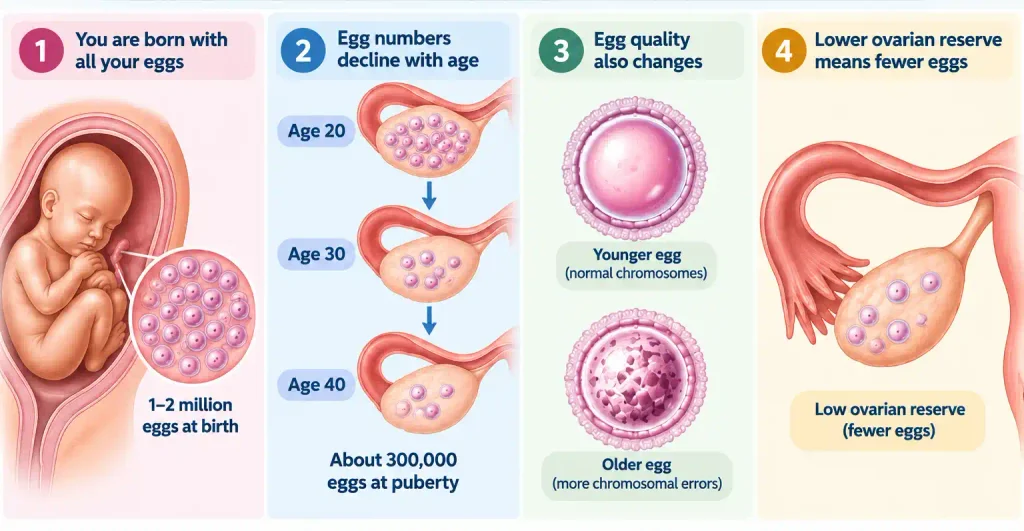
You were born with every egg you will ever have, roughly one to two million at birth, dropping to about 300,000 by puberty, and it keeps falling every month regardless of whether you are trying to conceive. Quantity is only half the story.
As eggs age, more develop chromosomal errors, meaning the genetic material does not divide correctly. These eggs are less likely to fertilise, more likely to end in early miscarriage, and more likely to lead to conditions like Down syndrome if a pregnancy continues.
2. What Does Low Ovarian Reserve Mean?
Ovarian reserve is simply the number of eggs remaining in your ovaries at any given time. Low ovarian reserve means fewer eggs than expected for your age, but it does not mean you cannot get pregnant. It means your natural conception window may be shorter, and it is a strong reason to get evaluated sooner.
Age-Wise Fertility Decline: Your 30s, 35, and 40 Compared
Numbers side by side often explain this better than paragraphs can.
| Age | Chance of Pregnancy Per Cycle | Chance Within 1 Year (Trying Naturally) | Egg Quality Trend | Typical IVF Live Birth Rate |
|---|---|---|---|---|
| Early 30s | About 20% | Up to 85% | Mostly stable | About 55% |
| 35 | About 15% | About 78% | Beginning to decline | About 41% |
| 40 | About 5% | About 44% | Noticeably reduced | 7% to 12% |
These are population averages, not a personal prediction. Your own AMH level and any underlying conditions, like PCOS or thyroid disorders, can shift where you actually fall on this curve.
What Is Meant by the Biological Clock?
The phrase “biological clock” simply describes how your egg supply and egg quality decline over time, on a schedule your ovaries set. It is less a countdown to panic over, and more a fuel gauge. Knowing where the needle sits lets you plan calmly, instead of guessing.
How Does Late Marriage Affect Fertility?
Late marriage itself does not damage your fertility. What it does is compress the time left to try naturally before age-related decline accelerates. A woman who marries at 32 and starts trying at 34 has a very different runway than one who starts at 38, and the second scenario usually benefits from a baseline fertility evaluation earlier, rather than waiting a full year to seek help.
What Does an AMH Test Actually Show?
AMH stands for Anti-Müllerian Hormone, released by tiny follicles in your ovaries. A blood test can measure it any day of your cycle, with no fasting required. A higher AMH generally means a larger egg reserve, but it cannot tell you egg quality, so it works best alongside a doctor’s full assessment.
1. What Is a Fertility MOT Test?
A fertility MOT is a bundled health check, usually an AMH blood test, a basic hormone panel, and an ultrasound scan of your ovaries and uterus. Think of it as a service check-up for your reproductive system, and women over 30 planning ahead often find it genuinely reassuring.
How Does the Risk of Miscarriage Change With Age?
Miscarriage risk rises steadily with age, largely because older eggs carry more chromosomal abnormalities. Roughly 1 in 10 pregnancies miscarry in a woman’s 20s, climbing toward 1 in 5 by the late 30s, and higher still after 40. This often frightens patients more than it should. A raised risk is not a guarantee, and many women in their late 30s and 40s carry perfectly healthy pregnancies to term.
Fertility Testing After 35: What Should You Actually Get Checked?
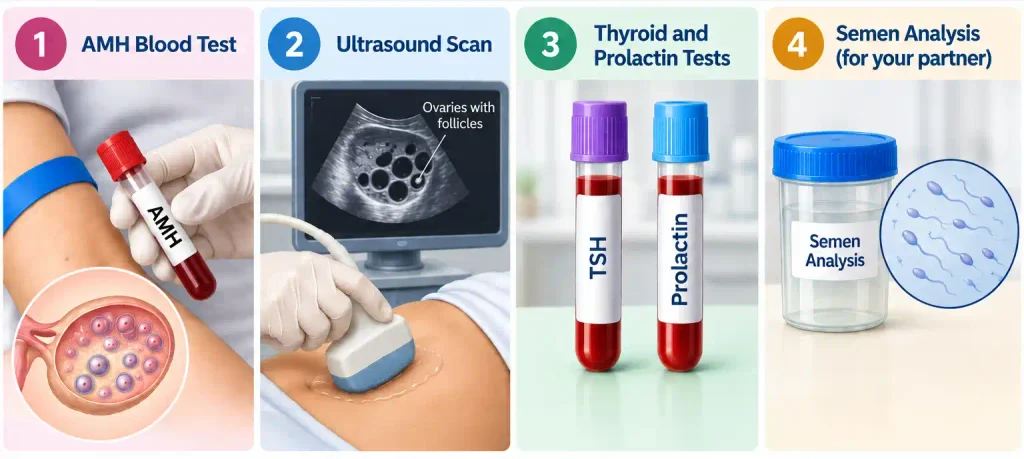
If you are over 35 and have been trying for six months without success, testing should start now, not after the one-year mark used for younger women. Useful tests typically include:
- AMH blood test, to estimate ovarian reserve
- Ultrasound scan, to check follicle count and uterine health
- Thyroid and prolactin hormone tests
- Semen analysis for your partner, since male factors contribute to nearly half of all fertility challenges
Our fertility evaluation covers what to expect at each appointment.
Is Pregnancy Still Possible After 40?
Yes, and we see it regularly in our clinic. It usually takes longer and needs closer monitoring, but healthy pregnancies at 40 and beyond are common, not rare. What changes most is the value of acting quickly once you decide to try, since natural conception windows shrink faster in this decade than the one before it.
Egg Freezing: A Proactive Option, Not a Last Resort
If you are not ready for pregnancy yet but want to protect your options, egg freezing lets you preserve eggs from your current, younger reserve for future use. The honest advice here is timing: it works best in your late 20s to early 30s, when egg quantity and quality are stronger. Freezing later still helps, but outcomes reflect your age at the time.
“Egg freezing is not about avoiding a decision. It is about keeping more choices available while you make it.” – Dr. Kaushal Patel
Our study on egg freezing in Vapi covers the process, cost, and who should consider it.
Fertility Treatment After 35: What Are Your Real Options?
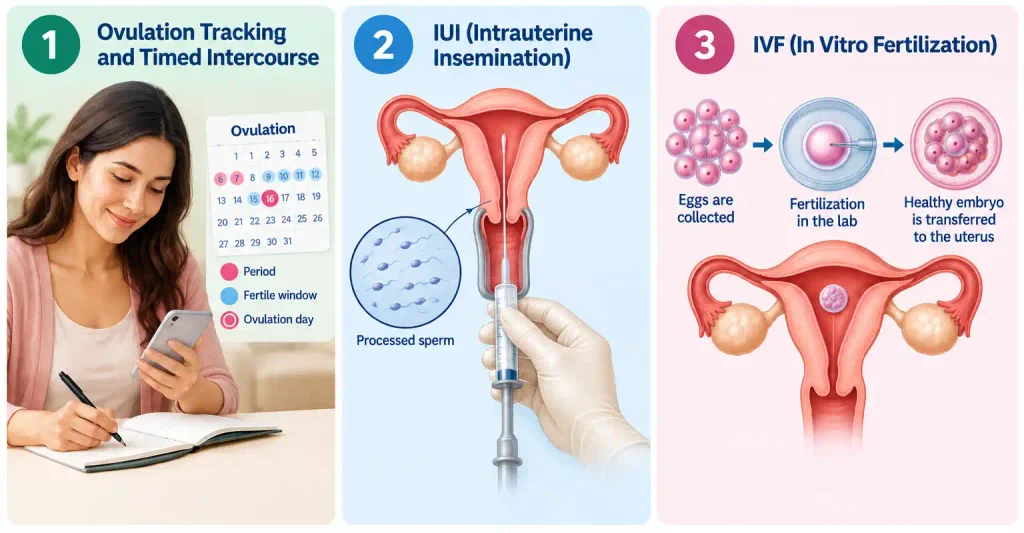
Natural conception rates drop enough after 35 that many couples benefit from medical support rather than waiting it out alone. Common paths include:
- Ovulation tracking and timed intercourse, for regular cycles with no major risk factors
- IUI (intrauterine insemination), for mild male-factor issues or unexplained infertility
- IVF (in vitro fertilization), when ovarian reserve is low, tubes are blocked, or time is limited
IVF tends to become the more time-efficient route after 35, since it works around several age-related hurdles at once, rather than waiting on natural cycles that may not produce a viable egg every month. You can review real IVF success rates in Vapi for outcomes at our own centre.
For Working Women in Vapi and Daman: You Do Not Have to Choose Alone
If you are managing a full-time job in Vapi’s industrial belt or commuting from Daman, fertility planning can feel like one more item on a full plate. You are not being asked to choose between your career and your family. A single AMH test and consultation, scheduled around a weekend or half-day off, gives you clarity on how much time you realistically have.
This is exactly why local access matters. Women from Vapi, Daman, Silvassa, Valsad, Umargam, and Navsari no longer need to travel to Ahmedabad, Surat, or Mumbai for serious fertility care. At iSHA, women from across South Gujarat and Dadra & Nagar Haveli can get AMH testing, ovarian reserve scans, and full IVF treatment under one roof, without the delays that travel and long waiting lists usually add.
Dr. Kaushal Patel’s Advice:
The single biggest regret I hear from patients is not that they tried and failed. It is that they waited a year longer than necessary before getting tested, out of hesitation or hope things would resolve on their own. Urgency here does not mean panic. It means treating a six-month delay after 35 the way you would treat any other time-sensitive health concern, by getting checked rather than guessing.
Our egg quality and broader fertility care programs are built around this principle: earlier information means more options, not fewer.
Final Thought
Getting pregnant after 35 is not a closed door. It stays open for a shorter, more specific window than it used to, and the best thing you can do is find out exactly how wide that window is for you, rather than guessing from statistics alone. One conversation, one blood test, and one scan can replace months of uncertainty with an actual plan.
Frequently Asked Questions
1. Why is it harder to get pregnant after 35?
Both egg number and egg quality decline after 35, and this decline speeds up compared to your early 30s. Hormonal shifts play a small role too, but egg-related changes remain the main factor.
2. Does fertility suddenly drop at 35, or does it decline gradually?
It declines gradually, starting subtly in the early 30s and speeding up after 35. There is no single “cliff,” just a curve that gets steeper each year.
3. How does egg quality change with age after 35?
Older eggs carry a higher chance of chromosomal errors, since the genetic material divides less cleanly with age. This raises the chance of failed fertilisation, miscarriage, and certain chromosomal conditions in ongoing pregnancies.
4. Does late marriage affect fertility and chances of pregnancy?
Late marriage does not damage fertility directly, but it shortens the time you have before age-related decline becomes significant. Couples who marry later usually benefit from starting fertility testing sooner rather than waiting the standard one year.
5. What does the biological clock mean for female fertility?
It refers to the natural, age-linked decline in egg number and quality that every woman experiences over time. It is not a strict deadline, just a gradual shift that becomes more noticeable after the mid-30s.
6. What does an AMH test actually show about fertility after 35?
An AMH test measures a hormone from small ovarian follicles, estimating how many eggs remain in your reserve. It does not measure egg quality, so it works best alongside other tests and a doctor’s assessment.
7. What does low ovarian reserve mean, and can you still get pregnant?
It means fewer eggs remain than typically expected for your age, based on AMH and ultrasound findings. Pregnancy is still possible, though the natural conception window is usually shorter and earlier support often helps.
8. How does the risk of miscarriage change with age?
Miscarriage risk rises steadily with age, since older eggs carry more chromosomal abnormalities. Roughly 1 in 10 pregnancies miscarry in a woman’s 20s, rising to around 1 in 5 by the late 30s, and higher after 40.
9. What is the IVF success rate after the age of 35?
Live birth rates average around 41% per cycle for women aged 35 to 37, dropping to roughly 26% between 38 and 40, per national fertility registry data. Individual results still vary with ovarian reserve and overall health.
10. Can you still get pregnant naturally after 40?
Yes, though the monthly chance is lower, around 5%, and it usually takes longer than in earlier years. Regular monitoring and earlier fertility testing are strongly recommended at this age.
11. When should a woman consider fertility treatment after 35?
Consider a fertility evaluation after six months of trying without success, rather than waiting the full year advised for younger women. Earlier testing protects the limited time you have for both natural conception and treatment.
12. When is the right time to freeze eggs if you are not ready for pregnancy?
The best time is generally your late 20s to early 30s, when egg quantity and quality are both still strong. Freezing later still helps, though fewer eggs are usually retrieved.
13. What is a fertility MOT test, and should women over 35 get one?
A fertility MOT is a combined check, usually an AMH test, hormone panel, and ovarian ultrasound. Women over 35 planning pregnancy soon often find this baseline snapshot genuinely useful.
14. What fertility tests should women consider after 35 if they are trying to conceive?
Consider an AMH test, an ultrasound of the ovaries and uterus, thyroid and prolactin checks, and a semen analysis for your partner. Together, these usually reveal the most common, treatable reasons behind delayed conception.
15. Can women in Vapi, Daman, Silvassa and Valsad get fertility testing and treatment after 35?
Yes, women from Vapi, Daman, Silvassa, Valsad, Umargam, and Navsari can get full fertility testing, including AMH and ultrasound scans, plus IVF treatment locally at iSHA. This removes the need to travel to larger cities for specialist care after 35.