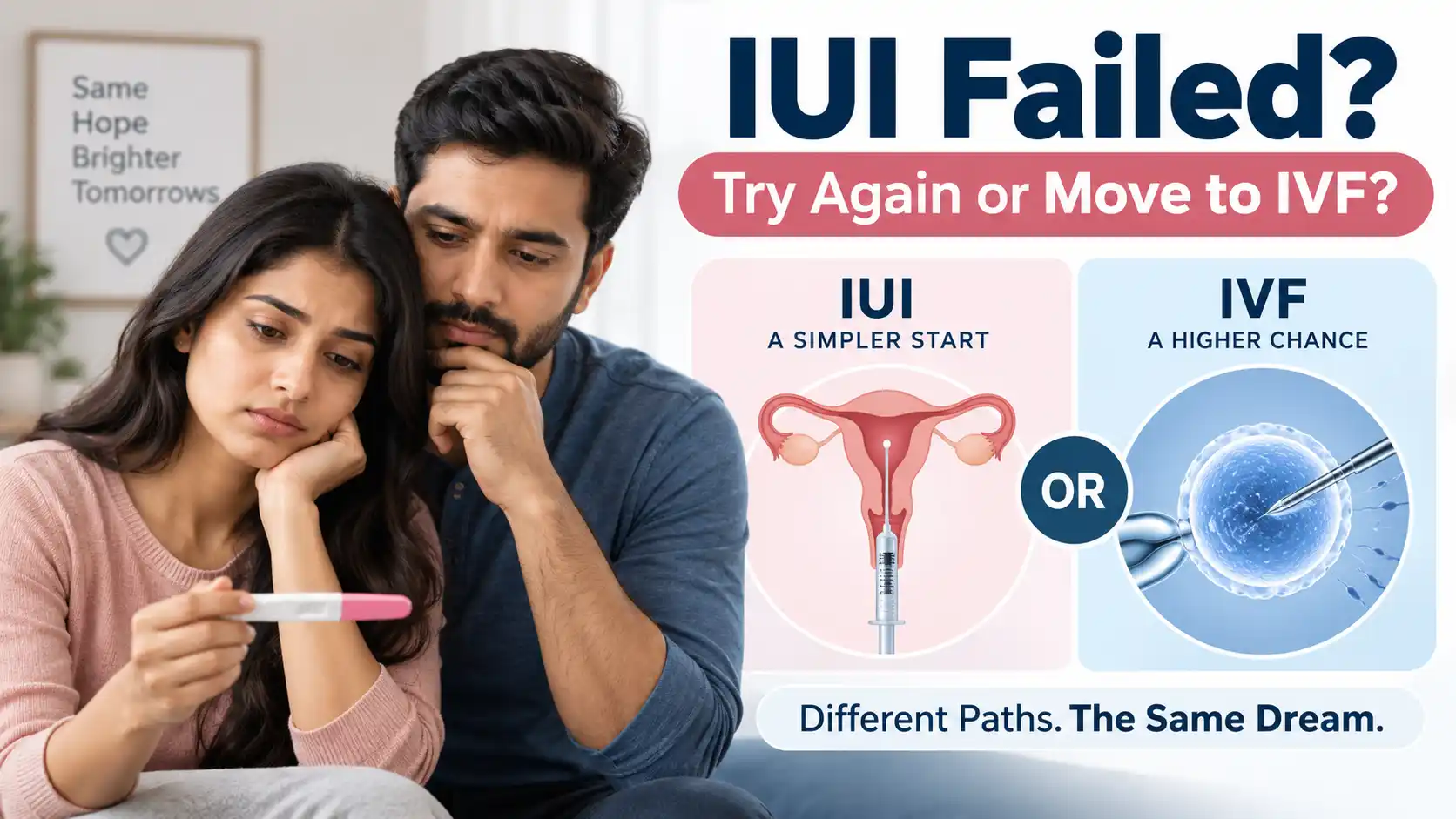

A young couple sat across my desk last month, married four years, holding reports from three different clinics. Their question was simple: “Doctor, do we actually need IVF, or is someone trying to sell us an expensive treatment?” That question deserves an honest answer.
This complete guide to IVF is written for that couple, and for every woman in Vapi, Daman, Silvassa, Valsad, Navsari and Umargam asking the same thing after another negative pregnancy test. You will learn when IVF is actually needed, how the IVF process works from the first scan to the pregnancy test, what IVF cost in Vapi realistically looks like, and how to judge whether a hospital is truly equipped to help you.
I have treated fertility patients across South Gujarat for over a decade, and most families arrive at IVF later than they should, often after months of confusion and treatments that were never right for their diagnosis. This guide aims to remove that confusion.
Key Takeaways
- Infertility affects roughly 1 in 6 people of reproductive age worldwide.
- IVF success is closely tied to age. Live birth rates around 32% for women under 35, dropping to about 11% for women aged 40 to 42.
- Most clinics advise waiting one full menstrual cycle, roughly four to six weeks, between IVF attempts.
- IVF is usually recommended after simpler treatments like IUI fail, or immediately for blocked tubes, severe male-factor infertility, or advanced maternal age.
- Indian law strictly prohibits using IVF to select a baby’s gender, under the PC-PNDT Act.
- Realistic IVF cost in Vapi depends on the protocol used, eggs retrieved, and whether add-ons like ICSI or genetic testing are needed.
What Is IVF, and When Is IVF Needed?

In vitro fertilization, or IVF, joins an egg and sperm outside the body, in a laboratory dish, and places the resulting embryo back into the uterus. It is rarely the first step. It becomes the right step when simpler treatments have failed, or when the diagnosis makes them unlikely to work.
Deciding when IVF is needed usually comes down to a few clear situations.
- Blocked or damaged fallopian tubes: sperm and egg cannot meet naturally.
- Severe male-factor infertility: very low sperm count, poor movement, or abnormal shape.
- Diminished ovarian reserve: fewer or lower-quality eggs, often flagged by a low AMH (Anti-Müllerian Hormone, a blood test estimating remaining egg supply).
- Endometriosis affecting egg quality or the pelvic environment.
- Failed IUI cycles: typically after three to four unsuccessful attempts.
- Unexplained infertility lasting over a year despite normal test results.
- Age above 35 to 38 with trouble conceiving for six months or more.
Recognizing your situation here does not mean IVF is your only option right away, but it means a proper fertility work-up should not wait.
“I have watched couples spend two precious years on treatments never suited to their diagnosis. A correct evaluation in month one can save two years of heartache later.” — Dr. Kaushal Patel
IVF vs IUI: Which Treatment Fits Your Situation?
Both are fertility treatments, but they solve different problems, and confusing the two often delays proper care.
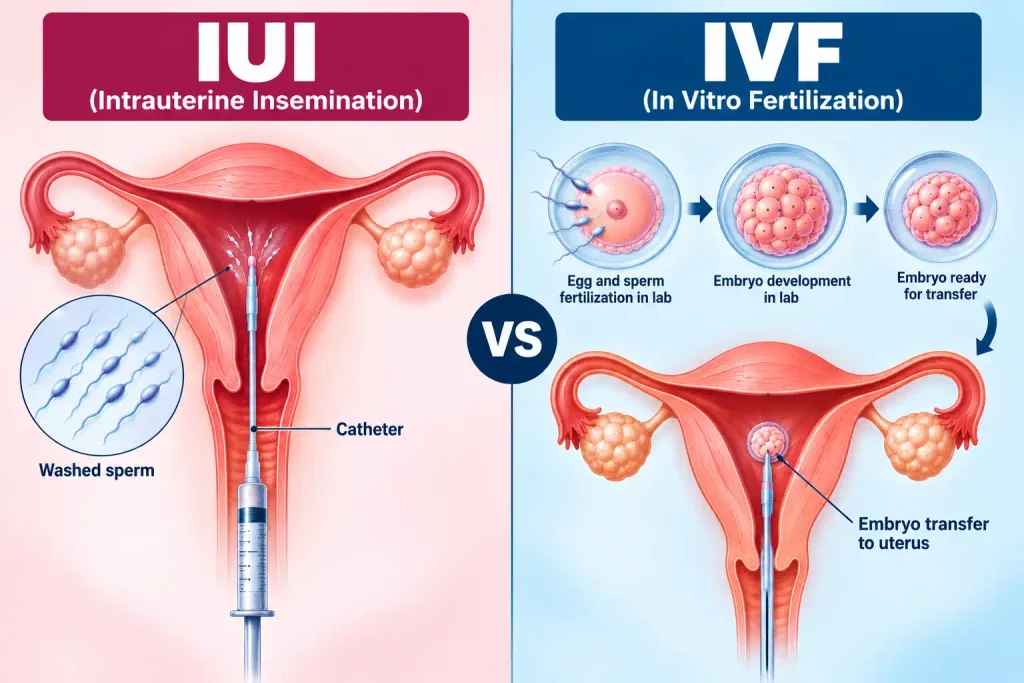
| Factor | IUI | IVF |
|---|---|---|
| What happens | Washed sperm placed into the uterus | Egg and sperm combined in a lab, embryo transferred |
| Best suited for | Mild male-factor issues, unexplained infertility | Blocked tubes, severe male-factor infertility, low reserve |
| Fertilization site | Inside the body | Outside the body, in the lab |
| Success rate per cycle | Roughly 10-15% | Roughly 30-40% under age 35 |
| Monitoring | Moderate | Intensive, injections and frequent scans |
| Typical cost | Lower | Higher |
How the IVF Process Works, Step by Step
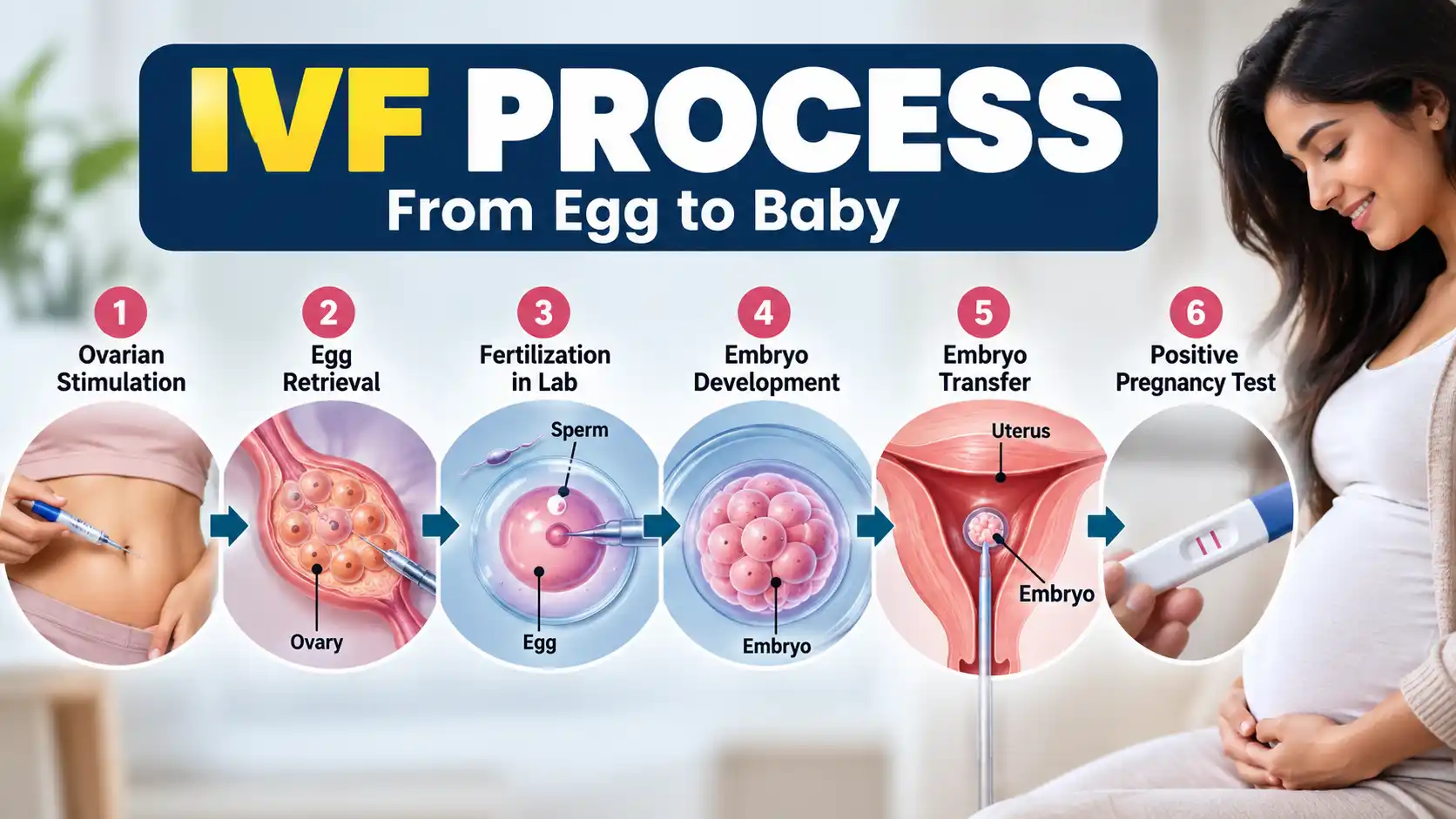
Understanding how the IVF process works removes most of the fear around it. Here is how IVF works step by step, from the first appointment to the pregnancy test.
- Consultation and testing: blood work, AMH levels, ultrasound, and semen analysis to identify the exact cause.
- Ovarian stimulation with IVF injections: daily hormone injections over 10 to 12 days encourage multiple eggs to develop.
- Monitoring: ultrasound and blood tests every few days track follicle growth.
- Trigger shot and egg retrieval: a final injection matures the eggs; retrieval follows 34 to 36 hours later.
- Fertilization in the IVF lab: through conventional insemination or ICSI (Intracytoplasmic Sperm Injection, where a single sperm is injected into an egg).
- Embryo culture: fertilized eggs grow for three to five days under strict lab conditions.
- Embryo transfer: the healthiest embryo is placed into the uterus via a thin catheter, no anesthesia needed.
- The two-week wait: a blood test confirms whether implantation has occurred.
What Are IVF Injections, and Why Are They Needed?
IVF injections are hormone medications, mainly FSH (Follicle Stimulating Hormone), given daily during stimulation. Naturally, one egg matures per cycle. These injections help mature several eggs at once, since more eggs generally mean more embryos to choose from.
Patients often worry about self-injecting. The needles are fine, similar to insulin needles, and our nursing team trains every patient before they leave. Mild bloating is common; severe reactions like Ovarian Hyperstimulation Syndrome are uncommon with careful monitoring, which is exactly why frequent scans matter here.
Is the IVF Procedure Painful?
- Injections cause a brief pinch, similar to an insulin shot.
- Egg retrieval happens under light sedation, so you feel nothing during the procedure, though mild cramping is common the next day.
- Embryo transfer feels similar to a Pap smear and takes about ten minutes, no sedation needed.
Discomfort is manageable for most women, and our team walks through pain management before every stage.
What Happens During Egg Retrieval and Embryo Transfer

Egg retrieval takes 20 to 30 minutes under light sedation. Guided by ultrasound, a thin needle draws fluid, and eggs, from each mature follicle. Most women rest an hour or two and go home the same day.
Embryo transfer happens days later, once embryologists confirm which embryo developed best. A soft catheter, guided by ultrasound, places it directly into the endometrium (the uterine lining where pregnancy implants). No cutting, no stitches, no anesthesia.
What to Do After an Embryo Transfer
- Rest for the remainder of transfer day, then resume light normal activity.
- Continue prescribed progesterone support exactly as directed.
- Avoid heavy lifting, intense exercise, and hot baths for about a week.
- Stay hydrated and eat a balanced, protein-rich diet.
- Avoid symptom-spotting online; cramping or no symptoms can both occur in successful cycles.
- Keep your blood test appointment rather than testing early at home.
How Does an IVF Lab Work, and Why Does It Matter?
The embryology lab decides outcomes more than most patients realize, since embryos are extremely sensitive to their environment in the first five days.
A well-run IVF lab typically includes:
- Incubators that mimic internal body conditions precisely.
- Air filtration removing compounds known to affect embryo development.
- Witnessing protocols, often electronic, confirming the right egg, sperm, and embryo match the right patient.
- Time-lapse imaging, in advanced labs, tracking development without disturbing the incubator.
When comparing clinics, ask about lab accreditation and embryologist experience just as closely as you ask about the treating doctor.
How Many IVF Cycles Are Considered Safe?
There is no universal cap, but sensible guardrails exist. Most clinics recommend a gap of one full menstrual cycle, roughly four to six weeks, between attempts, a practice supported by Cleveland Clinic guidance.
Cumulative success generally improves with repeated cycles, especially under age 35, though gains slow after the third or fourth attempt. Beyond three to four unsuccessful cycles, we usually recommend a deeper diagnostic review, checking uterine abnormalities or sperm DNA fragmentation, rather than repeating an unchanged protocol.
“Repeating the exact same cycle five times rarely helps. After two failed transfers, we look harder at the ‘why,’ not just try again.” — Dr. Kaushal Patel
Can IVF Be Used to Choose a Baby’s Gender?
The answer here is legal, not medical. Under India’s Pre-Conception and Pre-Natal Diagnostic Techniques (PC-PNDT) Act, 1994, determining or selecting a baby’s sex through any technology, including IVF, is strictly illegal, regardless of family history or preference.
Genetic screening like PGT-A (Preimplantation Genetic Testing for Aneuploidy) exists purely to check embryo chromosomal health, never for gender selection, and every reputable Indian clinic follows this law without exception. Any clinic offering gender selection is operating outside the law.
IVF Cost in Vapi: What Actually Goes Into the Price
IVF cost in Vapi varies more than patients expect, and the reason usually comes down to what a quoted package actually includes.
| Cost Component | What It Covers |
|---|---|
| Consultation and work-up | Scans, hormone tests, semen analysis |
| Ovarian stimulation | IVF injections, dosage varies by reserve and age |
| Monitoring | Ultrasounds and blood tests during stimulation |
| Retrieval and lab fees | Procedure, sedation, embryology work |
| Fertilization method | Standard IVF or ICSI, depending on sperm quality |
| Embryo transfer | Fresh or frozen transfer |
| Add-ons | PGT-A/PGD testing, embryo freezing, if required |
What Factors Can Increase IVF Cost in Vapi?
- Higher medication doses for lower ovarian reserve.
- ICSI, when sperm quality is poor.
- Genetic testing (PGT-A or PGD-PGS), an optional chromosomal screening add-on.
- Frozen embryo transfers, when a fresh transfer is not advisable.
- Multiple cycles, since not everyone conceives on the first attempt.
- Donor eggs or sperm, through third-party ART, where applicable.
Ask any clinic for a written, itemized package, and what happens financially if a cycle is cancelled or converted to a frozen transfer. Transparent pricing is one of the clearest signs of a trustworthy fertility centre.
What Are the Chances of IVF Success, and What Affects It?
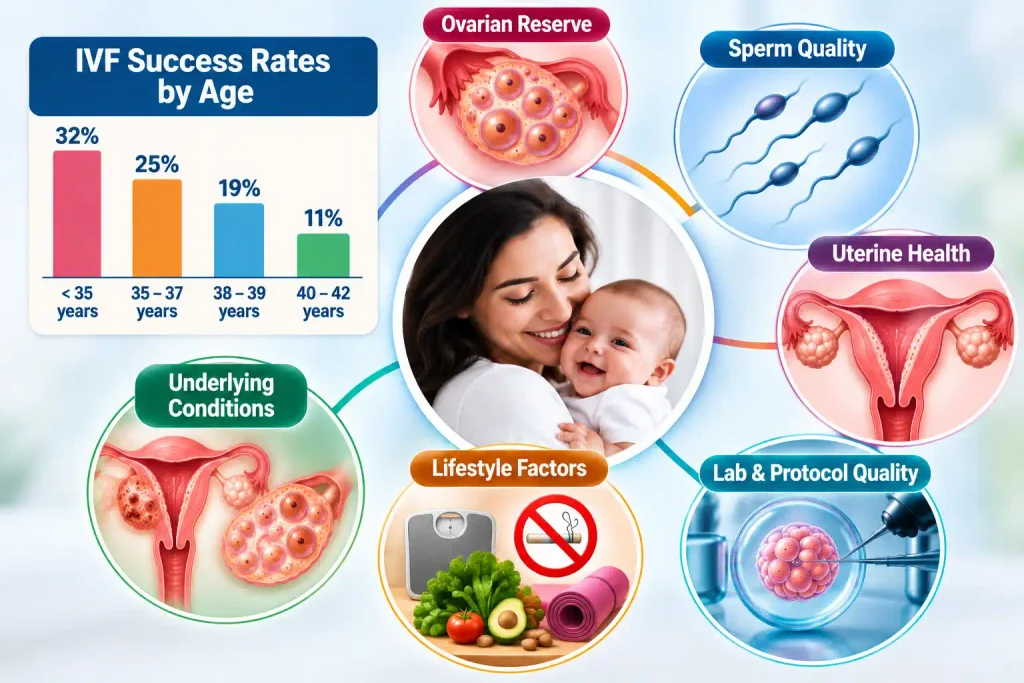
IVF success shifts significantly by age, diagnosis, and embryo quality. NHS data shows live birth rates per embryo transfer around 32% under 35, 25% for 35 to 37, 19% for 38 to 39, and roughly 11% for 40 to 42.
Beyond age, several factors matter:
- Ovarian reserve, reflected in AMH and antral follicle counts.
- Sperm quality, including count, motility, and DNA integrity.
- Uterine health, particularly endometrial thickness.
- Underlying conditions like PCOS (Polycystic Ovary Syndrome) or endometriosis.
- Lifestyle factors, including smoking, body weight, and stress.
- Lab and protocol quality, which matters as much as the treatment choice itself.
IVF Access for Women in Daman, Silvassa, Valsad, Umargam and Navsari
Fertility care should not depend on which side of a district border a family lives on. Women travel to Vapi from Daman, Silvassa, Valsad, Umargam, and Navsari weekly, because comprehensive IVF care close to home is still rare across South Gujarat and Dadra and Nagar Haveli.
At iSHA, patients from these areas typically manage the entire cycle within a manageable travel radius, often completing same-day scan visits during the working week. Families from Silvassa or Daman avoid relocating temporarily to a metro city, and keep continuity between the diagnosing doctor and treating team.
We maintain dedicated resources for these regions, including IVF treatment in Silvassa, IVF care in Daman, and fertility care in Valsad.
Real Patient Journeys From Vapi, Daman and Silvassa
A patient from Silvassa arrived after two failed IUI attempts, labeled “unexplained infertility.” Her hormone panel revealed a low AMH never discussed elsewhere. Adjusting her protocol, she conceived on her first IVF cycle with us.
A couple from Daman had been told IVF was their only option after a vasectomy. TESA (Testicular Sperm Aspiration, retrieving sperm from the testicle) combined with ICSI gave them viable embryos, and they welcomed twins the following year.
A Vapi patient managing both PCOS and thyroid imbalance needed careful stabilization before stimulation began. Patience in that preparatory phase, rather than rushing, made her transfer successful.
Meet Dr. Kaushal Patel, IVF Specialist in Vapi
Dr. Kaushal Patel is a practicing IVF and infertility specialist at iSHA Hospital, Vapi, with over a decade of clinical experience in reproductive medicine and gynaecological care across South Gujarat.
- MBBS, MD (Obstetrics & Gynaecology)
- Fellowship training in Reproductive Medicine and Infertility (IVF)
- Published author in a reputed international medical journal
- Regular consultant for complex cases, including PCOS-related infertility, recurrent IVF failure, and male-factor infertility
- Founder-led approach at iSHA Hospital, serving Vapi, Daman, Silvassa, Valsad, Navsari, and Umargam.
Why Choose iSHA: A Local Trust Section
Choosing the best IVF hospital in Vapi comes down to a few checkable factors, not advertising claims.
- In-house embryology lab: your eggs and embryos never leave the building.
- Continuity of care: the same specialist follows your case start to finish.
- Transparent, itemized costing, discussed before treatment begins.
- Regional accessibility, serving Vapi, Daman, Silvassa, Valsad, Navsari, and Umargam without relocation.
- Documented outcomes, shared through our patient success stories.
Final Thought
Every couple walking into a fertility consultation carries more than test reports. They carry years of hope, disappointment, and questions nobody answered clearly enough. Our role at iSHA is to replace that uncertainty with a clear plan built around your actual diagnosis, not a generic protocol.
If you are working out when IVF is needed in your situation, or want a transparent look at IVF cost in Vapi before committing to anything, book a consultation with our team. We will review your reports honestly, and tell you exactly where you stand. Book an appointment with iSHA Hospital, Vapi or contact our fertility team for a personal consultation.
Frequently Asked Questions
1. When is IVF needed, and how do I know if IVF is right for me?
IVF is typically needed when tubes are blocked, sperm quality is severely affected, ovarian reserve is low, or IUI has already failed. A proper work-up, including hormone tests and scans, is the only reliable way to know which treatment fits your diagnosis.
2. How does IVF work step by step from the first consultation to embryo transfer?
The process moves through testing, ovarian stimulation with daily injections, monitoring scans, egg retrieval under sedation, lab fertilization, embryo culture, and finally transfer. Each stage spans roughly two to three weeks, followed by a two-week wait for the pregnancy test.
3. What are IVF injections, and why are they needed during treatment?
IVF injections are hormones that help the ovaries mature multiple eggs in one cycle instead of the usual one. More mature eggs generally mean more embryos to choose from, improving the odds of a healthy pregnancy.
4. What happens during egg retrieval, and is the procedure painful?
Egg retrieval is a short, ultrasound-guided procedure under light sedation, so you feel nothing during the process. Mild cramping for a day afterward is common, but most patients find it far less uncomfortable than expected.
5. What happens during embryo transfer, and what should I do afterward?
A thin catheter places the healthiest embryo directly into the uterus, needing no anesthesia. Afterward, rest for the day, continue progesterone support, avoid strenuous activity for about a week, and wait for your scheduled blood test rather than testing early.
6. What is the difference between IVF and IUI, and which treatment is more suitable?
IUI places washed sperm into the uterus and suits mild male-factor or unexplained infertility, while IVF combines egg and sperm outside the body for more complex cases like blocked tubes or low ovarian reserve. Your diagnosis, not preference alone, should guide the choice.
7. How many IVF cycles are considered safe, and when should you consider another cycle?
Most clinics space cycles four to six weeks apart, giving the body a full menstrual cycle to recover. Success improves cumulatively over two to three attempts, but after three or four failures, a deeper diagnostic review is usually more valuable than repeating the same protocol.
8. What is the typical IVF cost in Vapi, and what does the treatment package include?
IVF cost in Vapi generally covers consultation, stimulation medication, monitoring scans, retrieval, lab fees, and embryo transfer, though figures vary by protocol and individual needs. Always request a written, itemized package before starting treatment.
9. What factors can increase the overall cost of IVF treatment in Vapi?
Higher medication doses for low ovarian reserve, ICSI for poor sperm quality, optional genetic testing, frozen embryo transfers, and multiple cycles all add to the total. Donor egg or sperm cycles, when required, carry additional expense too.
10. What are the chances of IVF success, and which factors affect the success rate?
Success rates decline with age, running roughly 32% under 35 and dropping toward 11% by the early forties, per NHS data. Ovarian reserve, sperm quality, uterine health, PCOS, and lifestyle factors all meaningfully influence individual outcomes.
11. How does an IVF lab work, and why does the laboratory matter for treatment outcomes?
The embryology lab maintains strict temperature and air-quality conditions supporting embryo development during its most fragile early days. A well-run lab with experienced embryologists directly affects how many healthy embryos a cycle produces.
12. Can IVF be used to choose a baby’s gender? What does Indian law allow?
No. India’s PC-PNDT Act strictly prohibits selecting a baby’s gender through any technology, including IVF, and every licensed clinic follows this without exception. Genetic testing like PGT-A exists solely to check embryo chromosomal health.
13. What should you do after an embryo transfer to support a healthy pregnancy?
Rest on transfer day, continue prescribed medications exactly as directed, avoid heavy lifting and intense exercise for about a week, and eat a balanced, hydrated diet. Avoid over-analyzing symptoms, since both cramping and no symptoms can occur in successful cycles.
14. Can women from Daman, Silvassa, Valsad, Umargam and Navsari get IVF treatment at an IVF centre in Vapi?
Yes. Women from all these areas regularly complete their entire IVF journey at iSHA in Vapi, including consultation, monitoring, retrieval, and transfer, without relocating to a larger city. Same-day scan visits make ongoing monitoring practical even from Silvassa or Daman.
15. How do I choose the best IVF hospital in Vapi for fertility treatment and ongoing care?
Look for an in-house embryology lab, transparent itemized costs, age-specific success rate data rather than vague averages, and continuity of care with one specialist throughout. A hospital that answers detailed questions openly, before you commit, is usually the right one.