
Most women hear the word osteoporosis and picture a grandmother with a bent back. Very few picture a 36 year old who stopped getting periods two years ago and was told it was “just stress.” Yet that younger woman may be losing bone faster than the grandmother ever did. The connection between premature menopause and bone density is one of the most ignored topics in women’s health, and it usually comes up only after a small slip ends in a broken wrist.
At iSHA Women’s Hospital and IVF Centre in Vapi, Dr. Kaushal Patel regularly meets women in their 30s and early 40s who come in for irregular periods, hot flushes or trouble conceiving. Their bones are rarely on their mind. iSHA Care also asked Dr. Prince Uchadiya, one of the leading orthopedic surgeons in Indore, to share what he sees at the other end of the same story: the fracture clinic. One doctor sees the hormone drop, the other sees the broken bone, and together they explain why the two belong in the same conversation.
Key Takeaways
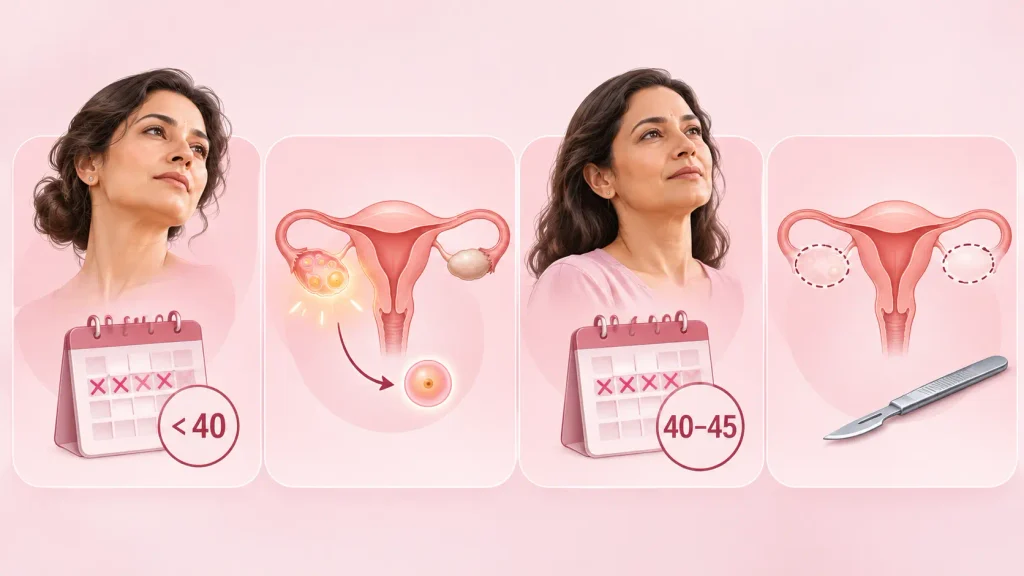
- Menopause before 40 is called premature menopause or premature ovarian insufficiency (POI). Menopause between 40 and 45 is called early menopause.
- Estrogen keeps bone breakdown under control. When it falls years ahead of schedule, bone loss also starts years ahead of schedule.
- Young women with POI have measurably lower bone mineral density than women of the same age with regular cycles, and a late diagnosis widens that gap.
- For most women, hormone therapy until around age 51 is the main protection for bones, unless a doctor finds a medical reason to avoid it.
- A DEXA scan shows exactly where your bone health stands, while calcium, vitamin D, strength exercise and a fall safe home complete the plan.
Premature Menopause, Early Menopause or POI: Which One Applies to You?
Doctors use three terms that sound alike but mean different things. Knowing which one fits you shapes how closely your doctor will watch your bone mineral density.
- Premature menopause: periods stop permanently before the age of 40.
- Premature ovarian insufficiency (POI): the medical name doctors now prefer, because the ovaries can occasionally wake up and release an egg. Around 5 to 10 percent of women with POI still conceive naturally at some point.
- Early menopause: periods stop between 40 and 45.
- Surgical menopause: both ovaries are removed during an operation, so estrogen drops overnight instead of over several years.
This is not as rare in India as many people assume. A 2024 analysis of National Family Health Survey data (2019 to 2021) estimated that about 2.2 percent of Indian women had premature menopause and about 16.2 percent had early menopause. Many women in Gujarat live with low estrogen far longer than their bones were built for, which makes early bone loss a real concern here, not a rare one.
What usually causes it? In most women, no single cause is found. When there is one, it is often one of these:
- A family pattern, where a mother or sister also stopped menstruating early
- Genetic conditions such as Turner syndrome or a Fragile X premutation
- Autoimmune problems, especially thyroid disease
- Chemotherapy or radiation to the pelvis
- Surgery that removes both ovaries
- Smoking and very low body weight
If your periods have become irregular before 40, the menopause age guide on our blog explains the typical age range and early symptoms in Hindi.
Why Premature Menopause and Bone Density Are So Closely Linked
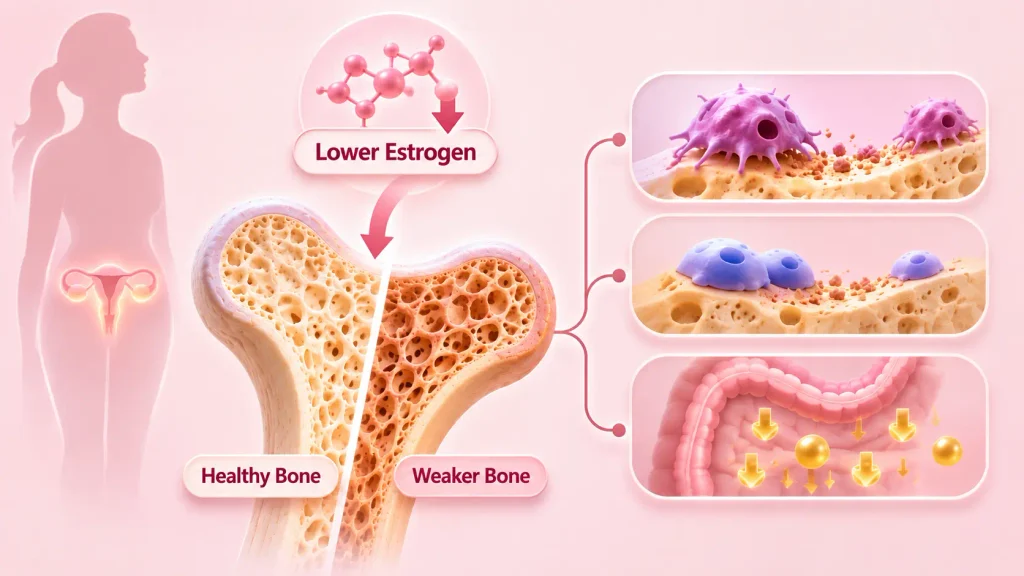
Bone feels solid, but it is living tissue that is rebuilt all the time. Two types of cells share the work. Osteoclasts break down old bone, and osteoblasts lay down new bone. In a healthy woman with regular periods, estrogen acts like a supervisor that keeps the breakdown crew from working too hard.
Think of your bones as a fixed deposit. You keep adding to it until about the age of 30, when peak bone mass is reached. After that, you slowly withdraw from it for the rest of your life. Estrogen controls how fast the withdrawals happen, and that one fact explains why an early menopause so often leads to weaker bones.
When estrogen falls early, four things happen inside the bone:
- Breakdown cells live longer and remove more bone than usual.
- Building cells cannot keep up with the faster breakdown.
- The gut absorbs less calcium from food, so less raw material reaches the bone.
- The spongy inner bone of the spine, wrist and hip thins first, which is why these are the common fracture sites.
Why the Number of Years Matters More Than Your Age
A woman who reaches menopause at 51 spends the rest of her life with low estrogen starting from 51. A woman whose periods stop at 37 starts that same process 14 years earlier. Bone loss is fastest in the first five to seven years after periods stop, often around 1 to 2 percent per year and higher in some women. Every extra year without estrogen adds to the total loss. A woman whose ovaries stopped very young may also never have reached her full peak bone mass in the first place.
Research on young women with ovarian insufficiency backs this up. A US NIH study of young women with POI found that their bone density at the spine and hip was 2 to 3 percent lower than women of the same age with regular cycles. The same study found that a delay in diagnosis was linked to lower bone density, because the right treatment started later. In simple words, the longer premature menopause goes unrecognised, the more bone it quietly takes.
Dr. Kaushal Patel, Founder and Scientific Director, iSHA Women’s Hospital and IVF Centre, Vapi: “Many women in their 30s ignore missed periods for a year or two. By the time they reach us, their bones have been without estrogen for that whole time. When a young woman’s periods stop for four months or more, I want to see her, not only for fertility, but because her bones are paying a silent price.”
Low Estrogen Without Menopause: Other Situations That Thin Bones
Menopause is not the only way estrogen can fall. Several other situations create a similar low estrogen state, and women dealing with them often have the same worries about estrogen deficiency and bone loss, even though their ovaries are still working.
- Periods missing because of low weight, heavy exercise or severe stress. The brain switches off the signal to the ovaries. This is a common cause of secondary amenorrhea in young women.
- GnRH medicines for endometriosis or fibroids. These injections deliberately lower estrogen for a few months. Doctors limit how long they are used, or add a small hormone dose to protect bone.
- Some long acting contraceptive injections. Bone density can drop during use and usually recovers after stopping.
The common thread is simple. Whenever a woman under 45 has gone months or years with low estrogen, her bones deserve a check.
Warning Signs That Early Menopause Bone Loss Is Catching Up With You
The difficult truth is that bone loss itself causes no pain. You cannot feel your bones getting thinner. The signs that do show up are of two kinds, and only one of them is about bone.
Signs that estrogen has dropped early:
- Periods becoming irregular, very light or stopping before 40
- Hot flushes and night sweats
- Vaginal dryness and pain during sex
- Poor sleep, mood swings and brain fog
- Difficulty getting pregnant
Signs that bone loss has already gone too far:
- A fracture from a minor fall, such as tripping at home or slipping on a wet floor
- Sudden back pain without any injury, which can be a small fracture in a spine bone
- Noticeable loss of height over a few years
- A rounded upper back that was not there before
Joint pain is common in menopause, but it is not a reliable sign of weak bones. Brittle nails and hair fall are not reliable signs either. The only way to know where you stand with premature menopause and bone density is to measure it.
What an Orthopaedic Surgeon Sees When Bone Loss Goes Unnoticed
Gynaecologists see the hormone side of this problem. Orthopaedic surgeons see what happens when nobody acts on it. Dr. Prince Uchadiya, DNB Orthopaedics Gold Medalist and founder of Dr. Prince Uchadiya Orthopaedic And Joint Care Clinic in Nipania, Indore, treats many of these fractures, so he sees the effect of early estrogen loss from the fracture side.
Dr. Prince Uchadiya, Orthopaedic and Arthroscopic Surgeon, Indore: “The story I hear in my clinic is often the same. A woman in her 40s slips in the bathroom, puts her hand out to stop the fall, and breaks her wrist. When I ask about her periods, she says they stopped at 38 or 39. Nobody connected the two. A wrist fracture from a simple fall at standing height is a warning sign, and I treat it as one. After we fix the fracture, I send her for a DEXA scan and back to her gynaecologist.”
Dr. Prince explains that fractures linked to low bone density tend to follow a pattern over the years:
- Wrist fractures often come first, usually in the 40s and early 50s.
- Spine compression fractures come next, and many women mistake them for a back sprain.
- Hip fractures usually come later and are the most serious, because recovery is slow and independence can suffer.
His practical advice for women with known low bone density is about everyday movement more than the gym. Lift a bucket of water with a straight back and bent knees, not by bending forward from the waist. Avoid sudden twisting while carrying weight. Keep bathroom floors dry, use anti slip mats, and add a grab bar near an Indian style toilet. These small changes prevent the fall that turns thin bone into a broken bone.
Testing for Early Menopause and Weak Bones: What Happens at Your Visit
The good news is that low estrogen and bone thinning are both easy to check. A visit at iSHA Care usually follows these steps:
- A detailed history: when your periods changed, family history of early menopause or fractures, past surgeries, cancer treatment, weight changes and smoking.
- Hormone blood tests: FSH is checked twice, four to six weeks apart, along with estradiol, AMH, thyroid and prolactin. Very young women may also be offered chromosome or Fragile X testing.
- Bone related blood tests: vitamin D, calcium and sometimes other markers that affect bone.
- A DEXA scan: a painless, low dose X ray of the spine and hip that takes about 10 to 15 minutes. It measures bone mineral density directly.
If your AMH is low or your periods have slowed before 40, you may also find our page on low AMH in Vapi helpful, since low egg reserve and early menopause are closely related.
Reading Your DEXA Report: T Score or Z Score?
This is where many young women get confused. A DEXA report shows two numbers.
- T score compares your bones with a healthy 30 year old. A score of minus 1 or above is normal. Between minus 1 and minus 2.5 is osteopenia. Minus 2.5 or lower is osteoporosis.
- Z score compares your bones with women of your own age. For women before the usual age of menopause, doctors give more weight to this number. A Z score of minus 2 or lower means bone density is below the expected range for your age.
A 35 year old with POI should ask her doctor which number applies to her. Reading only the T score can make the result look better or worse than it really is.
How Hormone Therapy Protects Bones After Premature Menopause
When doctors plan treatment after premature ovarian insufficiency, hormone therapy is usually the first choice for bone protection. The logic is simple: the therapy replaces the estrogen that the ovaries would normally have made until the early 50s. It is not an extra dose. It is giving back what is missing.
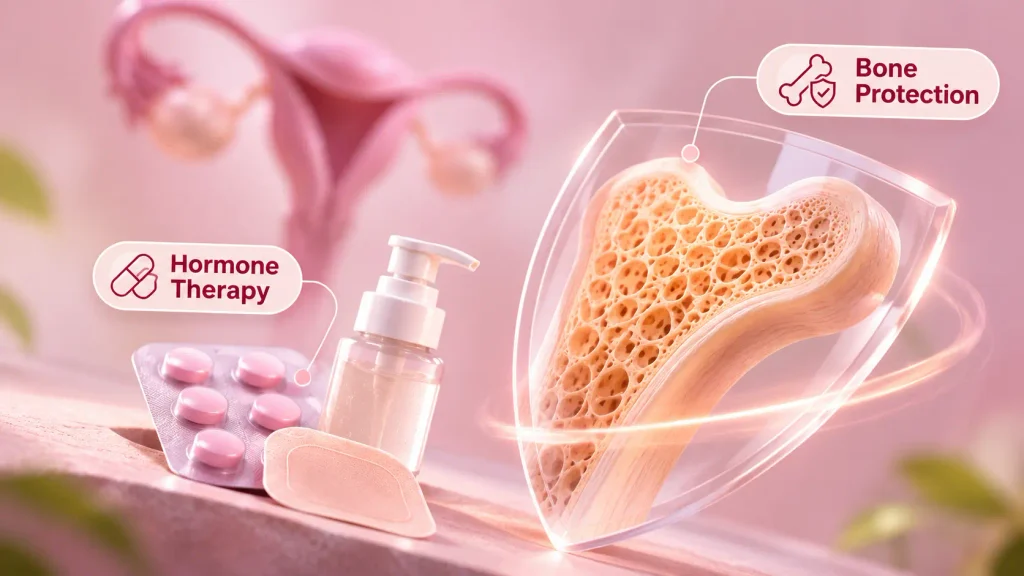
According to NHS early menopause guidance, the main options are hormone replacement therapy (HRT) or the combined contraceptive pill, along with regular exercise and calcium rich food. Most specialist guidelines advise continuing treatment until around 51, the average age of natural menopause.
- HRT: estrogen as tablets, skin patches or gel, with progesterone added if you still have a uterus.
- Combined pill: sometimes chosen by younger women who also need contraception.
- Bone specific medicines: considered when bone density is already low despite hormones, or when hormones are not suitable. Doctors are careful with some of these in young women planning pregnancy, because certain drugs stay in the bone for years.
Staying on treatment matters as much as starting it. A 23 year Australian study published in Human Reproduction (2024) followed women with POI and early menopause. Hormone therapy taken around ages 45 to 50 protected against osteoporosis and fractures, but simply having used it at some point in the past did not. The same study found that only about 39 percent of women who already had osteoporosis or fractures had ever received a bone medicine. Many women stop too early, and many are never treated at all.
Dr. Kaushal Patel: “The fear I hear most often is ‘HRT will give me cancer.’ For a woman whose ovaries stopped at 36, hormone therapy up to the natural age of menopause does not raise her breast cancer risk above that of other women her age. What it does is protect her bones, her heart and her quality of life. Some women do have reasons to avoid hormones, such as certain cancers or clotting problems, and we plan a different route for them.”
POI also affects fertility. Women facing chemotherapy or ovarian surgery can ask about fertility preservation before treatment begins. Women who already have POI and want a baby can discuss IVF options, including donor eggs, with the fertility team.
Everyday Habits That Protect Your Bones After Early Menopause
Hormones do the heavy lifting, but daily habits decide how well you protect your bones over the long run. Calcium and vitamin D alone cannot replace missing estrogen, yet bones cannot rebuild without them either.
1. Calcium From a Gujarati Kitchen
For women living with early menopause, Indian dietary guidance suggests about 1,000 to 1,200 mg of calcium a day for adult and postmenopausal women. Much of it can come from food you already eat:
- Milk, dahi, chaas and paneer
- Ragi (nachni) rotla or porridge
- Til (sesame) chikki and til in chutneys
- Rajgira, methi and other leafy greens
- Sprouts, chana and rajma
Take a calcium supplement only if your doctor finds that your diet falls short.
2. Vitamin D, Even in the Gujarat Sun
Living in a sunny state does not guarantee enough vitamin D. Indoor jobs, covered clothing, sunscreen and darker skin all reduce how much the skin makes. Low vitamin D is very common in India, so get your level tested and take supplements in the dose your doctor prescribes. Very high doses taken without testing can cause harm.
3. Exercise That Bones Respond To
- Weight bearing exercise: brisk walking, stair climbing and dancing, most days of the week.
- Strength training: resistance bands or light weights, two to three times a week.
- Balance work: simple yoga poses done near a wall, which cut the risk of falls.
Exercise is one of the few parts of bone care after early menopause that sits fully in your hands. If you already have osteoporosis, avoid deep forward bends, toe touches, sit ups and heavy twisting.
4. Habits That Quietly Drain Bone
- Smoking, which also brings menopause earlier
- Alcohol beyond small amounts
- Too little protein in daily meals
- Crash dieting and being underweight
Where to Get a Bone Health Check After Early Menopause in Vapi
Women from Vapi, Valsad, Daman, Silvassa, Umargam and Sarigam visit iSHA Care when their periods change too early. Dr. Kaushal Patel treats early menopause and bone health as one connected problem, checking hormones and bones in a single plan. When a fracture or advanced bone loss is found, he works with orthopaedic specialists to cover both sides of care.
You should book a menopause and bone health consultation if:
- Your periods have stopped or become very irregular before 40
- You had both ovaries removed or received chemotherapy or pelvic radiation
- Your mother or sister had menopause before 45
- You have broken a bone in a minor fall after your periods changed
Any woman who has questions about premature menopause and bone density can book an appointment online or visit iSHA Women’s Hospital and IVF Centre, 2nd Floor, Raj Complex, near DMart, Chanod, Vapi, Gujarat 396195. Phone: +91 94038 91590.
Early menopause is not something you chose, and bone loss is not something you have to accept. If you live in Vapi or nearby, a single visit can start a plan for premature menopause and bone density that protects you for decades. The earlier both are checked together, the more bone you keep.
Questions Women Ask About Early Menopause and Bone Health
1. My periods stopped at 38. Can I get osteoporosis in my 30s?
Yes, it can happen. Women with POI can develop osteopenia or even osteoporosis in their 30s, especially if diagnosis and treatment were delayed. That is why doctors who manage POI usually advise a DEXA scan soon after diagnosis rather than waiting until 65.
2. Are calcium and vitamin D enough, or do I really need HRT?
After early menopause, calcium and vitamin D alone are not enough for most women. They supply the building material, but without estrogen the bone breaks down faster than it can be rebuilt. Hormone therapy is usually the main protection, with calcium and vitamin D supporting it.
3. How long should I take HRT after premature menopause?
Most guidelines suggest continuing until around 51, the average age of natural menopause. After that, you and your doctor review whether to continue, based on symptoms, bone density and other health factors.
4. Does HRT increase breast cancer risk if my menopause came early?
For women with POI, taking hormones until the natural age of menopause does not raise breast cancer risk above that of women the same age whose ovaries still work. Women with a history of hormone sensitive cancer need a different plan, so always discuss your personal history with your doctor.
5. Can bone density come back after early menopause?
Bone loss can be slowed, stopped and sometimes partly reversed. Osteopenia can improve with hormone therapy, good nutrition and strength exercise. A diagnosis of osteopenia does not mean you will definitely develop osteoporosis. The earlier treatment begins, the more bone you keep.
6. When should I get my first DEXA scan?
Women diagnosed with POI or early menopause are usually advised to have a baseline DEXA scan at diagnosis. Follow up scans depend on the first result and whether you are on treatment. If you are unsure about the timing of your bone density test, ask your gynaecologist at your next visit.
7. I had a hysterectomy but my ovaries were kept. Am I at risk?
If your ovaries are still in place, they keep making hormones, so you do not enter menopause straight away. Some women do reach menopause a few years earlier after a hysterectomy. Without periods, the main signs to watch for are hot flushes and night sweats, and a blood test can confirm what is happening.
8. Is my joint pain a sign that my bones are weak?
Not usually. Joint pain is common during menopause and often comes from hormonal changes in joints and muscles. Weak bones do not hurt until a fracture happens, so a DEXA scan is the only reliable way to check.
9. Did years of taking birth control pills affect my bone density?
Combined birth control pills are not known to cause meaningful bone loss in adult women. In fact, they are sometimes used to replace estrogen in young women with POI. Long acting contraceptive injections are different, as they can lower bone density during use, though it usually recovers after stopping.
10. What exercises are safe if I already have osteoporosis?
Brisk walking, stair climbing, resistance band work and supported balance exercises are generally safe and helpful. Avoid deep forward bends, sit ups, toe touches and heavy twisting, as these put pressure on the spine. A physiotherapist can design a routine that suits your scan results.