
Most couples reach the topic of donor eggs after a long road. You may have already completed one or more IVF cycles with your own eggs. You may have simply heard the words “low ovarian reserve” today for the first time. Either way, the decision feels heavy, and you deserve clear answers before you make it.
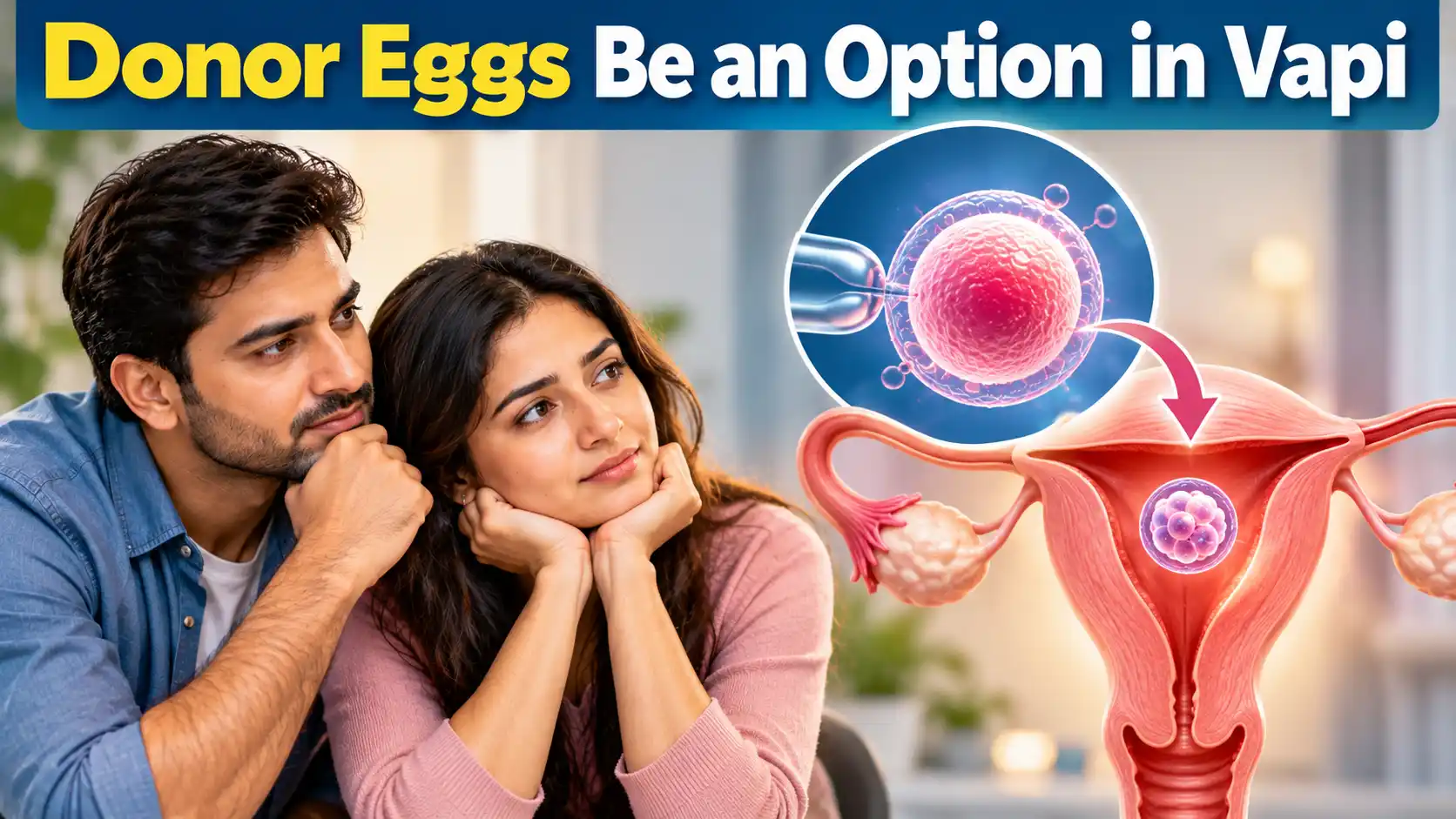
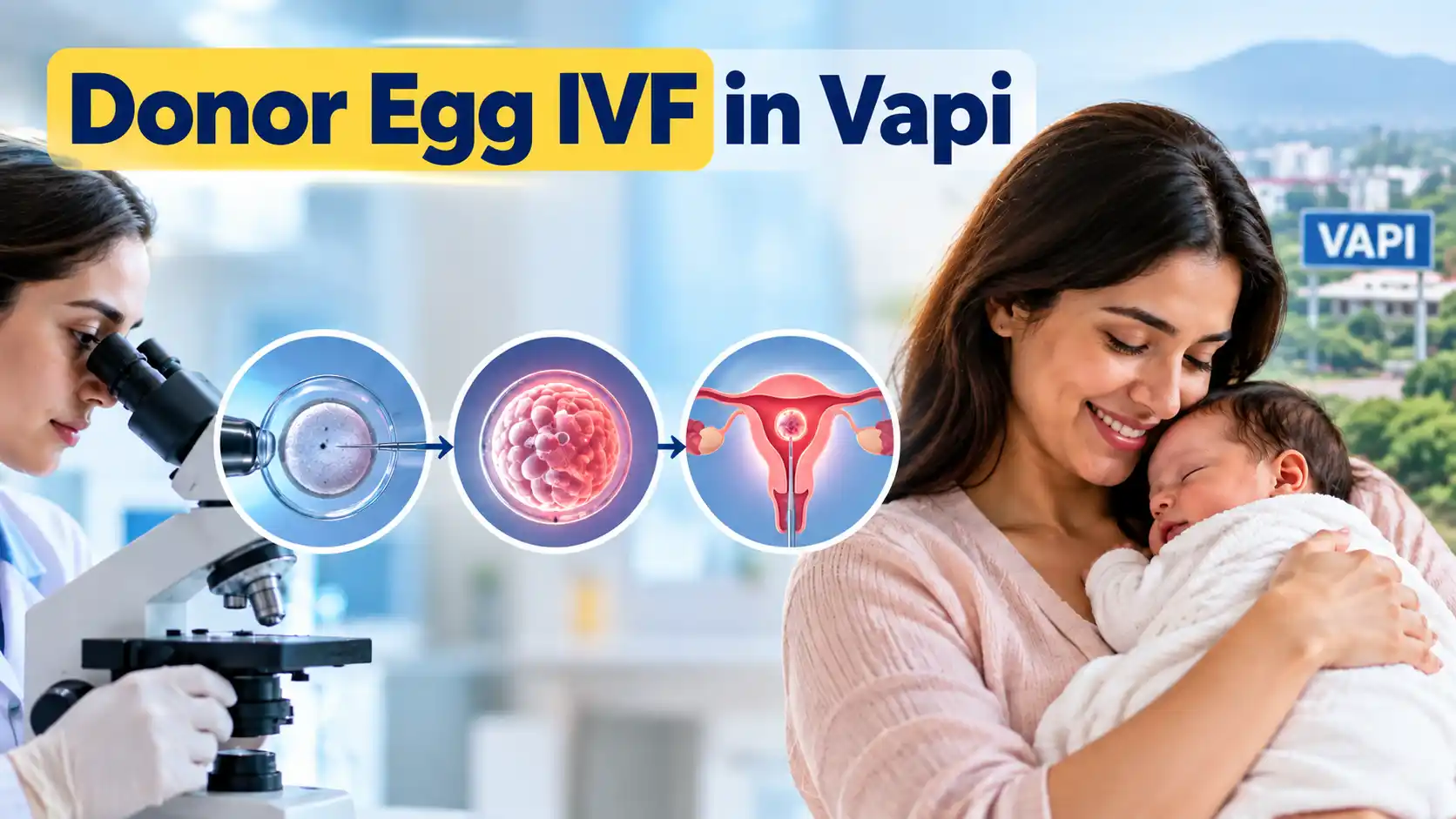
Donor egg IVF in Vapi has become a well-established treatment for women who cannot achieve a healthy pregnancy with their own eggs. The process uses eggs from a healthy, screened donor. Those eggs are fertilised with your partner’s sperm, and the resulting embryo is placed in your uterus. You carry the pregnancy. Your partner’s genes are part of the baby. In many cases, success rates are far higher than another attempt with your own eggs.
Key Takeaways
- Doctors consider donor eggs when egg quality, ovarian reserve, age, or repeated IVF failure lowers your chance of success with your own eggs.
- Premature ovarian insufficiency affects about 1 in 100 women under 40, and donor eggs are often the most effective route to pregnancy for these women.
- Birth rates with donor eggs stay broadly steady, near three in ten transfers, even as the patient’s age rises.
- Recent US data shows close to half of donor egg transfers lead to a live birth.
- With donor eggs, your result depends mostly on the donor’s age and your uterine health, not your own ovarian reserve.
- Donor egg IVF cost runs higher than a standard cycle because it adds donor screening, donor fees, and extra medications.
- Matching, counselling, and legal consent are core parts of a responsible donor programme, not add-ons.
- A personal assessment with your reports matters more than any statistic on this page.
When Do Doctors Recommend Donor Eggs Instead of Your Own?
Fertility specialists do not suggest donor eggs lightly. The recommendation usually follows clear evidence from your blood tests, scans, and IVF history. The four situations below cover most cases we see in clinic.
“Many women blame themselves for their egg quality, but in most cases it is biology, not lifestyle. My job is to show you your real numbers with your own eggs and your real numbers with donor eggs. Once you see both, the decision feels far less frightening.” Dr. Kaushal Patel
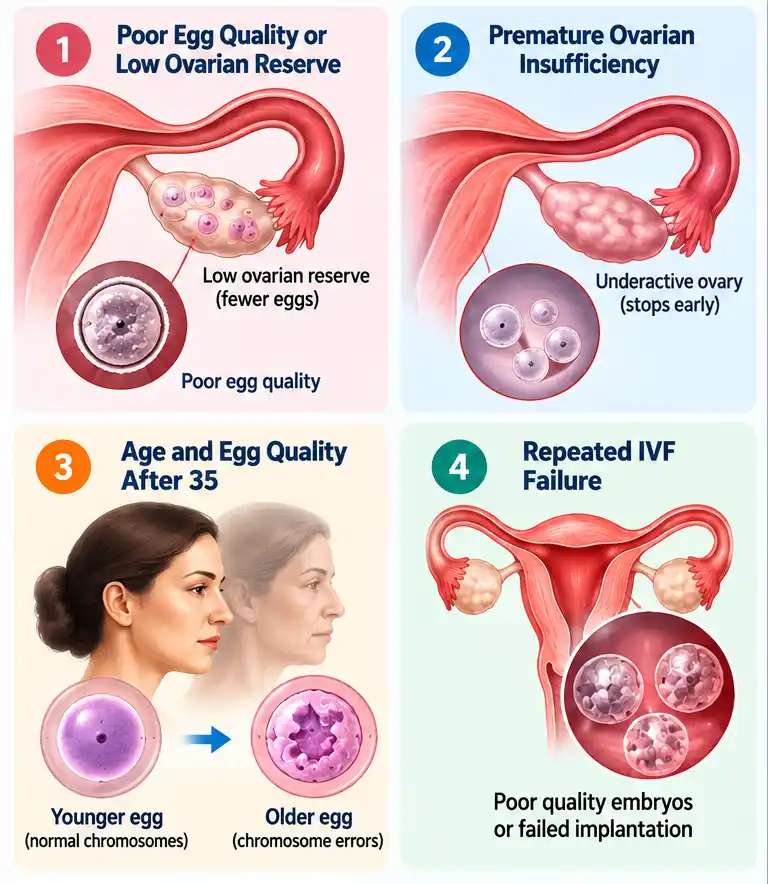
1. Poor Egg Quality or Low Ovarian Reserve
Ovarian reserve means the number of eggs left in your ovaries. Tests like AMH and antral follicle count give a good estimate. Low reserve usually means fewer eggs per cycle, and the eggs that remain may fertilise poorly or stop growing as embryos.
If you have already been told your AMH is low, our study on low AMH and low egg count explains what those numbers really mean. Poor egg quality is the single most common reason couples move to donor eggs.
2. Premature Ovarian Insufficiency
Premature ovarian insufficiency means the ovaries slow down or stop before age 40, bringing early menopause-like changes. It affects roughly 1 in 100 women under 40. Periods may become irregular or stop, and IVF with your own eggs often yields very few eggs.
Donor eggs change this picture completely. Your uterus usually works normally, so pregnancy chances with donor eggs can be excellent.
3. Age and Egg Quality After 35
Egg quality declines gently through the early thirties and drops faster after 37 or 38. The main reason is chromosome errors inside aging eggs. This raises the risk of failed implantation and miscarriage.
4. Repeated IVF Failure
Two or three failed IVF cycles deserve careful review, not just another attempt. When embryos have been poor quality, low cell counts, or heavy fragmentation, the eggs are the usual suspect. When good quality embryos have failed repeatedly, we first check the uterus, immune factors, and sperm before discussing eggs.
How Egg Donation IVF in Vapi Works, From Donor to Transfer
Donor eggs are one form of third-party ART in Vapi, alongside sperm donation and surrogacy. Egg donation IVF in Vapi follows a clear sequence, and knowing each step removes much of the fear.
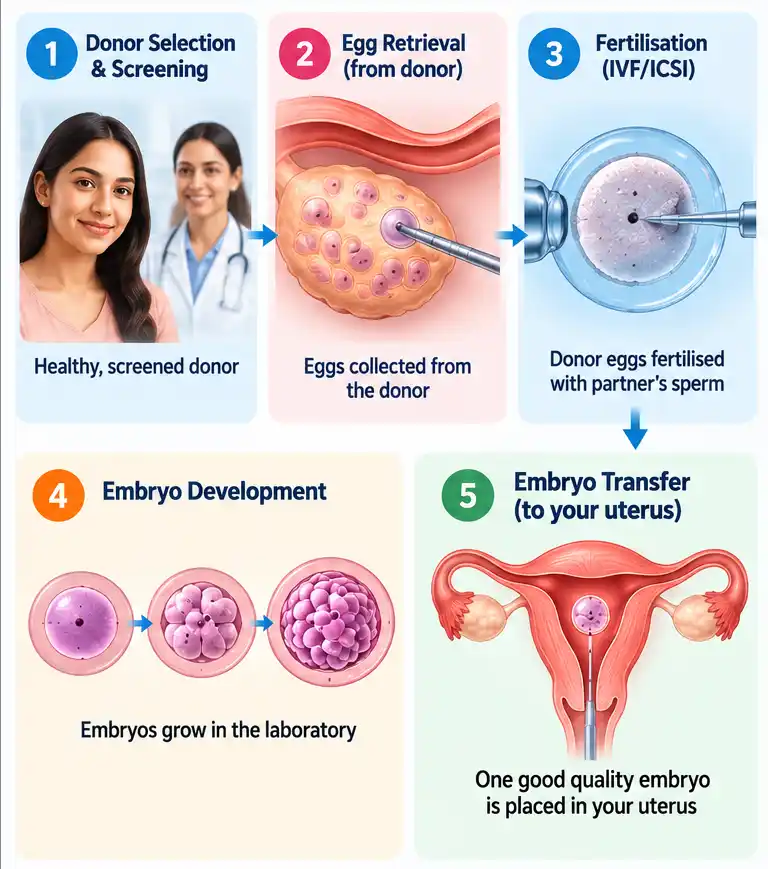
- Donor selection. A young, healthy donor is chosen through a registered ART bank, following the rules of India’s ART legislation.
- Screening. The donor completes medical, genetic, infectious disease, and psychological checks before approval.
- Matching. The clinic matches donor features to your preferences and confirms compatibility.
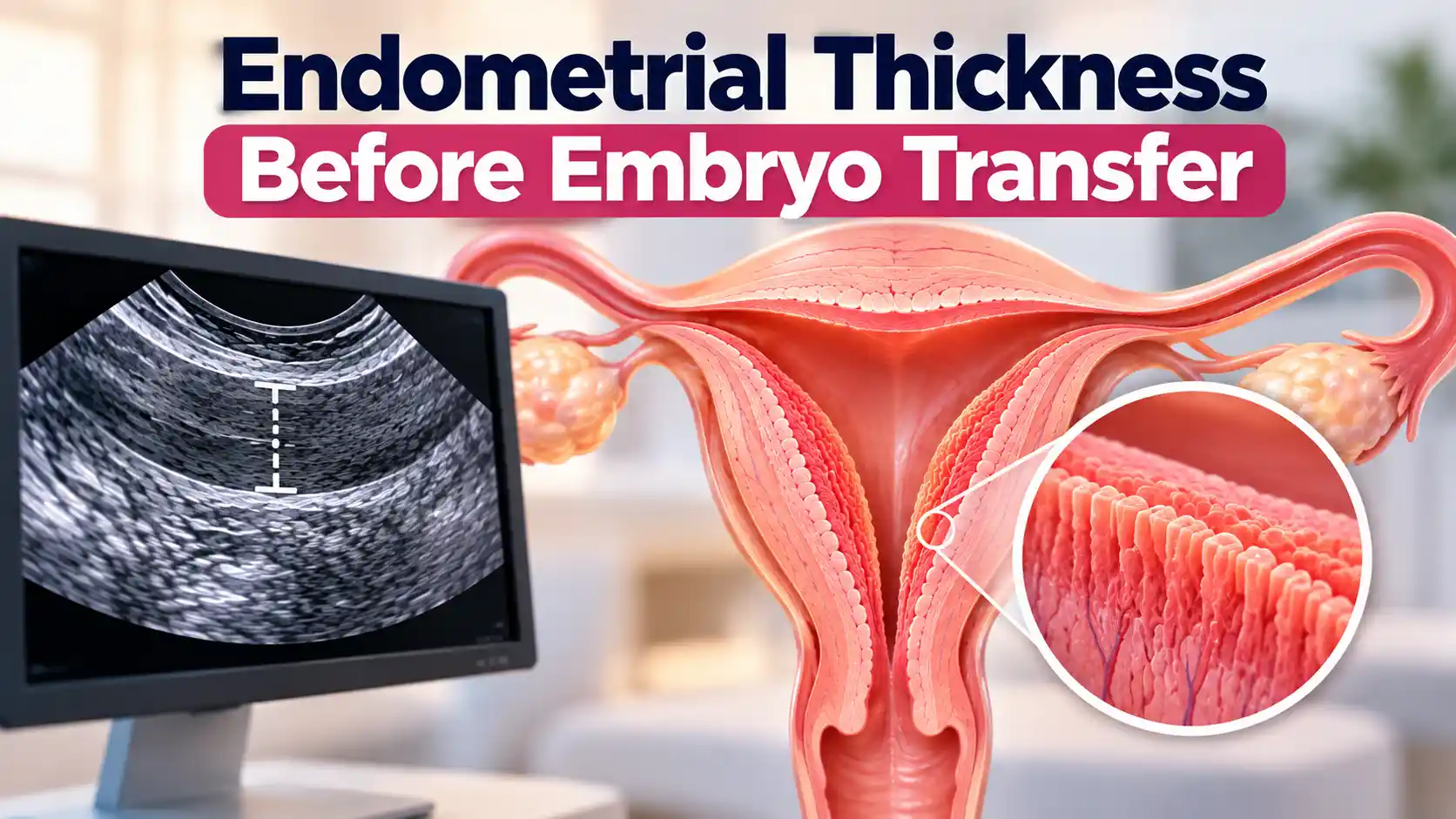
- Cycle preparation. Your uterus is prepared with medicines, usually tablets and injections, so the lining reaches the right thickness.
- Fertilisation. Donor eggs are fertilised with your partner’s sperm through IVF and ICSI treatment in the laboratory.
- Embryo transfer. One good quality embryo is placed into your uterus in a short, painless procedure.
- Pregnancy test. A blood test around two weeks later confirms the result.
How Egg Donors Are Screened
Donor screening is strict, and it should be. Under Indian law, egg donors are married women between 23 and 35 who have at least one living child of their own. Screening typically includes:
- Full medical history and physical examination
- Ovarian reserve tests such as AMH and ultrasound scans
- Blood tests for HIV, hepatitis B and C, and other infections
- Genetic carrier screening for common inherited conditions
- Psychological counselling and written consent
Oocyte donation, the formal medical term, only proceeds when every one of these checks is clear.
How Matching Works
Matching covers practical and personal factors. Clinics match blood group, complexion, build, and facial features to your preferences, since most Indian donors remain confidential. Some programmes share education or background details within legal limits. You never meet the donor, and her identity stays protected under Indian rules.
“Screening protects everyone involved. The donor gets a complete health check, and you get the reassurance that her eggs passed strict tests before a single embryo is created. That is the entire point of a registered programme.” Dr. Kaushal Patel
Will the Baby Be Genetically Related to You?
Honesty matters here. The baby’s DNA comes from two sources: the donor’s egg and your partner’s sperm. The baby will not carry your genetic material.
Your contribution is still real and biological in the lived sense. You provide the pregnancy environment for nine months. Research suggests the womb can influence some aspects of fetal development and gene activity, though the core DNA stays fixed. Legally and socially, you are the mother. Most parents tell us the genetic question fades quickly once they hold their baby.
Donor Egg IVF Cost in Vapi: What You Actually Pay For
Donor egg IVF cost is higher than a standard self-cycle, and the difference is easy to explain. You are paying for one more person’s medical care plus their egg retrieval. A transparent clinic will show every line item before you start. Typical components include:
- Donor registration and compensation through the ART bank
- Donor screening tests and counselling
- Donor stimulation injections and egg retrieval procedure
- Your own medicines to prepare the uterine lining
- Laboratory fees for fertilisation and embryo culture
- The embryo transfer procedure
- Optional extras such as embryo freezing or genetic testing of embryos
Success Rates: What the Evidence Says
Donor egg cycles succeed more often than self-egg cycles in older women, and the reason is simple. The embryo quality depends on the egg, and the egg belongs to a young donor.
UK registry data shows birth rates with donor eggs remain fairly steady across a patient’s thirties and forties, at around three in ten transfers. US data from the CDC shows close to half of donor egg transfers lead to a live birth. The difference between those numbers reflects how clinics select and report cases, not a contradiction.
Your personal odds depend on four things: donor age, your uterine health, sperm quality, and the clinic’s laboratory standards. Miscarriage risk is also lower than in same-age self-egg pregnancies, because chromosome errors come mostly from the egg. No honest doctor will promise success, and any centre quoting 100% rates should raise a red flag.
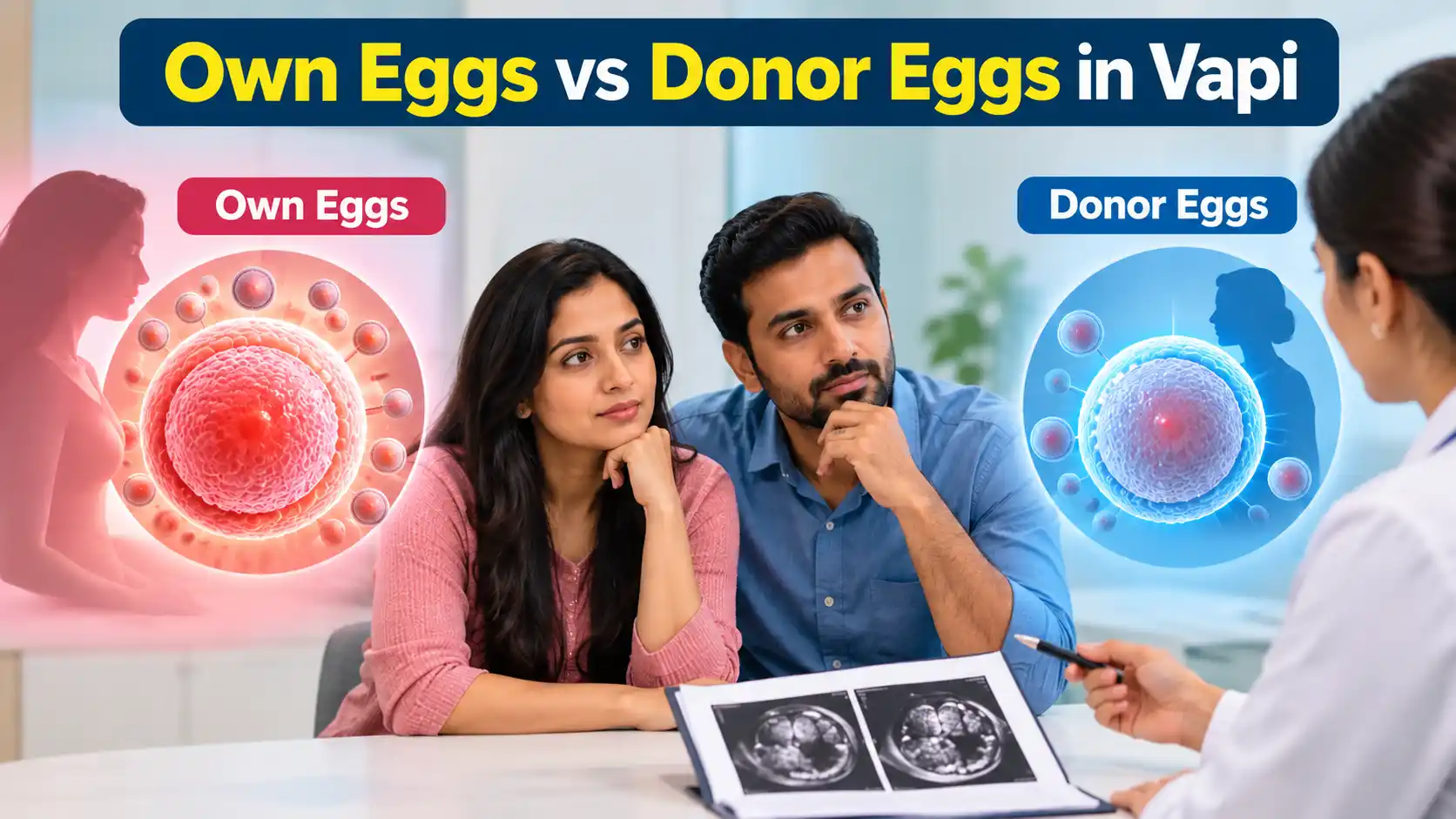
Donor Eggs vs Your Own Eggs: A Side-by-Side View
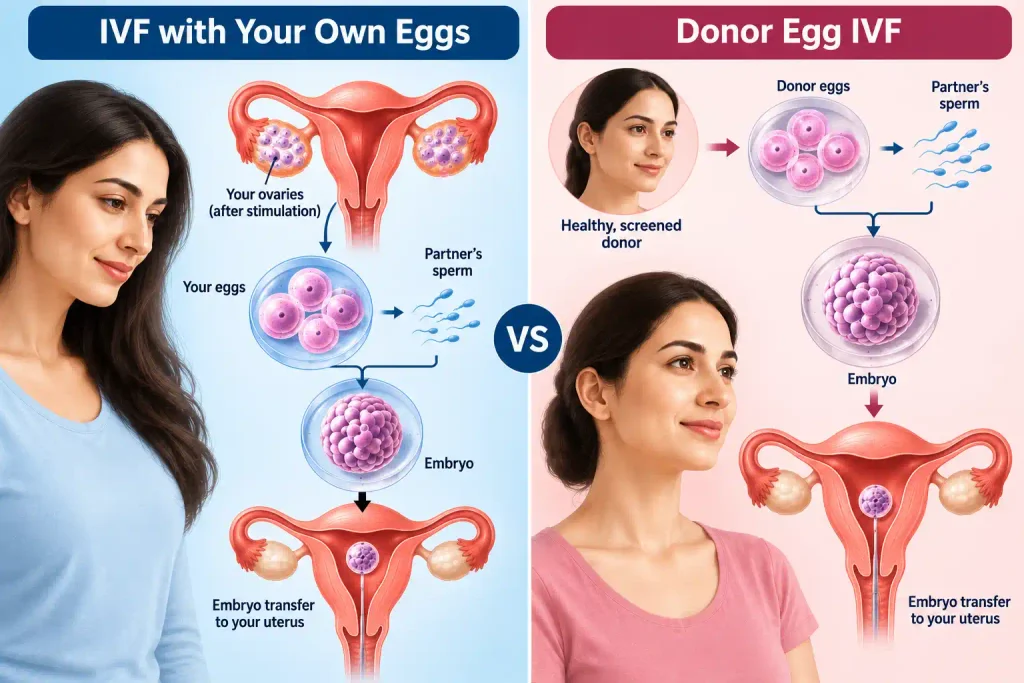
| Factor | IVF with your own eggs | Donor egg IVF |
|---|---|---|
| Egg source | Your ovaries, after stimulation | Screened young donor |
| Success pattern | Falls sharply with age | Stays fairly stable across recipient ages |
| Main result drivers | Your reserve, age, egg quality | Donor age, uterus, sperm, lab quality |
| Injections for you | Full stimulation course | Usually only lining preparation |
| Baby’s genetics | Yours and your partner’s | Donor’s and your partner’s |
| Cost per cycle | Lower | Higher, due to donor fees and screening |
| Best suited for | Good reserve and quality | Low reserve, poor quality, POI, repeated failure |
The table shows why the two options are not competitors. They answer different medical situations, and the right choice depends on your reports.
Still Unsure? Steps That Help Before You Decide
Feeling torn is normal, and it does not mean the decision is wrong. It means the decision deserves more input. A few steps help most couples gain clarity:
- Request a second review of your reports and IVF records.
- Attend counselling together, since this decision belongs to both partners.
- Ask for your realistic probability with your own eggs, not a generic chart.
- Give yourselves a fixed timeline, so the decision does not drift for years.
If you are in your early thirties with declining reserve but not ready for donor eggs, fertility preservation may buy time by storing your own eggs now. Ask whether that suits your case.
“No good clinic will rush you into donor eggs. If you feel pushed, pause and take a second opinion. A centre that explains both options honestly is the one you can trust with this decision.” Dr. Kaushal Patel
About the Author
Dr. Kaushal Patel is an IVF specialist in Vapi practising at Isha Women’s Hospital. He manages complex infertility cases, including low ovarian reserve, repeated IVF failure, and third-party reproduction. He is also a published author in a reputed international fertility journal.
Final Thoughts
Choosing donor eggs means accepting a real loss, the genetic link, before claiming a real gain, a much higher chance of carrying your baby. Both feelings deserve space, and neither cancels the other out. Parents who take this path tell us the bond with their child was never about DNA.
Start with facts, not fear. Bring your reports, ask your questions, and weigh both options with a specialist who shows you honest numbers. If you want to explore donor egg IVF in Vapi, discuss whether donor-egg IVF may be an appropriate option with the fertility team in Vapi.
Frequently Asked Questions
1. When might donor egg IVF in Vapi be recommended instead of IVF with my own eggs?
Doctors recommend it when your own eggs are the limiting factor: poor quality, very low reserve, premature ovarian insufficiency, or advanced age. A history of failed cycles with poor-quality embryos is another strong signal. Your specialist confirms this with AMH, scans, and embryo records.
2. Can donor egg IVF help if I have poor egg quality or low ovarian reserve?
Yes, and this is the classic indication. The egg is the main driver of embryo quality, so replacing it often removes the bottleneck. Your uterus usually functions normally, which keeps pregnancy chances strong.
3. Is donor egg IVF an option for women with premature ovarian insufficiency?
Yes. Premature ovarian insufficiency means the ovaries stopped early, so IVF with your own eggs rarely produces usable embryos. Donor eggs bypass the problem entirely and offer some of the best success rates in this group.
4. At what age do doctors commonly consider donor egg IVF?
There is no fixed cutoff, but egg quality falls faster after 37 or 38. Many specialists discuss donor eggs after 40 to 42, or earlier if reserve tests are very poor. Age matters for your eggs, far less for donor eggs.
5. Should I consider donor eggs after repeated IVF failures?
Review the embryo records first. Poor-quality embryos across cycles point towards egg-related causes, making donor eggs a reasonable next step. If good-quality embryos failed repeatedly, your specialist should check the uterus, immune factors, and sperm before switching direction.
6. How does egg donation IVF in Vapi work from donor selection to embryo transfer?
The clinic selects and screens a donor through a registered ART bank, then matches her to your preferences. Donor eggs are fertilised with your partner’s sperm, and embryos are cultured in the lab. Your uterus is prepared with medicines, one embryo is transferred, and a blood test after two weeks confirms pregnancy.
7. How are egg donors screened before they can donate eggs?
Screening covers medical history, physical examination, ovarian reserve tests, infectious disease markers, genetic carrier tests, and psychological counselling. Indian law requires donors to be married women aged 23 to 35 with at least one living child. Every test must be clear before donation proceeds.
8. How is the donor matched with the intended mother in donor egg IVF?
Matching considers blood group, complexion, build, and facial features based on your preferences. Donor identity stays confidential under Indian regulations, and you do not meet her. Some programmes share limited background details within legal limits.
9. Will the baby be genetically related to the egg donor or the intended parents?
The baby inherits DNA from the donor and the father, not from you. You are the birth mother and legal mother, and your body supports the pregnancy for nine months. Most parents find the genetic question fades once the baby arrives.
10. What does donor egg IVF cost in Vapi, and what is usually included in the treatment package?
Packages typically include donor fees, donor screening, the retrieval procedure, lab fertilisation, lining preparation, and embryo transfer. Medicines, embryo freezing, and genetic testing often sit outside the base package. Ask for an itemised written estimate so nothing surprises you later.
11. Are donor egg IVF costs higher than IVF using my own eggs?
Yes, modestly higher. The extra amount covers donor compensation, her screening, and her stimulation cycle, while the lab and transfer stages cost the same. The trade is additional cost for a substantially higher chance per cycle in most indicated cases.
12. How many eggs or embryos can I expect from donor egg treatment?
Young donors typically produce 10 or more eggs per retrieval. After fertilisation and culture, that usually gives several embryos to work with. Frozen donor egg cycles may come with a fixed number of oocytes, so confirm the count in advance.
13. What are the chances of pregnancy with donor egg IVF compared with using my own eggs?
At the same age, donor eggs give higher pregnancy rates and lower miscarriage rates, especially after 38. Registry data shows results stay fairly steady across recipient ages because embryo quality depends on the donor. Your uterine health and sperm quality then decide your personal outcome.
14. What should I ask an IVF specialist in Vapi before choosing donor egg treatment?
Ask about the donor’s screening proof, fresh versus frozen eggs, expected embryo numbers, blastocyst culture, and genetic testing options. Request the full cost breakup and the clinic’s plan if the first transfer fails. Also ask whether counselling is offered before consent.
15. What should I do if I am unsure whether donor egg IVF is the right option for me?
Take your reports for a second opinion and attend counselling with your partner. Ask for your individual probability with your own eggs versus donor eggs, in writing. A fixed decision timeline usually helps couples move forward without pressure.