
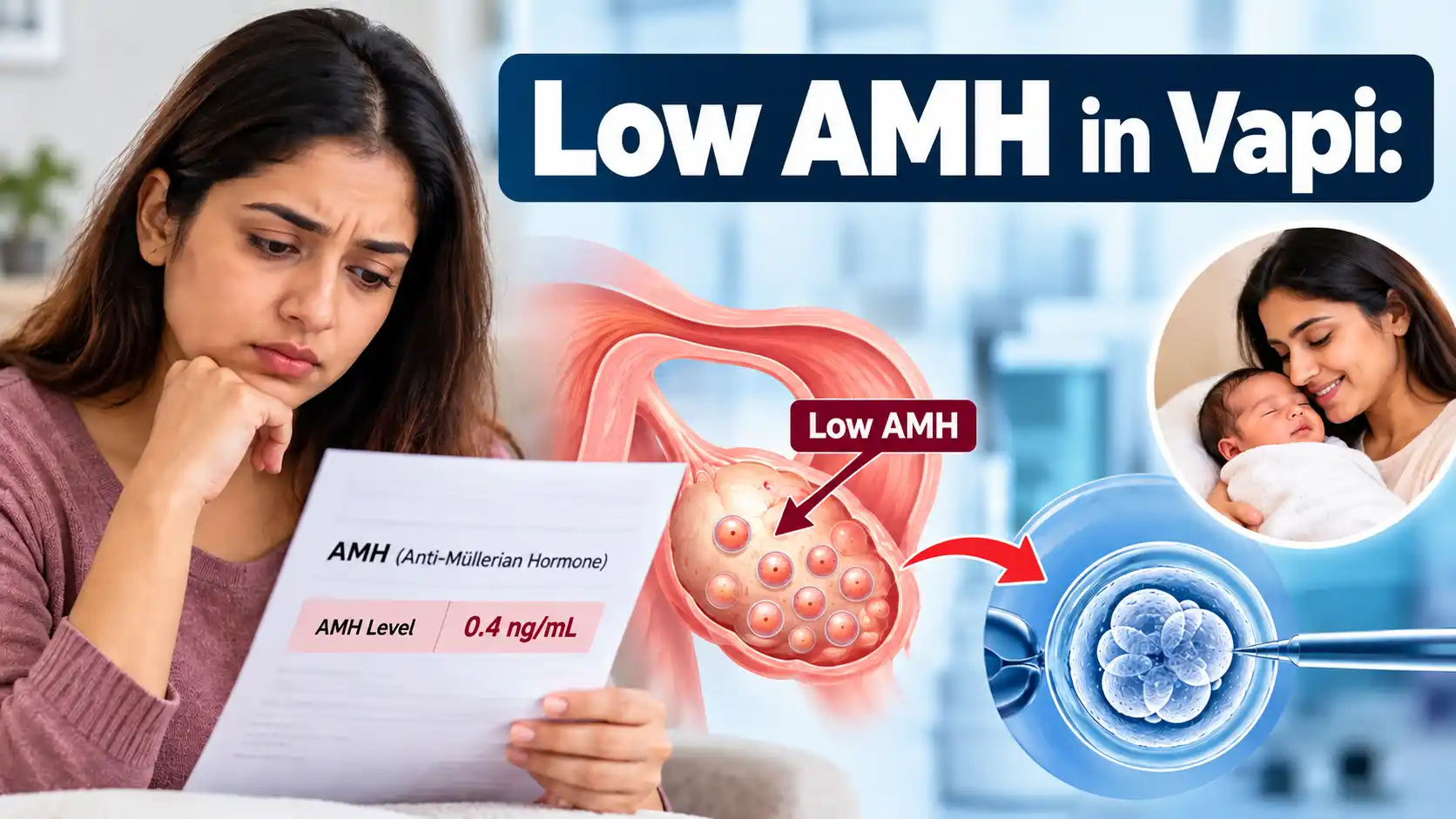
One blood report can turn a quiet evening into a sleepless one. Many women search for answers about low AMH in Vapi within minutes of holding their lab result, still sitting in the parking lot of the collection centre. If that sounds familiar, take a slow breath. A low number deserves attention, never despair.
AMH stands for anti-Mullerian hormone. It estimates how many resting eggs your ovaries hold, a measure doctors call ovarian reserve. What it does not measure is your worth as a woman or your real chance of holding a baby one day.
The next few minutes of reading will clear up what your AMH level means for IVF, which tests matter, which treatments genuinely help, and when to act. The claims below come from published clinical evidence and from years of conversations with patients who once sat exactly where you sit now.
Key Takeaways
- AMH below 1.0 ng/mL usually suggests a declining egg supply, and levels under 0.5 ng/mL are considered very low.
- AMH predicts how ovaries may respond to IVF stimulation. It does not predict egg quality, natural pregnancy, or the exact time to menopause.
- Women are born with about 1 to 2 million eggs. Roughly 25,000 remain by age 40, which is why age shapes fertility so strongly.
- IVF live birth rates near 32% for women under 35, falling to about 5% by ages 43 to 44.
- In women with AMH under 0.5 ng/mL, those under 35 still reached a clinical pregnancy rate of about 31% per egg collection, while rates at ages 40 to 43 were near 10%. Low AMH alone was not a reason to refuse IVF.
- Doctors read AFC and AMH together before choosing a stimulation plan, because one number never tells the full story.
- Early consultation protects your options. Waiting rarely improves low AMH, but a well-timed, well-planned cycle improves your experience and your odds.
What Is AMH and What Does It Actually Measure?
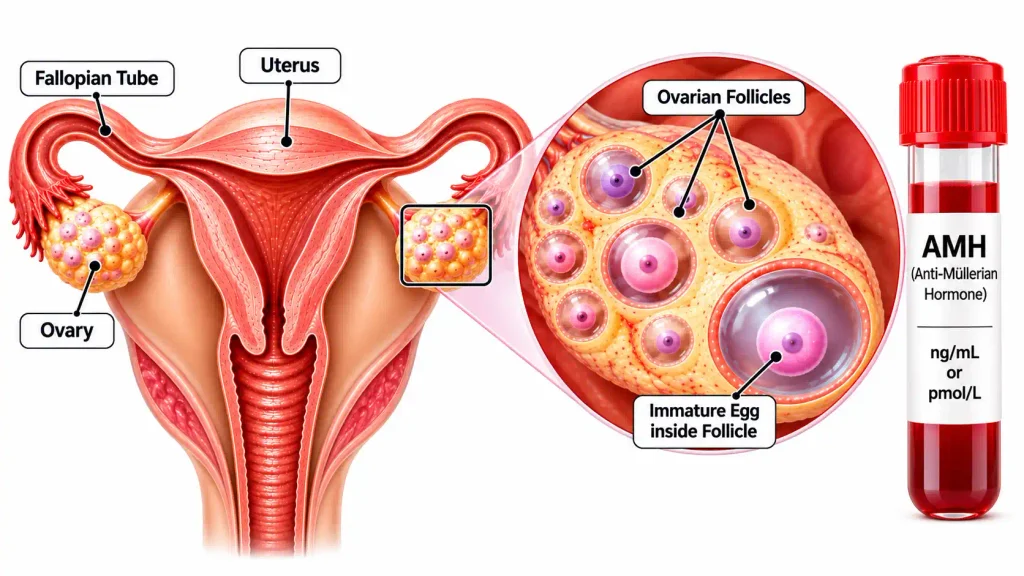
AMH is a hormone released by small growing follicles in your ovaries. Each follicle is a tiny fluid pocket that holds one immature egg. Higher AMH usually means more follicles are waiting in reserve, so the blood test works as a rough census of your remaining supply.
The test needs only a simple blood draw and can be done on any day of your cycle. Results arrive in ng/mL in most Indian labs, though some report pmol/L. Both units describe the same thing, so ask your clinic which scale your report uses.
What AMH Cannot Tell You
An AMH value is useful, but it has firm limits. Keeping these limits in mind prevents most of the panic patients bring into my OPD.
- It cannot tell you whether an egg is healthy or chromosomally normal.
- It cannot predict whether you will conceive naturally this year.
- It cannot fix an exact date for your menopause.
- It cannot guarantee how your ovaries will behave in a given cycle.
AMH tells us how many eggs are likely waiting, not how good they are or whether you can conceive. I have seen women with an AMH of 0.6 hold their babies, and women with normal levels struggle for entirely different reasons. The number deserves respect, never panic. Dr. Kaushal Patel
As a working rule, most labs read the ranges below this way. Your own report always needs an expert eye, because machines and methods differ between labs.
| AMH level (ng/mL) | Roughly in pmol/L | What it usually suggests |
|---|---|---|
| Above 3.0 | Above 21 | Normal or high, often seen with PCOS |
| 1.0 to 3.0 | 7 to 21 | Typical range for fertile age groups |
| 0.5 to 1.0 | 3.6 to 7 | Low, egg retrieval numbers may be reduced |
| Below 0.5 | Below 3.6 | Very low, expect fewer eggs and careful planning |
Reading a low AMH in Vapi reports becomes far less frightening once you see the value as one clue among several, not a final verdict on your fertility.
Low AMH vs Diminished Ovarian Reserve: Are They the Same?
These two terms get mixed up constantly, so a clean distinction helps. Low AMH is one laboratory finding. Diminished ovarian reserve is the broader clinical conclusion a doctor reaches after weighing AMH, your antral follicle count, cycle history, and age together.
A diagnosis of diminished ovarian reserve simply means the ovaries hold fewer remaining eggs than expected for your age. Common causes include natural ageing, genetic factors, endometriosis, previous ovarian surgery, chemotherapy or radiation, and smoking.
Sometimes no clear cause is found, which frustrates patients but is genuinely common. Reserve and outcome are not the same thing either, if your reports mention low AMH and low egg count together.
Does Low AMH Mean Poor Egg Quality?
No, and this is the single most reassuring fact most patients have never been told clearly. AMH measures quantity. Egg quality is mainly driven by age, because the eggs sitting in your ovaries have been waiting since before you were born, and their internal machinery ages with you.
So a 30-year-old with an AMH of 0.8 often produces embryos of perfectly good quality, just fewer of them. A 41-year-old with an AMH of 1.8 may retrieve more eggs yet see more abnormal embryos. Quantity and quality move on separate tracks.
The practical takeaway is simple. Never judge your eggs by your AMH value alone. Age, embryo development in the lab, and pregnancy history tell the quality story far better.
Age vs AMH: Which One Matters More for IVF?
When women compare the two, age almost always wins for predicting pregnancy, while AMH wins for predicting response. Both matter, but they answer different questions. AMH estimates how many eggs a stimulation cycle might yield. Age largely decides how well those eggs will work.
NHS figures make the age effect plain. IVF live birth rates sit near 32% per embryo transferred for women under 35 and fall to roughly 5% by ages 43 to 44. No AMH value overrides that pattern, in either direction.
Age shapes egg quality far more than AMH does. A 31-year-old with low AMH often has a smoother path than a 39-year-old with a normal count. When I plan IVF, I always read the two numbers together, never in isolation. Dr. Kaushal Patel
This is also why clinics resist giving one success percentage for low AMH in Vapi or anywhere else. The honest answer depends on your age band, your follicle count, your uterus, and your partner’s sperm parameters.
IVF With Low AMH: What Are Your Real Chances?
Let me separate two questions patients constantly merge. First, how will your ovaries respond to stimulation? Second, what is the chance of a baby? Low AMH mainly affects the first answer, and only indirectly touches the second.
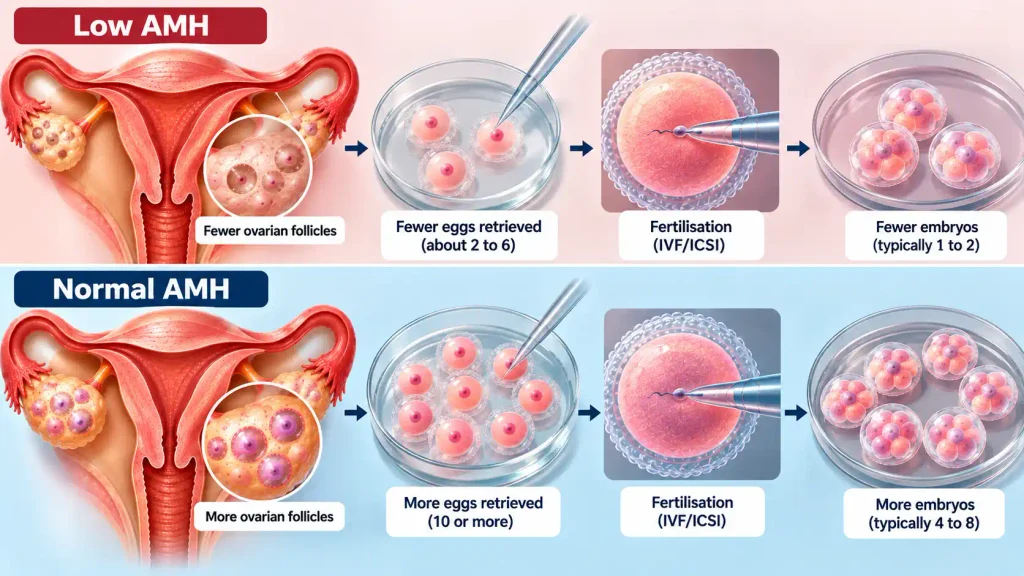
Here is what low reserve genuinely changes in an IVF treatment cycle:
- Fewer eggs retrieved, often 2 to 6 instead of 10 or more.
- A higher chance of cycle cancellation if only one or two follicles grow.
- Greater sensitivity to stimulation dose, so protocols need personalisation.
- More value from laboratory skill, since every embryo counts more.
- A stronger case for freezing embryos across more than one cycle.
Chance of pregnancy is a different chapter. A study in the Journal of Assisted Reproduction and Genetics followed women with AMH under 0.5 ng/mL, a severely low group. Women under 35 still achieved clinical pregnancies in about 31% of egg collections, compared with 23% at ages 35 to 39 and 10% at ages 40 to 43. The authors concluded that low AMH alone should never be a reason to refuse IVF.
1. How Many Eggs Will You Retrieve?
There is no fixed number, but a fair expectation is one mature egg for every two to three antral follicles seen on scan. Some cycles yield fewer eggs than the scan predicted, and some surprise us pleasantly. What matters most is not the count on collection day but how many good embryos those eggs become.
2. Can You Still Make Good-Quality Embryos?
Yes, particularly in your twenties and early thirties. Embryo quality depends far more on the egg’s age than on how many of its sisters were retrieved alongside it. Many women with low reserve produce just one or two strong embryos per cycle, and those embryos can absolutely lead to a healthy pregnancy.
AFC and AMH: Why Doctors Use Both
AFC means antral follicle count, the number of small resting follicles your doctor counts on a day 2 to 4 ultrasound. AMH is a blood census of the same population, gathered chemically. The two tests agree often, but not always.
When AFC and AMH tell the same story, planning is straightforward. When they disagree, doctors look deeper, because scan quality, cycle timing, and lab methods all introduce noise. Using both gives your IVF plan a far more reliable foundation than either test alone, which is why the AMH level for IVF decisions is always read beside the scan.
Tests to Do Along With an AMH Test Before IVF
The AMH test and IVF planning go hand in hand, but AMH never travels alone in a proper workup. A complete fertility evaluation answers questions AMH cannot, on both the female and male side. Expect most of the following:
- AFC by transvaginal ultrasound, ideally between days 2 and 4 of the cycle.
- Day 2 or 3 FSH, LH, and estradiol to see how the brain is signalling the ovaries.
- TSH and prolactin, since thyroid and prolactin problems quietly disturb cycles.
- Blood sugar testing where PCOS, weight, or family history raises concern.
- Semen analysis for the partner, because male factor explains a large share of delays.
- Infection and genetic screening as advised before embryo transfer.
Couples often tell me the semen analysis was never mentioned at their first clinic, yet it is basic. Roughly half of all fertility journeys involve a male factor, so both partners deserve testing. If you want the full sequence laid out, our step-by-step IVF process study shows what happens week by week.
Low AMH Treatment Options in Vapi
Treatment for low AMH does not raise the egg count. The honest goal is different: get the best possible embryos from the eggs you have, in the least stressful and most efficient way. Any clinic promising to refill your ovaries should be heard with caution.
Approaches that fertility specialists actually use include:
- Individualised stimulation doses, tuned to your AMH, AFC, weight, and past response.
- Mild or natural cycle IVF, which retrieves the one or two eggs your body selects on its own.
- Double stimulation or cycle pooling, collecting eggs in two phases of one cycle when appropriate.
- ICSI, where a single sperm is placed into each egg, maximising the value of every retrieved egg.
- Embryo banking, freezing embryos over two or three cycles to build a small pool before transfer.
- Egg donation, discussed openly as a well-proven option when the ovarian reserve is extremely low or quality is the barrier.
Supplements deserve a straight answer. DHEA, CoQ10, and vitamin D are widely discussed, and evidence for meaningful improvement remains weak. None of them restores lost eggs. Avoiding smoking, keeping weight in a healthy range, and managing thyroid or sugar problems are the lifestyle steps with real support behind them.
Low AMH rewards action more than waiting. We usually have weeks, not months, to fine-tune your health and design the cycle properly. A focused plan started early almost always beats a rushed plan started late. Dr. Kaushal Patel
Families searching for low AMH IVF Vapi services usually want exactly that kind of honest, unhurried planning rather than a sales pitch, and that is the right instinct to carry into any consultation.
Should You Start IVF Immediately If AMH Is Low?
Urgency, yes. Panic, no. Low AMH tends to decline slowly over months and years, not days, so a sensible gap of a few weeks to complete your workup, optimise health, and choose a protocol costs you nothing meaningful.
The urgency becomes real with age. At 32, a three-month breathing space is usually harmless. At 38 or 40, the same delay carries a measurable cost, because egg quality shifts faster in the late thirties. So the right speed depends far more on your birth certificate than on your hormone report.
Getting an Ovarian Reserve Test in Vapi
Local testing makes practical sense for families in South Gujarat. An ovarian reserve test in Vapi can be arranged quickly, often with reports the same week, and follow-up scans for AFC happen without long travel to Surat or Mumbai. Continuity matters, because low reserve management rewards a team that watches your response across cycles.
When couples with low ovarian reserve in Vapi visit our OPD, the first consultation covers three things: what the report means for their specific age, which tests remain incomplete, and which treatment path fits their timeline and budget. Family support matters too, so we encourage husbands and parents to join that first conversation. Patients who search about low AMH in Vapi often arrive fearing the worst, and most leave with a plan that feels manageable.
About the Author
Dr. Kaushal Patel is an IVF specialist and gynecologist at Isha Women’s Hospital, Vapi, with over a decade of experience in fertility treatment, laparoscopy, and high-risk pregnancy care. He is also a published author in a reputed international journal. You can read more about Dr. Kaushal Patel and his approach to ethical, evidence-based fertility care.
Final Thoughts
A low AMH report marks the start of better information, not the end of your family story. The number measures supply, and IVF has become remarkably good at working with modest supply when the plan is personalised and the lab is strong. Age and embryo quality decide more of your outcome than any single hormone value ever will.
If your report shows low AMH in Vapi or anywhere else in South Gujarat, the most valuable next step costs nothing but an hour: sit with a fertility specialist, get your AFC and partner’s testing done, and hear your actual numbers explained. Patients who replace fear with a clear plan almost always tell us the same thing afterwards. They wish they had come sooner.
Frequently Asked Questions
1. Can you get pregnant with low AMH through IVF?
Yes, many women with low AMH conceive through IVF every year. Your chances depend more on age, embryo quality, and uterine health than on the AMH value itself. Low reserve usually means fewer eggs per cycle, not an automatic no to pregnancy.
2. What AMH level is considered too low for IVF?
Most labs consider AMH under 1.0 ng/mL low, and under 0.5 ng/mL very low. No value is an absolute cutoff for IVF. Labs use different machines, so doctors always read your AMH with your age and antral follicle count before drawing conclusions.
3. What are the chances of getting pregnant with low AMH and IVF?
Chances are modestly lower per cycle than for women with normal reserve, but they remain meaningful. Published data in women with AMH under 0.5 ng/mL showed clinical pregnancy rates around 31% per egg collection for those under 35. Cumulative chances also grow across more than one cycle.
4. Does low AMH mean I have poor-quality eggs?
No. AMH measures how many eggs remain, not how healthy they are. Egg quality mainly follows your age, so a young woman with low AMH often produces good embryos in smaller numbers. Judging quality from AMH alone is a common and unnecessary fear.
5. What is the difference between low AMH and diminished ovarian reserve?
Diminished ovarian reserve is the clinical diagnosis a doctor makes after reviewing several findings. Low AMH is one lab marker that supports it. Reserve is usually confirmed by combining AMH with an antral follicle count and cycle history rather than one blood value alone.
6. Can IVF work if you have a very low AMH level?
Yes, IVF can work with very low AMH, though cycles need careful design. Expect fewer eggs, individualised stimulation, and sometimes more than one collection to build embryos. Very low AMH raises the cancellation risk but does not close the door to treatment.
7. Does age matter more than AMH when planning IVF?
For predicting pregnancy, yes, age matters more, because it drives egg quality. AMH predicts how many eggs stimulation might produce. That is why a 31-year-old with low AMH often has better IVF outcomes than a 39-year-old with a normal count.
8. What tests are needed along with an AMH test before IVF?
Standard workup includes an antral follicle count on ultrasound, day 2 to 3 FSH, LH, and estradiol, TSH and prolactin, blood sugar where indicated, and a partner’s semen analysis. Infection and genetic screenings are added before treatment. This full picture protects you from one-number decisions.
9. How do AFC and AMH work together to assess ovarian reserve?
AFC counts resting follicles on a day 2 to 4 ultrasound, while AMH measures the hormone those follicles release. The two usually agree and together predict stimulation response reliably. When they disagree, doctors repeat scans or look for lab variation before finalising your protocol.
10. Can AMH levels increase naturally before starting IVF?
Not meaningfully. AMH drifts down with age, and no diet, yoga routine, or supplement has been proven to restore the count. Quitting smoking and treating thyroid or sugar problems help overall fertility, but nobody should delay IVF hoping a number will rise on its own.
11. What treatment options are available for low AMH in Vapi?
Options include personalised stimulation dosing, mild or natural cycle IVF, double stimulation, ICSI, and embryo banking across cycles. Egg donation remains a proven path when reserve is extremely low. The right choice depends on your age, follicle count, and how quickly you want to try.
12. How does low ovarian reserve affect the number of eggs retrieved during IVF?
Low reserve usually means fewer eggs per cycle, often 2 to 6 instead of 10 or more. Doses can only do so much when the starting pool is small. Fewer eggs matter less than it sounds if those eggs fertilise and develop well.
13. Can you still produce good-quality embryos with low AMH?
Yes, especially in your twenties and early thirties. Embryo quality depends mainly on egg age rather than how many eggs were collected. Many low-reserve patients create one or two strong embryos per cycle, and a single good embryo can lead to a healthy baby.
14. Should you start IVF immediately if your AMH is low?
Start the process promptly, but do not rush the cycle itself. Use a few weeks to finish testing, improve health markers, and choose the right protocol. After 35, that balance tilts toward faster action, since egg quality declines more quickly in the late thirties.
15. When should you consult a fertility specialist about low AMH in Vapi?
See a specialist if you are under 35 and have tried for a year without pregnancy, or after six months if you are 35 or older. Irregular cycles, endometriosis, or a known low AMH report justify going sooner. Early advice protects options, whatever you finally decide.