
A low sperm count can make couples fear that pregnancy is no longer possible. Yet one abnormal semen report does not decide the future. The cause, the degree of the sperm problem, the female partner’s health, and the couple’s treatment history all matter.
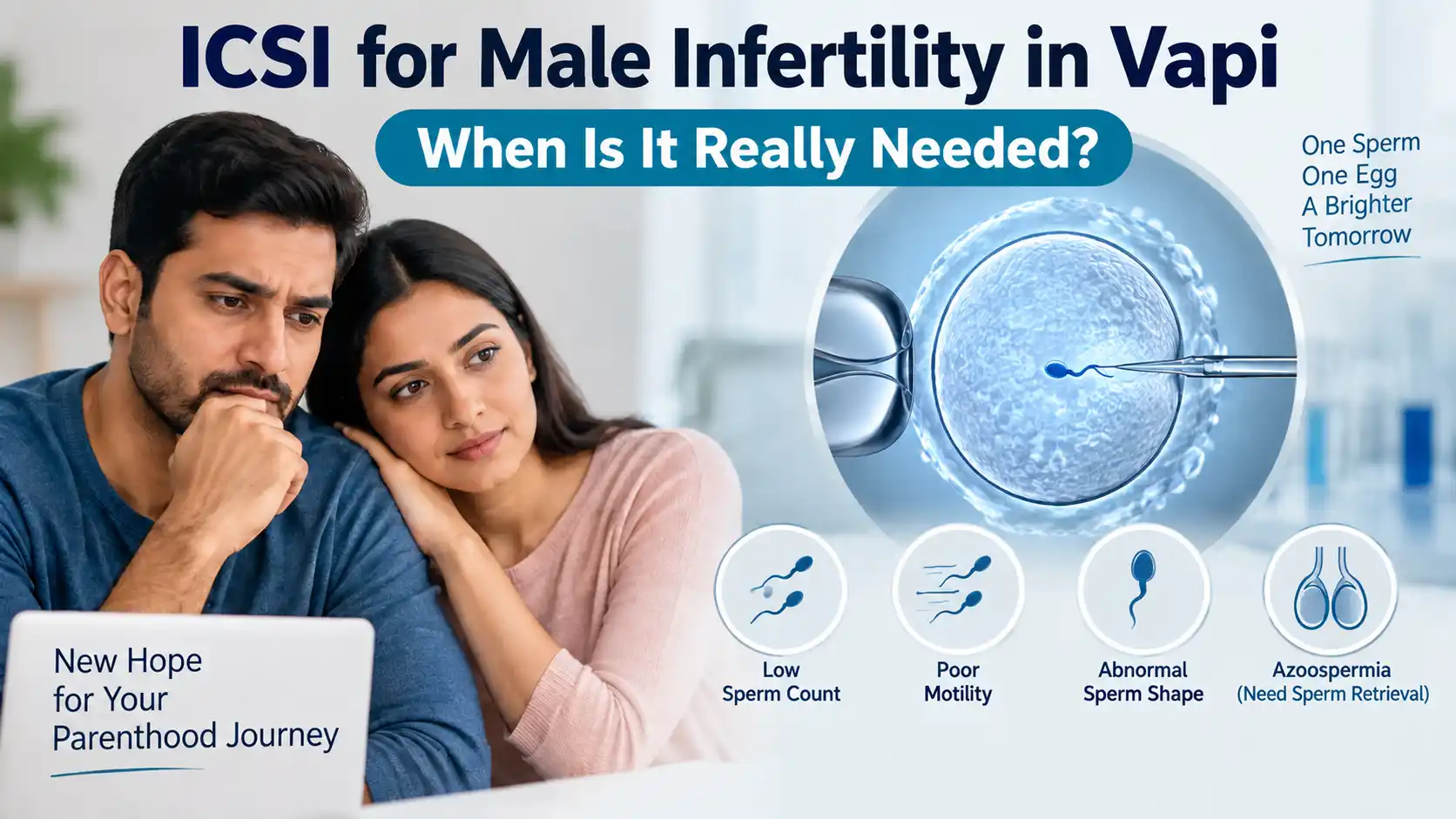
ICSI for male infertility in Vapi may be considered when sperm cannot reach or fertilise an egg in the usual way. During ICSI, an embryologist places one sperm inside a mature egg. This can help in severe male-factor cases, but it is not an automatic answer for every couple having IVF.
Key Takeaways
- ICSI is a type of IVF. The main difference is the lab step used for fertilisation. One live sperm is injected into one mature egg.
- ICSI is most useful for very low sperm numbers, poor motility, abnormal sperm morphology, sperm taken from the testicle or epididymis, or past poor fertilisation with standard IVF.
- ICSI helps sperm enter the egg. It cannot ensure fertilisation, a healthy embryo, implantation, pregnancy, or a live birth.
- In men with normal sperm count and motility, research has not shown a clear reason to use ICSI for every IVF cycle. A 2024 trial found no support for routine use in non-severe male-factor infertility.
- For non-obstructive azoospermia, micro-TESE may retrieve sperm in about 40% to 60% of cases, but results vary by cause and centre.
“ICSI solves one narrow problem: getting sperm into an egg. Before advising it, I want to know why the sperm problem exists and whether it can be treated or needs sperm retrieval.” Dr. Kaushal Patel
What Is ICSI and How Does It Work?
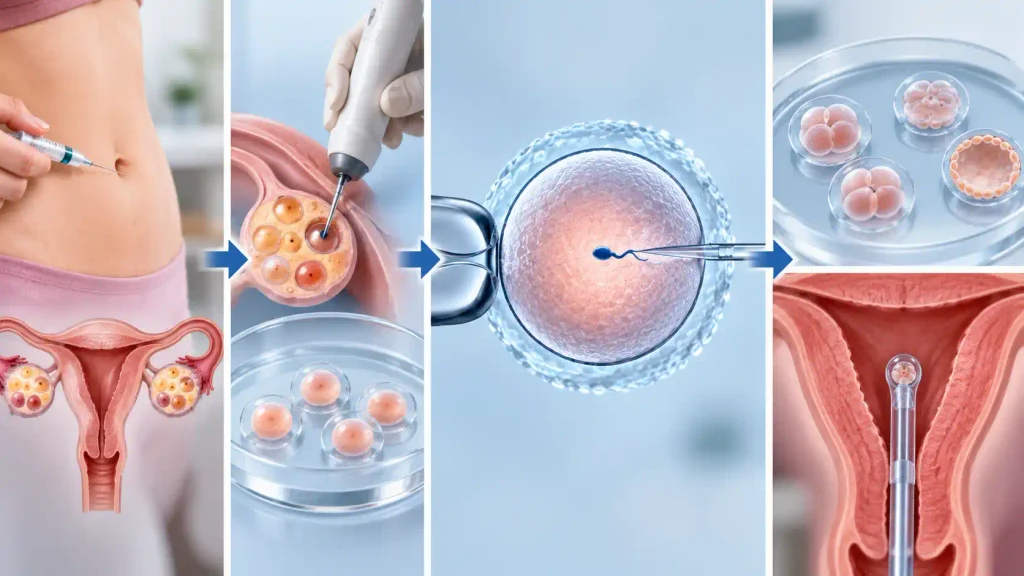
ICSI stands for intracytoplasmic sperm injection. It forms part of an IVF cycle. The female partner takes medicines to help several eggs mature. The eggs are then collected.
In the lab, an embryologist removes the cells around each egg and checks which eggs are mature. A suitable live sperm is selected. Using a fine glass needle, the embryologist performs the sperm injection into the egg’s inner fluid.
The eggs are checked the next day for signs of fertilisation. Any embryos that develop are watched for several days. A suitable embryo may then be transferred to the uterus or frozen for later use.
Couples can review the full IVF/ICSI process before making a treatment choice.
IVF With ICSI Versus Standard IVF
The ovarian injections, scans, egg collection, embryo culture, and embryo transfer are much the same. Only the method of fertilisation differs.
| Point | Standard IVF | IVF with ICSI |
|---|---|---|
| Lab method | Many sperm are placed near each egg | One sperm is injected into each mature egg |
| Sperm action | A sperm must reach and enter the egg | The entry step is bypassed |
| Often considered when | Sperm results are adequate | There is a major sperm problem or past fertilisation failure |
| Main limit | Fertilisation may fail | Injection still may not lead to fertilisation or a healthy embryo |
| Does it ensure pregnancy? | No | No |
When Is ICSI Really Needed for Male Infertility?
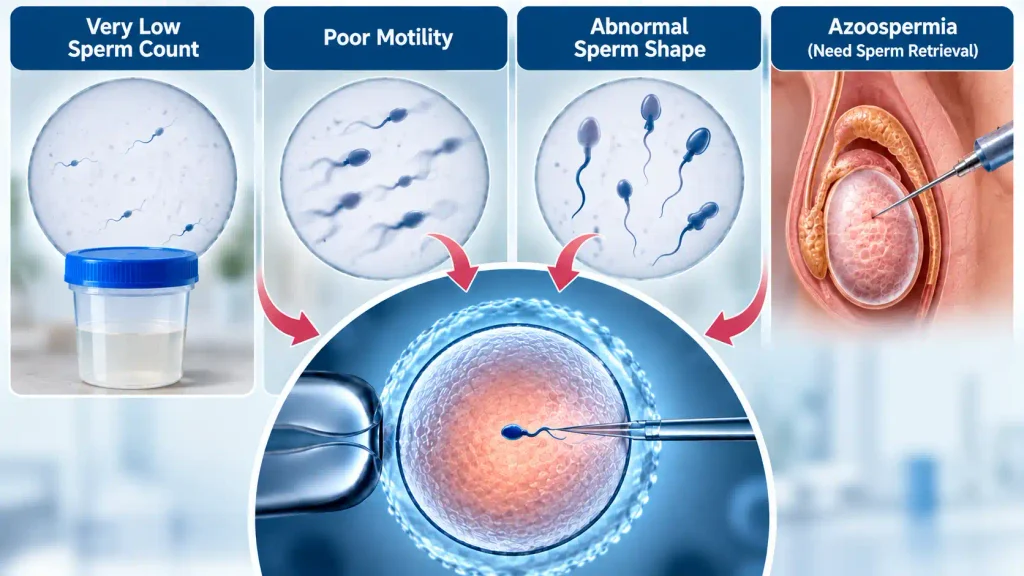
A doctor may advise ICSI for male infertility in Vapi after reviewing at least one repeat semen test, the man’s history, an examination, and the couple’s full fertility picture. Common reasons include the following.
1. Very Low Sperm Count
With a very low sperm count, too few sperm may reach or enter an egg during standard IVF. ICSI for male infertility in Vapi can reduce that barrier because only one usable sperm is needed for each mature egg.
A low count can arise from a varicocele, hormone disorder, genetic cause, infection, medicine, heat exposure, or testicular injury. Sometimes no clear cause is found.
2. Poor Motility or Abnormal Shape
Poor motility means sperm do not move forward well. Abnormal sperm morphology means a high share of sperm have an unusual shape. Either problem may reduce the chance that sperm can penetrate an egg.
ICSI bypasses movement toward the egg and entry through its outer layer. It does not repair sperm DNA or turn an unhealthy sperm into a healthy one. Selection under a microscope also cannot reveal every genetic defect.
3. Azoospermia and Surgically Retrieved Sperm
Azoospermia means no sperm are seen in the ejaculate. It may be obstructive, where sperm production continues but a blockage prevents release. It may also be non-obstructive, where sperm production is very low or absent.
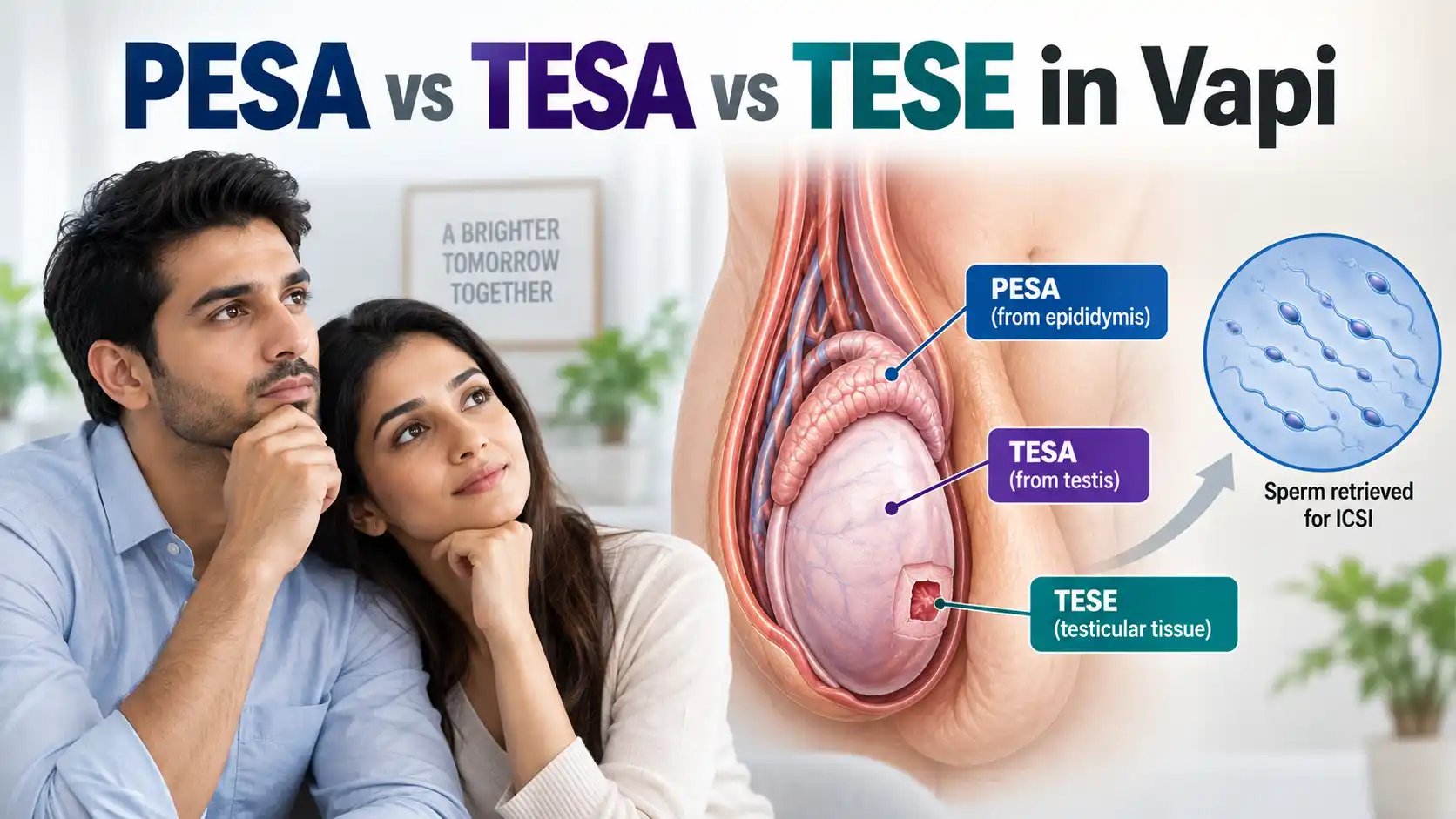
Some men still make sperm in small areas of the testicles. PESA, TESA, TESE, or micro-TESE may be used to look for sperm, based on the cause. Retrieved sperm are often few and may not move well. In such cases, ICSI for male infertility in Vapi is often needed.
ICSI for male infertility in Vapi may be considered when no eggs, or very few eggs, fertilised in an earlier standard IVF cycle. The team should still review egg maturity, sperm quality, and lab factors before deciding on the next plan.
4. Frozen or Limited Sperm Samples
ICSI may help when only a small amount of frozen sperm is available. ## When May ICSI Not Be Necessary?
ICSI for male infertility in Vapi should not be added only because it sounds more advanced. If sperm count and motility are normal, standard IVF may be suitable. Evidence does not show that routine ICSI improves outcomes for every couple without a clear male-factor reason.
It may also be too early to move to IVF with ICSI when a correctable cause has not been assessed. For example, selected men may benefit from treatment for a hormone disorder, infection, ejaculation problem, or clinical varicocele.
“More treatment is not always better treatment. A careful plan may save a couple from cost, delay, and procedures that do not address the true cause.” Dr. Kaushal Patel
What Tests Should Be Done Before ICSI?
A single semen analysis can change due to fever, illness, collection issues, or natural variation. If the first result is abnormal, a repeat sample is often needed. Timing depends on how severe the result is and whether urgent care is needed.
The male assessment may include:
- Medical, sexual, fertility, surgery, and medicine history
- Physical examination of the testes, penis, and scrotum
- Repeat semen analysis with count, motility, and morphology
- Hormone tests such as FSH, LH, and testosterone when indicated
- Ultrasound when a blockage or other scrotal problem is suspected
- Genetic counselling and tests in severe oligospermia or azoospermia
- Other tests, such as sperm DNA fragmentation, only when they may change care
The female partner also needs an assessment. Age, ovarian reserve, egg number, uterine health, and past pregnancy history strongly affect the final chance of success.
Genetic Tests in Severe Male Infertility
A doctor may discuss a chromosome test, called a karyotype, in severe low sperm count or azoospermia. Y-chromosome microdeletion testing may help explain very poor sperm production and may guide sperm retrieval decisions.
CFTR gene testing may be advised when the sperm ducts are absent or an obstruction is suspected. Results can affect the man’s care, the chance of finding sperm, and risks for a child. Genetic counselling helps couples understand what a result means before they decide.
Choosing a Sperm Retrieval Method
The best method depends on where sperm are likely to be found and whether the problem is a blockage or poor production.
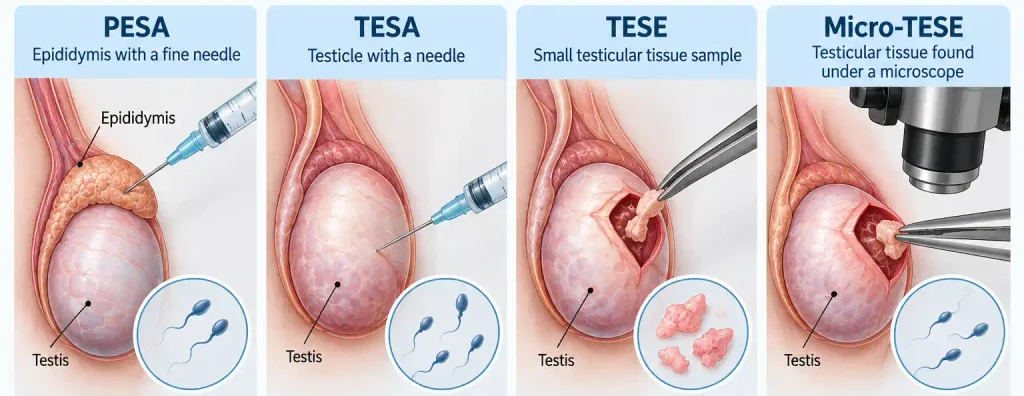
| Method | Where sperm are taken from | Common use |
|---|---|---|
| PESA | Epididymis with a fine needle | Obstructive azoospermia |
| TESA | Testicle with a needle | Selected retrieval or diagnostic cases |
| TESE | Small testicular tissue sample | When tissue sampling is needed |
| Micro-TESE | Testicular tissue found under a microscope | Non-obstructive azoospermia |
Micro-TESE lets the surgeon look for wider, more promising tubules while limiting tissue removal. It still cannot promise that sperm will be found. If sperm are retrieved, they can often be used fresh or frozen for ICSI.
Can Medicines or Surgery Help First?
Medicines can help when a defined hormone problem is reducing sperm production. Men using testosterone for bodybuilding or low-testosterone symptoms should tell their doctor, as outside testosterone can suppress sperm production. They should not stop prescribed treatment without medical advice.
Antibiotics may treat a proven infection, but they do not reverse every sperm problem. Antioxidants and supplements are widely sold, yet evidence is mixed. A research review found that the quality of evidence across male infertility treatments remains limited.
Surgery may help selected men with a clinical varicocele or a repairable blockage. A reconstruction may allow sperm to return to the semen, but it is not suitable for all causes. The female partner’s age and ovarian reserve may also make IVF ICSI the more timely option.
What Affects the Chance of Success?
ICSI can improve the chance of fertilisation when sperm entry is the main barrier. The result after that depends on more than sperm count.
Key factors include:
- Female partner’s age and egg reserve
- Number and maturity of eggs collected
- Egg and sperm quality
- Cause and length of infertility
- Embryo development
- Uterine health
- Lab skill and quality systems
- Past treatment response
Ask an IVF specialist Vapi for results that match your age, diagnosis, and use of ejaculated or retrieved sperm. A single clinic percentage may describe fertilisation, pregnancy per transfer, or live birth per cycle. These are not the same outcome.
Risks and Limits to Discuss
ICSI involves the usual burdens of IVF, including injections, egg collection, cost, and emotional strain. A small number of eggs may be damaged during injection. Some mature eggs will not fertilise, and some embryos will stop developing.
Severe male infertility can have a genetic cause. ICSI may allow sperm with an inherited issue to fertilise an egg, so testing or counselling may be useful in selected cases.
“A good consultation should cover what ICSI can do, what it cannot do, and what the couple may face if no sperm or no healthy embryo is found. Clear expectations protect hope rather than reduce it.” Dr. Kaushal Patel
Questions to Ask at an IVF ICSI Centre in Vapi
Before choosing ICSI for male infertility in Vapi, ask questions that reveal how the team makes decisions:
- Why is ICSI advised in our case?
- Do we need another semen test or male hormone tests?
- Could medicine, surgery, or standard IVF be reasonable?
- Is sperm retrieval likely, and which method fits the diagnosis?
- Should we consider genetic testing or counseling?
- What result do your success figures measure?
- What happens if no sperm, mature egg, or embryo is available?
- What costs may arise beyond the quoted cycle fee?
About the Author
Dr. Kaushal Patel is the Scientific Director of iSHA Hospital & IVF Centre in Vapi. His training includes reproductive medicine and clinical andrology, with qualifications from India, Germany, Singapore, and Dubai. His work covers fertility assessment, IVF, ICSI, and care for male-factor infertility.
Final Thought
A severe sperm result does not always mean the same treatment for every couple. The right path may involve repeat testing, treatment of a cause, sperm retrieval, standard IVF, or ICSI.
For couples considering ICSI for male infertility in Vapi, a joint review of both partners gives the clearest basis for a decision. Discuss whether ICSI may be suitable for your fertility treatment in Vapi.
Frequently Asked Questions
1. Can severe male infertility in Vapi be caused by a hormone problem?
Yes. Problems involving FSH, LH, testosterone, prolactin, or the pituitary gland may reduce sperm production. Blood tests and an exam can show whether hormone treatment may help.
2. How many semen analyses are needed before diagnosing severe male infertility?
An abnormal result is often checked with a second semen analysis. A very low or zero count may prompt faster repeat testing and a specialist review.
3. What genetic tests may be recommended for severe male infertility?
Tests may include a karyotype and Y-chromosome microdeletion test. CFTR testing may be advised when the sperm ducts are missing or a blockage is likely.
4. Can a man with severe male infertility still produce sperm in the testicles?
Yes. Some men with no sperm in the semen still have small areas of production in the testicles. A clinical review helps estimate whether retrieval is reasonable.
5. When is testicular sperm retrieval recommended for severe male infertility?
It may be advised when sperm cannot enter the semen or when rare sperm may exist in testicular tissue. The method depends on whether azoospermia is obstructive or non-obstructive.
6. Can micro-TESE find sperm in men with non-obstructive azoospermia?
It can find sperm in some men, but not all. Published reviews report retrieval in about 40% to 60% of cases, with the cause and prior treatment affecting the result.
7. What is the difference between TESE, TESA, PESA and micro-TESE?
PESA collects sperm from the epididymis, while TESA uses a needle in the testicle. TESE takes a small tissue sample, and micro-TESE uses a microscope to search testicular tissue more closely.
8. Can retrieved testicular sperm be used for ICSI?
Yes, if viable sperm are found. Fresh or frozen retrieved sperm can often be injected into mature eggs during ICSI.
9. Can ICSI work when only a very small number of sperm are available?
Yes. One suitable sperm is needed for each mature egg, so ICSI may be possible with very few sperm. It still cannot guarantee fertilisation or pregnancy.
10. Can medicines improve sperm production in severe male infertility?
Medicines may help when there is a treatable hormone disorder. Routine hormone use, supplements, or antioxidants do not help every man and should follow a clear diagnosis.
11. When is surgery an option for severe male infertility?
Surgery may help selected men with a clinical varicocele or a blockage. The likely benefit, recovery time, female partner’s age, and other fertility factors should guide the choice.
12. Can a blocked sperm pathway be treated without IVF or ICSI?
Sometimes. Microsurgery may repair certain blockages and allow sperm to return to the semen. Other couples may have a better chance with sperm retrieval and ICSI.
13. When should a man with severe male infertility consider donor sperm?
Donor sperm may be discussed if no sperm are found, a serious genetic risk cannot be reduced, or further procedures are not acceptable. Counselling should support a private, informed choice without pressure.
14. How long does treatment for severe male infertility usually take?
Testing may take several weeks, while hormone or surgical treatment may need months before reassessment. An IVF cycle often takes a few weeks, but the full plan varies by diagnosis.
15. When should you see a male infertility specialist or andrologist in Vapi?
Seek help after 12 months of trying, or after 6 months if the female partner is 35 or older. Go sooner for absent sperm, testicular problems, sexual or ejaculation concerns, cancer treatment, or past groin surgery.