

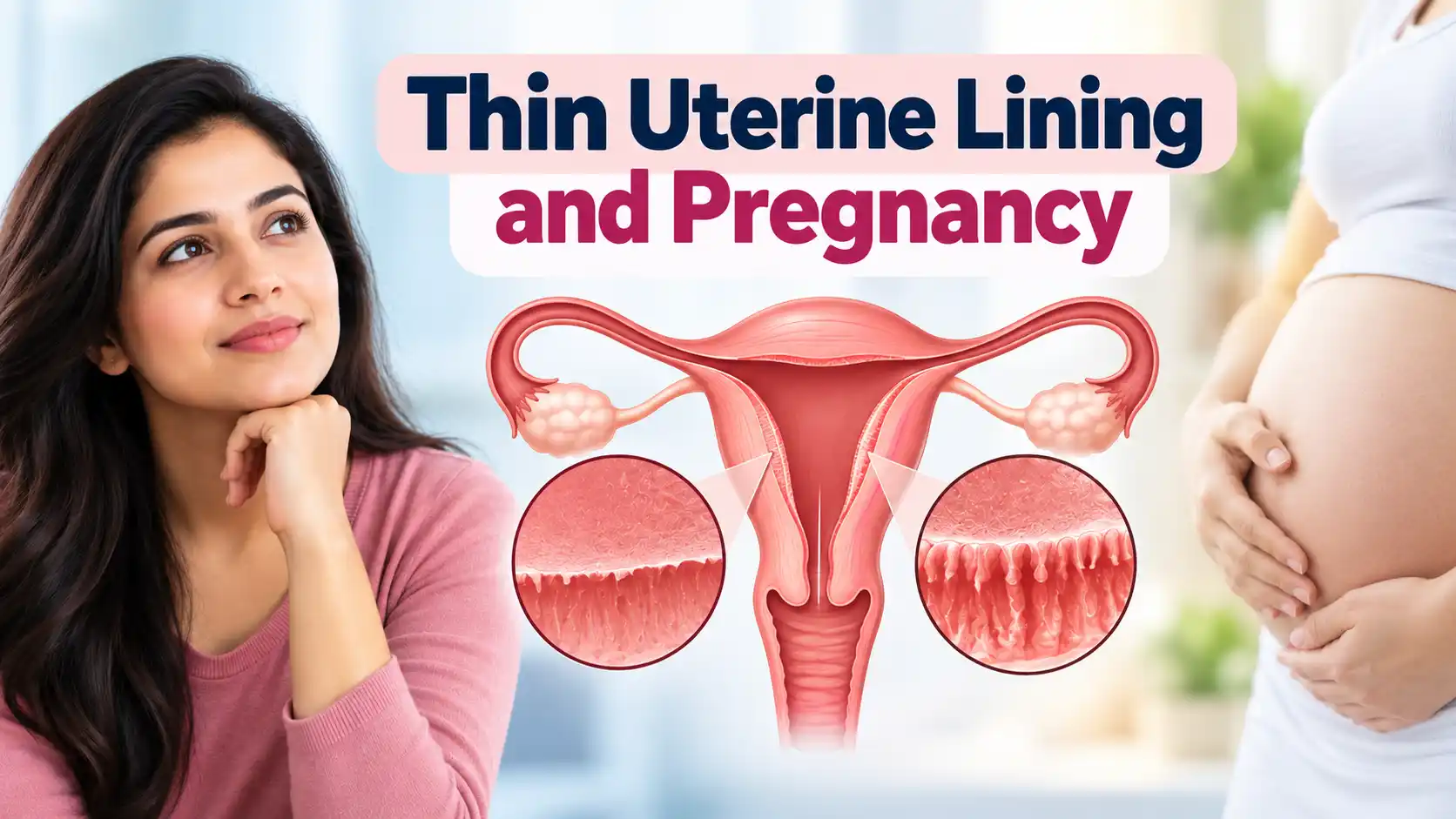
Many women hear the words “thin lining” for the first time during a routine ultrasound, and not while trying for a baby on purpose. It often comes up during an IUI cycle, an IVF work-up, or even a scan for something unrelated. Suddenly, a new worry appears: does thin uterine lining and pregnancy even go together?
The honest answer is that it depends on how thin, why it is thin, and what you do next. A thin lining is a solvable problem in most cases, not a life sentence on your fertility. This piece walks through what the lining does, why it thins out, how doctors check it, and the natural and medical options that genuinely help.
Key Takeaways
- The endometrium (uterine lining) normally needs to reach around 7–8 mm for a healthy chance of implantation, though pregnancies have occurred at 5–6 mm too.
- A large meta-analysis of over 10,000 IVF cycles found clinical pregnancy rates of 23.3% when the lining was 7 mm or less, versus 48.1% when it was thicker, though a lining under 7 mm was seen in only 2.4% of cases studied.
- Thin lining is usually caused by low estrogen, scarring from past procedures, poor blood flow, chronic inflammation, or age-related changes.
- It is checked with a transvaginal ultrasound, sometimes followed by a hysteroscopy if scarring or polyps are suspected.
- Within an IVF cycle, lining growth is tracked scan by scan, giving doctors a real chance to intervene before transfer.
What Is the Uterine Lining, and Why Does It Matter?
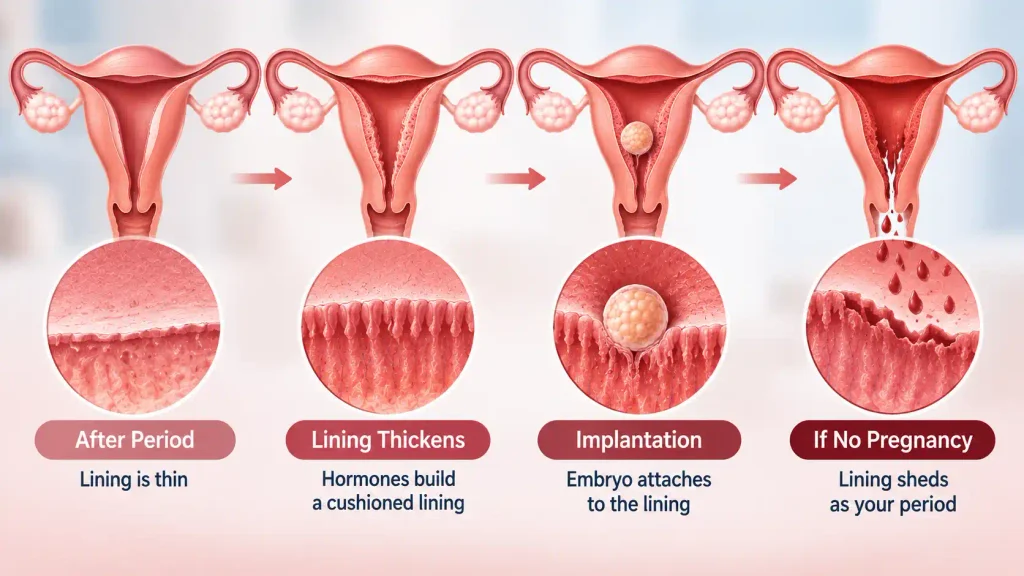
The endometrium is the soft tissue lining the inside of your uterus (womb). Every month, hormones tell it to thicken, building a cushioned bed. If an embryo arrives, it needs to bury itself into this tissue, a process called implantation. If pregnancy doesn’t happen, the lining sheds as your period.
Think of it like soil in a garden. A seed can be perfect, but it won’t grow well in soil that is too thin, dry, or scarred. The embryo is the seed. The lining is the soil.
“In my clinic, I see two kinds of worry around thin lining. One is the woman who has been trying naturally and just found out. The other is mid-IVF, staring at a scan report with a number she doesn’t fully understand. Both deserve the same thing: a clear explanation and a real plan, not just reassurance.” – Dr. Kaushal Patel
How Thick Should the Endometrium Be for Pregnancy?
Doctors measure the lining in millimeters (mm) using ultrasound. The number changes through your cycle, so there is no single “correct” figure. What matters most is the thickness around ovulation or just before an embryo transfer.
| Cycle Phase | Typical Endometrial Thickness |
|---|---|
| Right after your period | 2–4 mm |
| Mid-cycle, near ovulation | 8–12 mm |
| Just before your period | 12–16 mm |
| Considered “thin” for conception | 7 mm or less at ovulation/transfer |
Most fertility specialists consider 7–8 mm or more a reasonable target for embryo transfer,and pooled global data show pregnancies do occur below this, just at somewhat lower odds. So a report showing 6 mm is a reason to plan, not to panic.
What Causes a Thin Uterine Lining?
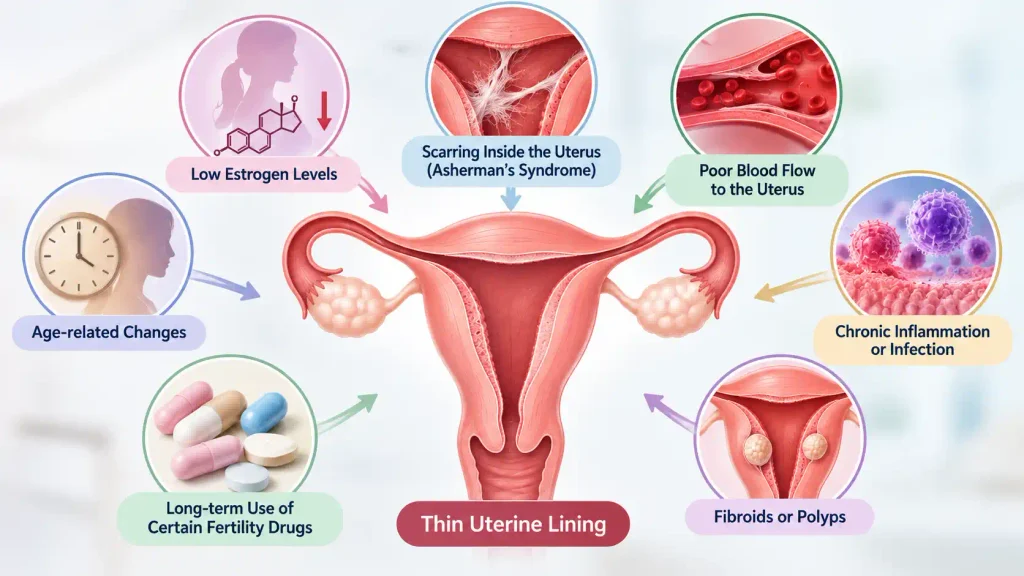
A thin lining rarely has one single cause. It usually comes from one or more of these:
- Low estrogen levels: estrogen is the hormone that builds the lining, so low levels mean less growth.
- Scarring inside the uterus (Asherman’s syndrome): often from a past D&C, infection, or uterine surgery.
- Poor blood flow to the uterus: reduced circulation means less tissue nourishment.
- Chronic inflammation or infection: such as untreated endometritis.
- Long-term use of certain fertility drugs: some ovulation-inducing medicines can thin the lining over repeated cycles.
- Age-related changes: the lining’s response to hormones can weaken over time.
- Fibroids or polyps: these can distort the cavity and interfere with even growth.
Often Discovered Late, During Another Treatment
This is one of the most common patterns we see. A woman comes in for an unrelated concern, irregular periods, an IUI cycle, or a fertility work-up, and the scan report quietly flags a thin lining. Nobody warned her this could be a factor.
This is not a failure on your part. Endometrial thickness is invisible without a scan. There are no symptoms that reliably point to it. The good news is that once it’s found, there is almost always something that can be done.
How Is Uterine Lining Measured?
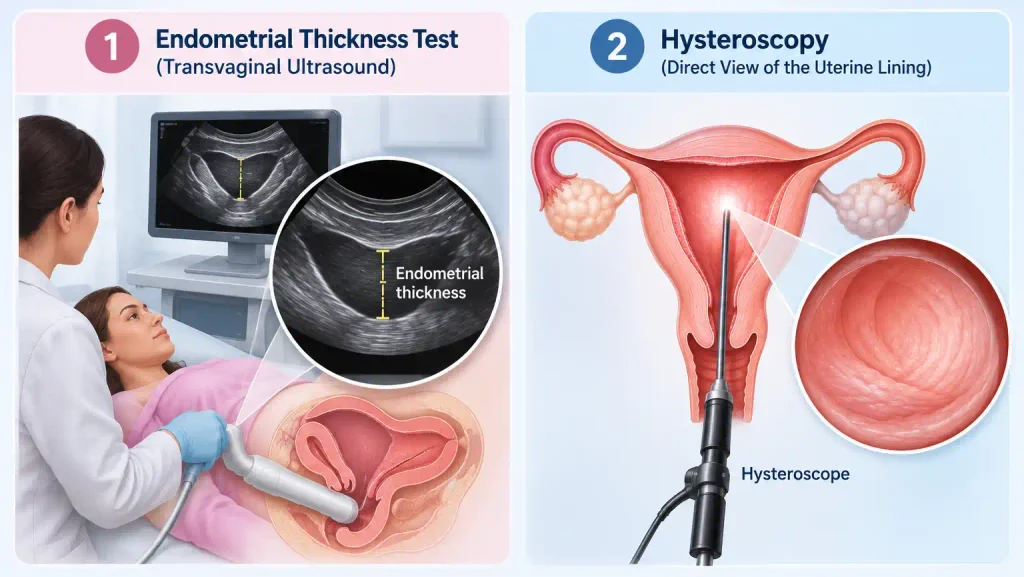
1. What Is an Endometrial Thickness Test?
An endometrial thickness test is simply a transvaginal ultrasound scan that measures the lining in millimeters. A small probe is placed inside the vagina to get a close, clear image of the uterus. It takes a few minutes, causes mild pressure at most, and gives an instant reading. Your doctor may repeat this scan two or three times across a cycle to watch how the lining grows, since one single reading can be misleading.
2. What Is a Hysteroscopy, and How Does It Check the Lining?
A hysteroscopy is a procedure where a thin, lighted camera is passed through the cervix into the uterus, so your doctor can look directly at the cavity. Unlike an ultrasound, which measures thickness from outside, a hysteroscopy shows the actual surface. It can spot scarring, polyps, or fibroids that an ultrasound alone might miss, and many of these can be treated in the same sitting. Hysteroscopy is used both to diagnose and to treat causes of abnormal uterine findings in one visit, which is why it’s often recommended when a thin lining doesn’t respond to simple treatment.
Why Doesn’t the Embryo Implant When the Lining Is Thin?
A thin lining offers less surface area and fewer blood vessels for the embryo to attach to. Implantation depends on the lining being receptive, meaning it has the right thickness, blood supply, and hormonal signal at exactly the right time. When any of these pieces is missing, the embryo may simply not attach, or it may attach weakly and be lost early.
This is called implantation failure, when a healthy-looking embryo does not successfully attach to the uterine wall. It can happen with natural conception or during IVF, and thin lining is one of several possible reasons behind it. Others include embryo quality, immune factors, and uterine abnormalities.
Can a Thin Lining Cause Miscarriage or Recurrent Miscarriage?
Yes, in some cases. If the lining is thin, the early placenta may not get enough blood supply to support the pregnancy properly, which can raise the risk of early loss. This is different from most causes of recurrent miscarriage, which more often involve chromosomal, hormonal, or clotting factors, but a persistently thin lining is worth ruling out if losses keep happening. Your doctor may suggest checking the lining alongside standard recurrent miscarriage tests.
Natural and Medical Ways to Improve Lining Thickness
1. Natural Steps That Can Help
For mild cases, small lifestyle changes genuinely support lining growth over a few cycles:
- Stay well hydrated, since blood volume affects circulation to the uterus.
- Eat iron-rich and protein-rich foods to support healthy blood flow.
- Add gentle daily movement, like a 30-minute walk, to improve pelvic circulation.
- Avoid smoking and limit caffeine, both of which can constrict blood vessels.
- Manage stress, since chronic stress affects hormone balance.
- Treat underlying thyroid or hormonal issues, since these directly affect estrogen levels.
Natural steps rarely fix a lining that is thin due to scarring or a structural issue. They work best for lining that is thin simply due to low estrogen or poor circulation.
2. Medical Treatments for Thin Endometrium
When natural steps aren’t enough, thin endometrium treatment usually starts simple and becomes more targeted if needed:
- Extended estrogen support: giving the body more time and more estrogen to build the lining.
- Vaginal sildenafil: improves local blood flow to the uterus in some patients.
- Low-dose aspirin or blood-thinning support: used selectively to improve circulation, under medical supervision.
- Hysteroscopy: removes scarring, polyps, or adhesions that are physically blocking growth.
- PRP (Platelet-Rich Plasma) treatment: discussed further below.
3. What Is PRP Treatment for Uterine Lining?
PRP stands for Platelet-Rich Plasma. It is prepared by drawing a small sample of your own blood, spinning it in a machine to concentrate the platelets (the part rich in growth factors), and placing this concentrated plasma directly into the uterine cavity. The growth factors are thought to stimulate the lining’s tissue to grow and improve blood supply.
PRP is generally used when the lining has stayed thin despite estrogen support and other standard steps. Early studies show promising improvement in thickness and pregnancy rates for some women, though it works better for some causes than others, so it is usually recommended case by case rather than as a first step for everyone.
Natural vs Medical Approach: A Quick Comparison
| Factor | Natural Approach | Medical Treatment |
|---|---|---|
| Best suited for | Mild, hormone-related thinning | Scarring, structural issues, non-response to lifestyle changes |
| Typical timeline | 2–3 menstrual cycles | Varies; some options work within one cycle |
| Needs a specialist? | Not usually | Yes, always |
| Addresses root cause? | Supports estrogen and blood flow | Can directly treat scarring, blood flow, or hormone levels |
| Example | Hydration, diet, gentle exercise | Estrogen support, hysteroscopy, PRP |
Why Does Lining Thickness Matter During IVF?
During IVF, timing is everything. Your ovaries are stimulated to produce eggs, those eggs are fertilized in the lab, and the resulting embryo is transferred back into the uterus on a specific day. If the lining hasn’t reached an adequate thickness by then, the embryo has a lower chance of implanting successfully, even if the embryo itself is high quality.
This is exactly why IVF cycles are monitored so closely. Unlike a natural cycle, where the lining’s growth is rarely checked at all, IVF gives your doctor several chances to measure, adjust medication, and even delay the transfer if the lining needs more time. Once pregnancy is confirmed, this same close monitoring continues, much like the pregnancy scan schedule your doctor will guide you through in the weeks that follow.
Thin Endometrium Treatment in Vapi: Access for Women Nearby
Women across Vapi, Daman, Silvassa, and Valsad often discover a thin lining the same way, mid-treatment, with no local specialist nearby to guide the next step. Traveling to Mumbai or Ahmedabad for every scan and consultation adds stress, cost, and delay to an already difficult journey.
At iSHA, women from Vapi and the surrounding belt, including Umargam, Navsari, and Dadra & Nagar Haveli, can access the full pathway for thin endometrium treatment in Vapi itself: ultrasound-based lining assessment, hysteroscopy where needed, and medical treatments like estrogen protocols and PRP, all under one roof. For those closer to Daman, Silvassa, or Valsad, the same team and protocols are reachable without a long commute to a metro city. This matters because lining treatment is rarely a single visit. It usually needs a few scans across one or two cycles, and having a trusted, local IVF specialist in Vapi makes that process realistic instead of exhausting.
How Lining Is Monitored Within an IVF Cycle
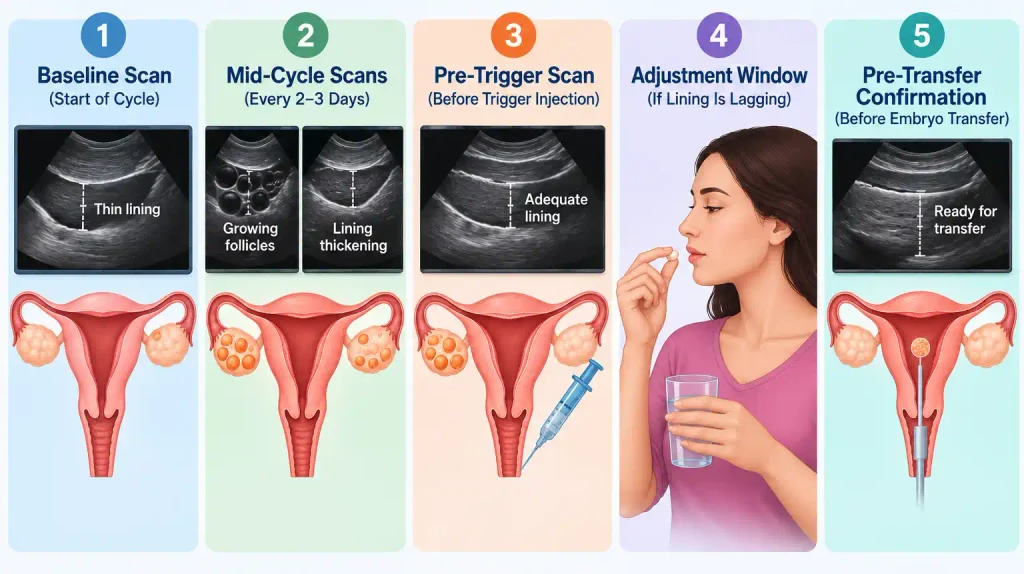
Once you’re in an active IVF cycle, your uterine lining becomes part of the daily plan, tracked alongside your egg development. A typical monitoring pattern looks like this:
- Baseline scan, at the start of the cycle, to confirm the lining has shed fully and is thin, as expected.
- Mid-cycle scans, every two to three days, tracking both the growing follicles and the thickening lining together.
- Pre-trigger scan, checking whether the lining has reached a workable thickness before the trigger injection is given.
- Adjustment window, where estrogen support or timing can be modified if the lining is lagging.
- Pre-transfer confirmation, a final check to confirm the lining is ready before the embryo is placed.
This step-by-step tracking is the biggest advantage IVF offers over a natural cycle. If the lining needs more time, your doctor can freeze the embryo and transfer it in a later, better-prepared cycle instead of proceeding with poor odds.
Final Thought
A thin uterine lining and pregnancy are not opposites. For most women, it’s a manageable finding, not a diagnosis that ends the journey. What changes the outcome is catching it early, understanding what’s causing it, and following through with the right combination of natural support and medical treatment.
If you’ve just been told your lining is thin, take it as useful information, not a verdict, and bring it to a specialist who can build a real plan around your specific case.
Frequently Asked Questions
1. Can you get pregnant with a thin uterine lining?
Yes, it is possible, though the chances are generally lower than with a lining of adequate thickness. Many women with a lining of 5–6 mm have gone on to conceive successfully, especially once the underlying cause is addressed.
2. What thickness of the uterine lining is needed for conception?
Most specialists look for around 7–8 mm at ovulation or before embryo transfer as a reasonable target. This isn’t a strict cutoff, since pregnancies do occur below this thickness, but it’s the range associated with the best odds.
3. How thick should the endometrium be for pregnancy?
The endometrium naturally grows from about 2–4 mm right after your period to 8–16 mm as you approach ovulation and beyond. For conception, doctors generally prefer to see it reach at least 7 mm by the fertile window.
4. What causes a thin uterine lining?
The most common causes are low estrogen levels, scarring from past uterine procedures, poor blood flow, chronic inflammation, and age-related hormonal changes. Fibroids or polyps distorting the cavity can also play a role.
5. Can a thin uterine lining make it difficult for an embryo to implant?
Yes, a thin lining offers less surface area and blood supply for the embryo to attach to, which can lower the chances of successful implantation. This doesn’t mean implantation is impossible, just that it becomes harder without support.
6. What is implantation failure, and can a thin lining cause it?
Implantation failure means a seemingly healthy embryo does not attach to the uterine wall. A thin lining is one of several possible contributing factors, alongside embryo quality, immune factors, and uterine abnormalities.
7. How is uterine lining thickness measured during an ultrasound?
A transvaginal ultrasound probe is placed inside the vagina to get a clear, close image of the uterus, and the lining is measured in millimeters on screen. It’s quick, generally comfortable, and gives an immediate reading.
8. What is an endometrial thickness test, and when is it recommended?
It’s simply the transvaginal ultrasound scan used to measure lining thickness. It’s commonly recommended during fertility work-ups, before IUI or IVF, or when a woman has a history of thin lining or unexplained implantation failure.
9. Can the uterine lining be increased naturally before trying to conceive?
In mild cases caused by low estrogen or poor circulation, yes, steps like better hydration, iron-rich food, gentle exercise, and cutting caffeine and smoking can help over a few cycles. Lining thinned by scarring or structural issues usually needs medical treatment alongside these changes.
10. What treatments are available for thin endometrium?
Options include extended estrogen support, vaginal sildenafil to improve blood flow, hysteroscopy to remove scarring or polyps, and PRP therapy in cases that don’t respond to simpler measures. The right combination depends on the underlying cause.
11. What is a hysteroscopy, and how can it help find problems affecting the uterine lining?
A hysteroscopy uses a thin, lighted camera passed through the cervix to give your doctor a direct view inside the uterus. It can identify and often treat scarring, polyps, or fibroids in the same procedure, which an ultrasound alone might miss.
12. What is PRP treatment for the uterine lining, and does it improve pregnancy chances?
PRP involves concentrating growth factors from your own blood and placing them into the uterine cavity to encourage the lining to grow. It’s generally reserved for cases that haven’t responded to estrogen support, and early results show it can improve thickness and outcomes for some women, though it isn’t guaranteed to work for everyone.
13. Why does uterine lining thickness matter during IVF?
The embryo can only implant successfully if the lining is thick enough and receptive at the time of transfer, regardless of how good the embryo quality is. This is why IVF cycles include repeated scans to track lining growth and adjust the plan if needed.
14. Can a thin uterine lining increase the risk of miscarriage or recurrent miscarriage?
It can contribute to early pregnancy loss in some cases, since a thin lining may not support adequate blood supply to the developing placenta. It’s usually checked as one part of a broader recurrent miscarriage work-up, alongside hormonal, genetic, and clotting factors.
15. Where can I get thin endometrium treatment in Vapi?
iSHA provides complete thin endometrium treatment in Vapi, including ultrasound assessment, hysteroscopy, and medical therapies like PRP, all at one center.