

Getting a semen report that says “no sperm found” can feel like the ground has shifted under you. Many men read those two words and quietly assume their chance of becoming a father is over. If you are asking yourself whether with a zero sperm count can we still have a baby, take a slow breath first. The honest answer, in most cases, is yes. Azoospermia is a diagnosis, not a life sentence, and modern fertility medicine has real, proven paths to biological parenthood even when the ejaculate itself contains no sperm.
I have sat across the table from hundreds of couples in Vapi and nearby South Gujarat who walked in convinced their family-building journey had ended. It hadn’t. It just needed a different route.
Key Takeaways
- Azoospermia (zero sperm in the ejaculate) affects close to 1% of all men and around 10 to 15% of infertile men.
- There are two broad types, obstructive and non-obstructive, and the treatment path differs sharply between them.
- Many men with azoospermia still produce sperm inside the testicle. Sperm retrieval procedures like TESA and TESE can collect it directly.
- Retrieved sperm, even in tiny amounts, can fertilise an egg through ICSI, a specialised form of IVF.
- Couples in Vapi, Daman, Silvassa, Valsad, Umargam and Navsari no longer need to travel to Mumbai or Ahmedabad for this level of care.
What Is Azoospermia and What Causes It?
Azoospermia simply means there is no measurable sperm in a man’s semen after ejaculation. It is confirmed only after two separate semen analyses, spun in a lab centrifuge, both come back empty. One report alone is never enough to confirm it. The causes generally fall into three groups:
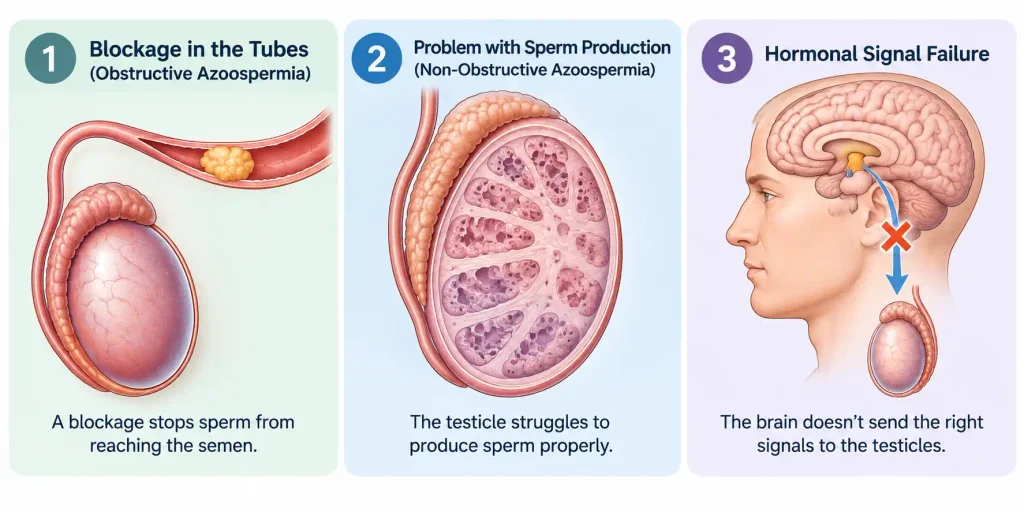
- A blockage somewhere in the tubes that carry sperm from the testicle to the ejaculate (obstructive azoospermia).
- A problem with sperm production itself inside the testicle (non-obstructive azoospermia).
- A hormonal signal failure, where the brain isn’t sending the right signals to the testicles to make sperm.
Infections, past surgeries, a vasectomy, genetic conditions like Klinefelter syndrome, undescended testicles in childhood, chemotherapy, and untreated varicocele can all play a role. In many men, the cause only becomes clear after proper testing, not before.
No Sperm Found in Semen Report: What Should You Do Next?
If your report reads “azoospermia” or “no sperm found,” do not panic and do not accept it as final on the first reading. Semen analysis is sensitive to lab technique, abstinence period, and even how the sample was handled.
“The first thing I tell every patient is: one report is a clue, not a verdict. We repeat the test, review your history, and only then decide what it actually means for you.” — Dr. Kaushal Patel
Here is what a proper next step looks like:
- Repeat the semen analysis after 2 to 4 weeks at a reliable andrology lab.
- See a fertility specialist or male infertility specialist, not just a general physician.
- Get a physical examination, including a check for varicocele and testicular size.
- Complete a hormone panel and, if advised, genetic testing.
Skipping straight to assumptions, or worse, to unverified home remedies, wastes precious time. Age affects your partner’s fertility too, so early evaluation matters for the couple as a unit.
This Is Not the End of the Road
I want to say this plainly, because so many men carry this diagnosis in silence. Zero sperm count in the ejaculate does not mean zero sperm in the body. In a large number of cases, sperm production is still happening quietly inside the testicular tissue, just unable to reach the semen.
That single fact changes everything. It is the reason sperm retrieval surgery exists, and the reason so many couples with a zero count diagnosis go on to have biological children. The path is different from a natural pregnancy, but the destination, a baby that is genetically yours, is still very much reachable for most families.
Obstructive vs Non-Obstructive Azoospermia: What’s the Real Difference?
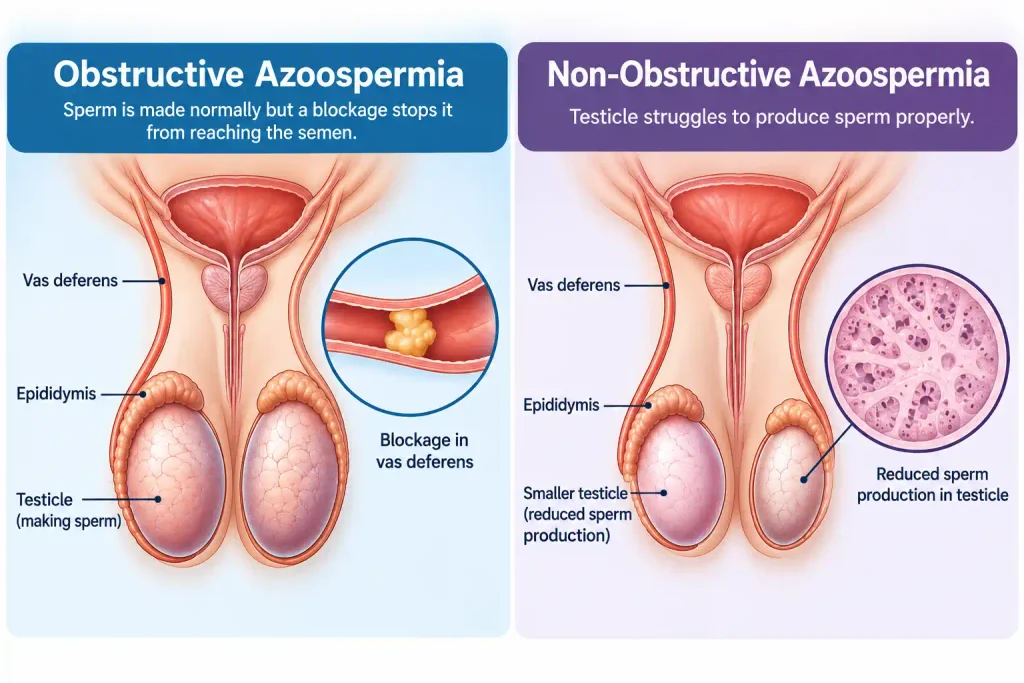
This distinction is the single most important thing your doctor will figure out early, because it decides everything that follows.
| Feature | Obstructive Azoospermia | Non-Obstructive Azoospermia |
|---|---|---|
| What’s happening | Sperm is made normally but a blockage stops it from reaching the semen | Testicle struggles to produce sperm properly |
| Testicle size | Usually normal | Often smaller than normal |
| Hormone levels (FSH) | Usually normal | Often raised |
| Common causes | Vasectomy, infection, congenital absence of vas deferens | Genetic causes, undescended testicle, chemotherapy, unexplained |
| Sperm retrieval success | Very high, often near 100% | Moderate, roughly 40 to 60% with advanced techniques |
| Typical next step | Simple sperm retrieval (TESA/PESA) + ICSI | TESE or micro-TESE + ICSI, sometimes hormone therapy first |
Knowing which category you fall into changes the entire treatment conversation, which is exactly why proper diagnosis comes before any procedure is planned.
How We Find the Cause: Tests That Actually Matter
1. Which Hormone Tests Are Done for Male Infertility?
A basic hormone panel usually checks FSH, LH, testosterone, and sometimes prolactin. High FSH often points toward a testicular production problem. Normal FSH with a blockage suspected points toward obstruction. These numbers guide, but never replace, a full clinical picture.
2. What Happens During a Testicular Biopsy?
A testicular biopsy is a small, minor procedure where a tiny piece of testicular tissue is examined under a microscope. It tells us whether sperm-producing cells are present and active, even if none are reaching the semen. It is usually done under local anaesthesia and takes only a short while, with mild soreness afterward that settles in a day or two.
3. How Is Varicocele Linked to Sperm Count?
A varicocele is an enlargement of the veins inside the scrotum, similar to varicose veins elsewhere in the body. It raises the local temperature around the testicle, which can quietly damage sperm production over years. Correcting a significant varicocele through a short surgery sometimes improves sperm counts enough that assisted reproduction becomes easier, or in select cases, even unnecessary.
What Is Sperm Retrieval Surgery for Azoospermia?
Sperm retrieval surgery is a set of minor procedures designed to collect sperm directly from the testicle or the tube beside it (the epididymis), bypassing the blockage or the low natural output entirely. It is done under sedation or local anaesthesia, usually as a day-care procedure, meaning the patient goes home the same day.
1. What Is the TESA Procedure and How Is It Done?
TESA stands for Testicular Sperm Aspiration. A fine needle is passed into the testicle under local anaesthesia, and a small amount of tissue and fluid is gently drawn out. That sample is checked in the lab, right there, for sperm.
The whole procedure typically takes 20 to 30 minutes. There is no large cut, no stitches in most cases, and recovery is usually quick, with mild discomfort for a day or two. It is most commonly used when obstructive azoospermia is suspected, since sperm production itself is normal and only the pathway is blocked.
2. What Is the Difference Between TESA and TESE for Zero Sperm Count?
TESA uses a needle to draw out tissue. TESE, or Testicular Sperm Extraction, involves a small surgical incision to remove a slightly larger tissue sample directly. TESE tends to be preferred in non-obstructive cases, where sperm may be scattered in small pockets and a needle alone might miss them. A more advanced version, micro-TESE, uses a surgical microscope to spot the healthiest-looking tubules, which meaningfully improves retrieval rates in difficult non-obstructive cases.
Neither procedure is something to fear. Both are well established, performed daily in fertility centres worldwide, and carry a low complication rate when done by an experienced surgeon.
From Retrieved Sperm to Baby: How Does ICSI Work?
Once sperm is retrieved, even a handful of healthy sperm cells, it can be used with ICSI, short for Intracytoplasmic Sperm Injection. Instead of relying on sperm to swim and penetrate an egg on its own, an embryologist selects a single healthy sperm and injects it directly into the centre of a mature egg under a high-powered microscope.
This is part of the broader IVF process, where eggs are first collected from the partner through a short procedure, fertilised through ICSI, and then the resulting embryo is transferred into the uterus a few days later. ICSI was designed exactly for situations like this, where sperm numbers are extremely low or difficult to obtain, so a single viable sperm can still lead to fertilisation.
Couples often ask me directly: can a couple still have a biological child with zero sperm count? When even one healthy sperm cell can be retrieved, the answer is yes, through this exact combination of retrieval surgery and ICSI.
Is Donor Sperm an Option in India?
In the small number of cases where no sperm can be found anywhere, even with micro-TESE, donor sperm remains a legal and regulated option in India under the Assisted Reproductive Technology (Regulation) Act. Donor sperm is screened extensively for infections and genetic conditions before use. Some couples choose this route themselves; others prefer to explore every retrieval option first. Either choice is personal, and a good clinic will support you through that decision without pressure, discussing third-party options openly and honestly.
You Don’t Need to Travel to a Metro City for This
I meet families from Vapi, Daman, Silvassa, Valsad, Umargam, Navsari and across Dadra & Nagar Haveli who assume azoospermia treatment only exists in Mumbai, Ahmedabad or Surat. That gap has closed. Complete evaluation for azoospermia, including hormone testing, ultrasound, TESA, TESE and ICSI, is now available right here in South Gujarat.
For a couple already coping with the emotional weight of this diagnosis, avoiding repeated long trips to a metro city for consultations, tests and procedures makes a genuine difference. Families from Daman and Silvassa reach us within thirty to forty minutes. Couples from Valsad and Umargam find the drive manageable even for follow-up visits. That local access means less time away from work, less travel fatigue during an already stressful phase, and continuity of care with the same doctor throughout.
Dr. Kaushal’s Advice
“Do not let a semen report define your worth as a partner or a future parent. I have watched men walk in devastated and walk out, months later, holding their newborn. The medicine here is proven. What I ask from every couple is patience through the diagnostic process and honesty about what they’re feeling along the way. That combination gets results.” — Dr. Kaushal Patel
If you’re facing low sperm count or male infertility of any degree, not just a zero count, the same principle applies. Early, correct diagnosis nearly always opens up more options than waiting does.
Final Thought
A zero sperm count report is frightening, and nobody should pretend otherwise. But it is also, in most cases, the beginning of a clearer path rather than the end of one. Between accurate testing, sperm retrieval surgery, and ICSI, the vast majority of couples we see find a genuine route to a biological child. The next right step is a proper evaluation, not a search engine spiral at 2 a.m. Book a consultation and let a specialist look at your actual reports before you decide anything about your future.
Frequently Asked Questions
1. Can you have a baby with zero sperm count?
Yes, in most cases. Many men with a zero sperm count in their ejaculate still produce sperm inside the testicle. Sperm retrieval surgery, combined with ICSI as part of IVF, allows that sperm to fertilise an egg and lead to a biological child.
2. No sperm found in a semen report: what should you do next?
Get the test repeated at a reliable lab before drawing any conclusions, since one report can be affected by technique or timing. Then see a fertility specialist for a physical exam, hormone tests, and a clear plan based on your specific cause.
3. What is azoospermia and what causes it?
Azoospermia is the complete absence of sperm in the ejaculate, confirmed through two separate lab tests. It can be caused by a physical blockage, a problem with sperm production in the testicle, or a hormonal signalling issue from the brain.
4. Does zero sperm count mean permanent infertility?
Not always. Some causes, like a varicocele or a hormonal imbalance, can improve with treatment. Even when the underlying cause cannot be reversed, sperm retrieval surgery combined with ICSI still allows many men to father a biological child.
5. What is the difference between obstructive and non-obstructive azoospermia?
Obstructive azoospermia means sperm production is normal but a blockage prevents it from reaching the semen, so retrieval success is very high. Non-obstructive azoospermia means the testicle itself struggles to produce sperm, so retrieval is possible but less certain and often needs more advanced techniques.
6. Can azoospermia be treated, or does it always require assisted reproduction?
Some cases respond to treatment alone, such as surgical correction of a varicocele or hormone therapy for a signalling problem. Many cases, however, do need assisted reproduction, usually sperm retrieval surgery paired with ICSI, to achieve a pregnancy.
7. Which tests are done to find the cause of zero sperm count?
Doctors typically order a repeat semen analysis, a hormone panel including FSH and testosterone, a scrotal ultrasound, and sometimes genetic testing. A testicular biopsy may also be recommended to check whether sperm production is happening inside the tissue.
8. Can varicocele cause zero sperm count, and can treatment improve fertility?
Yes, a significant varicocele can reduce sperm production over time by raising testicular temperature. Surgical correction sometimes improves sperm counts enough to help natural conception or makes assisted reproduction more successful.
9. What is sperm retrieval surgery for azoospermia?
It is a minor procedure that collects sperm directly from the testicle or the epididymis, bypassing the ejaculate entirely. It is usually done as a day-care procedure under local anaesthesia or sedation, with quick recovery for most men.
10. What is the TESA procedure and how is it done?
TESA, or Testicular Sperm Aspiration, uses a fine needle to draw a small sample of tissue and fluid from the testicle under local anaesthesia. The sample is checked immediately in the lab for the presence of sperm, and the whole procedure usually takes around 20 to 30 minutes.
11. What is the difference between TESA and TESE for zero sperm count?
TESA collects tissue using a needle, while TESE involves a small surgical cut to remove a slightly larger sample. TESE and its advanced form, micro-TESE, are generally preferred in non-obstructive azoospermia because they allow a more thorough search for sperm within the tissue.
12. Can retrieved sperm be used with ICSI to have a biological child?
Yes. Even a very small number of retrieved sperm can be used with ICSI, where a single sperm is injected directly into an egg under a microscope. This bypasses the need for large sperm counts entirely and is the standard approach after successful sperm retrieval.
13. What are the IVF options for couples dealing with azoospermia?
The main pathway is sperm retrieval, either TESA or TESE, followed by ICSI as part of a standard IVF cycle. Depending on the cause, hormone therapy or varicocele correction may be tried first to improve the chances of a successful retrieval.
14. Is donor sperm an option in India if sperm cannot be retrieved?
Yes, donor sperm is a legal, regulated option in India under the ART Regulation Act, and donor samples are screened thoroughly for infections and genetic conditions. It is generally considered only after retrieval options like TESA and TESE have been fully explored, and always remains the couple’s personal choice.
15. Where can you get azoospermia treatment in Vapi, Daman, Silvassa or Valsad?
Complete azoospermia evaluation and treatment, including hormone testing, TESA, TESE and ICSI, is available locally without needing to travel to a metro city. Couples from Vapi, Daman, Silvassa, Valsad, Umargam and Navsari can access diagnosis, sperm retrieval surgery and IVF care close to home.