
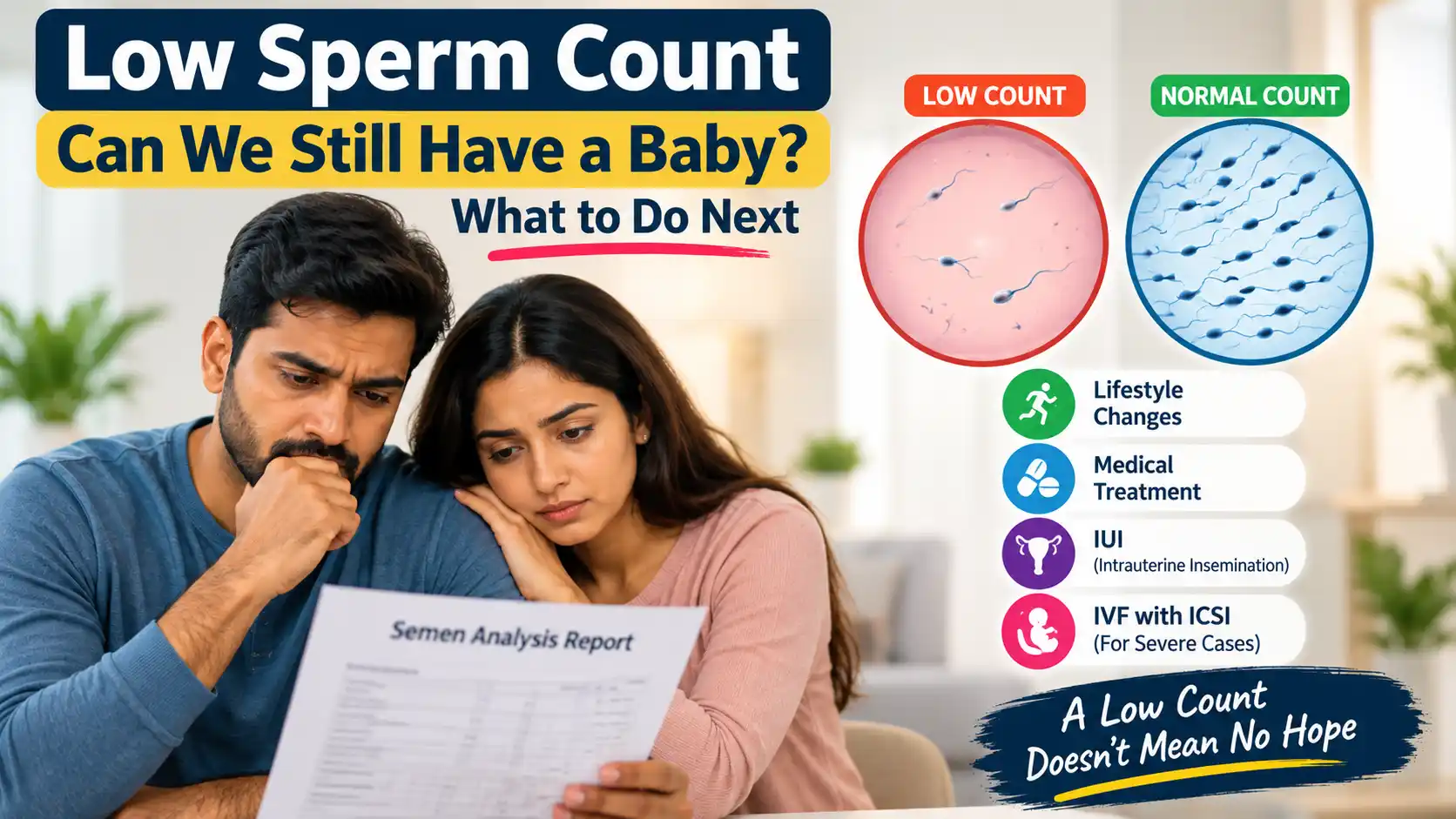
The words land quietly, usually in a doctor’s cabin. “Your husband’s sperm count is low.” For a moment nobody speaks. Then the unspoken questions start: Is this our fault? Can we still have a baby with low sperm count? Will people find out?
If you’re holding a semen report right now, take a breath first. A low sperm count is common, often treatable, and rarely the end of the road to parenthood. It’s information, and information is something we can act on.
I have sat across from many couples in Vapi, Daman, and Silvassa holding this exact report. What they need first isn’t a biology lecture. They need to know, plainly, what comes next.
Key Takeaways
- A low sperm count (oligospermia) means fewer sperm than average, but it does not automatically mean infertility. Many men with mild to moderate low counts still father children naturally or with basic treatment.
- Male factors contribute to roughly half of all infertility cases, and about 1 in 6 people globally face infertility at some point.
- A normal sperm concentration is generally 15 million per millilitre or higher. Counts below this are graded mild, moderate, or severe.
- Treatment depends on severity: lifestyle changes and medicines help mild cases, IUI works for select mild-to-moderate cases, and IVF with ICSI is usually needed for severe cases or azoospermia (zero sperm).
- Couples from Vapi, Daman, Silvassa, Valsad, and nearby South Gujarat towns can access full male fertility testing and treatment locally at iSHA, without travelling to a bigger city.
Low Sperm Count, Can We Still Have a Baby?
Yes, in most cases. The count sits on a spectrum, not a single verdict of “fertile” or “infertile.” Some men with a mild reduction conceive within months, sometimes without treatment. Others need medical help to get there.
“I tell couples this on the first visit: a low number on a report is a starting point for a conversation, not a full stop. Most men with a low count still have sperm capable of fertilising an egg, once we understand the cause.” — Dr. Kaushal Patel
What decides your path is how low the number is, why it’s low, and whether the wife’s fertility factors are also involved. A proper work-up matters more than the single figure on the page.
What a Semen Analysis Actually Shows
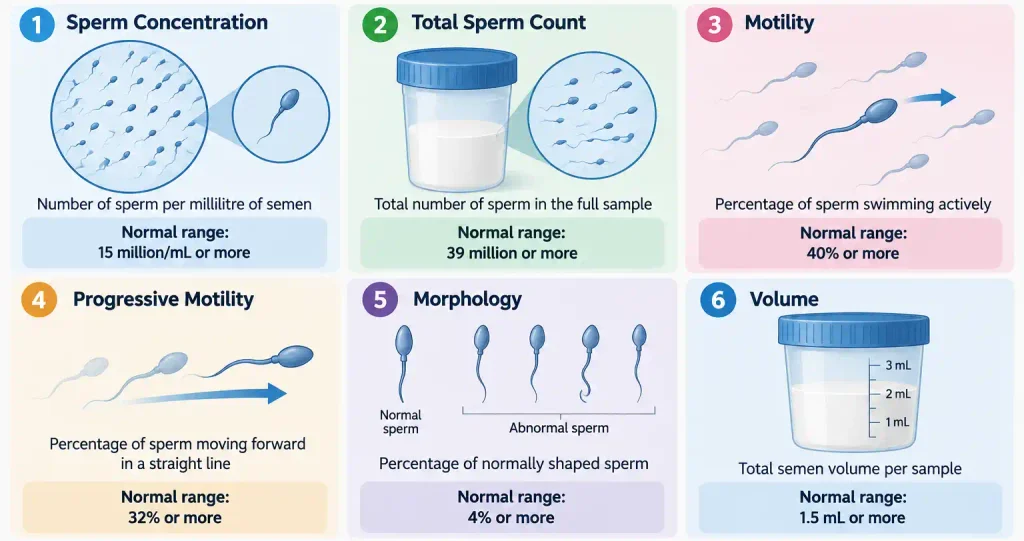
A semen analysis measures several things together, not just concentration.
| Parameter | What it means | Typical normal range |
|---|---|---|
| Sperm concentration | Sperm per millilitre of semen | 15 million/mL or more |
| Total sperm count | Total sperm in the full sample | 39 million or more |
| Motility | Percentage of sperm swimming actively | 40% or more |
| Progressive motility | Sperm moving forward in a straight line | 32% or more |
| Morphology | Percentage of normally shaped sperm | 4% or more |
| Volume | Total semen volume per sample | 1.5 mL or more |
A report rarely shows just one abnormal value. Often it’s a mix, low count with reduced motility, or normal count with poor shape. That combination guides treatment, not the count alone.
Sperm motility is simply how well sperm swim. A man can have a decent count but if most sperm barely move, natural conception gets harder. A normal count is generally 15 million/mL or above. Below that, doctors grade it: mild (10-15 million/mL, natural conception often realistic), moderate (5-10 million/mL, harder but achievable with help), severe (below 5 million/mL, usually needs IVF), or azoospermia, no sperm detected, which needs specialised evaluation.
What Causes This
Couples almost always ask why. Often it’s several small factors adding up. Lifestyle habits matter most: smoking, heavy alcohol, tobacco chewing, obesity, and chronic stress all reduce sperm production over time. Heat exposure from long drives, laptops on the lap, or frequent hot baths raises scrotal temperature, which sperm don’t tolerate well. Medical conditions like varicocele, hormonal imbalance, past infections, or undescended testicles in childhood are common. Occupational exposure to industrial chemicals is relevant for men working in Vapi’s industrial belt. Genetic factors, though less common, can also play a role.
Most men have no obvious symptoms, which is why the report often comes as a shock. Occasionally there are clues: reduced sex drive, testicular pain or swelling, smaller than average testicles, or reduced facial and body hair. None confirm infertility alone, they’re simply reasons to get evaluated sooner.
The Silence Nobody Talks About
In most homes across Vapi and Silvassa, when a couple struggles to conceive, the first assumption falls on the wife. She gets sent for scans and tablets, often before anyone suggests checking the husband. This isn’t accurate, male factors are involved in close to half of all infertility cases.
The shame runs deep for men too, since it often feels like a personal failure rather than a medical finding. Wives often feel relief that it isn’t “her fault,” alongside a quiet worry about supporting a husband who feels smaller for it. Couples who treat this as a shared issue, not one partner’s burden, move through treatment faster and with less strain on the marriage.
“The couples who do best are the ones who sit together and treat this as ‘our’ problem, not ‘his’ problem. That shift alone changes how quickly they heal, mentally and medically.” — Dr. Kaushal Patel
How Is It Diagnosed
Diagnosis starts simple. A semen analysis, ideally repeated after 2-3 months since sperm production cycles take about that long, is always the first step. One report is never enough to base treatment on.
If the number is low, a hormone panel checks testosterone, FSH, LH, and thyroid, since hormonal imbalance is a frequent, correctable cause. A physical exam checks for varicocele or structural issues. Depending on findings, scrotal ultrasound, genetic testing, or DNA fragmentation testing may follow. For azoospermia, TESA (Testicular Sperm Aspiration), retrieving sperm directly from testicular tissue with a fine needle, helps determine whether sperm exist at all.
Can It Improve With Medicines, Lifestyle, or Treatment
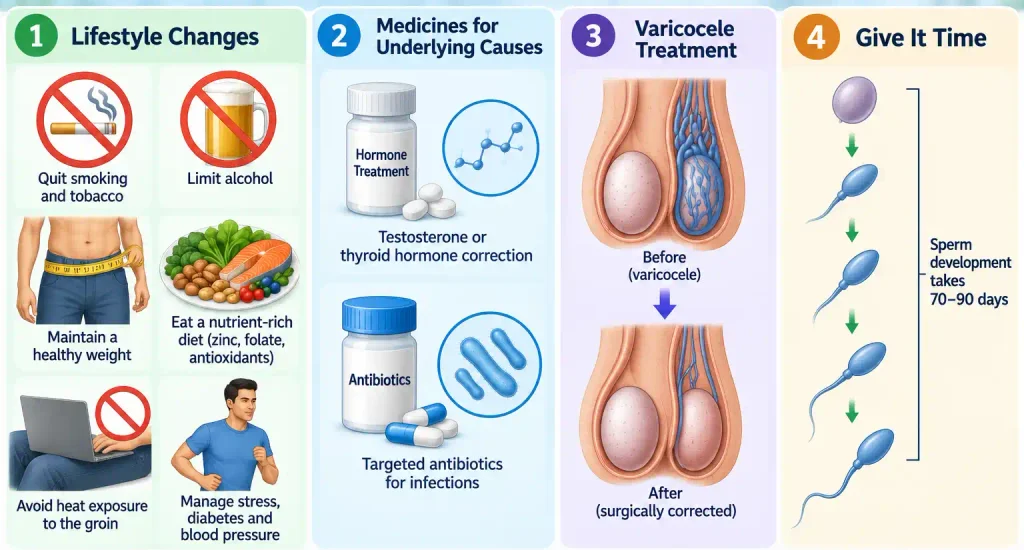
Often, yes, especially when the cause is identifiable. Lifestyle changes can meaningfully improve semen parameters over 3-6 months in mild cases: quitting smoking and tobacco, limiting alcohol, losing excess weight, managing diabetes and blood pressure, avoiding heat exposure to the groin, and eating a diet rich in zinc, folate, and antioxidants.
Which medicines help? When hormonal imbalance is the cause, medicines correcting testosterone or thyroid levels can improve production over a few months. Infections are treated with targeted antibiotics before reassessing. A significant varicocele may be corrected surgically. None of this is instant, sperm takes 70-90 days to mature, so treatment needs at least one full cycle before its effect shows on a repeat report.
What to Do First
Book a joint consultation rather than sending the husband alone or as an afterthought. Bring both partners’ history. Repeat the semen analysis if the first report is old. Ask directly what category the number falls into and what that means for your chances. Discuss a realistic timeline together, including what happens if lifestyle changes don’t shift things within a few months.
Should the wife also be tested? Yes, almost always, even when the husband’s report is clearly abnormal. Fertility is a shared process, and treating only one partner’s factor delays real progress. A basic evaluation typically includes hormone levels, an ultrasound, and a check on ovulation and tubal health. A fertility evaluation for couples trying to conceive moves faster and more accurately when both partners are assessed together from the start.
Can We Get Pregnant Naturally, or Do We Need Treatment
This depends on severity and the wife’s fertility factors. With a mild reduction and no issues on her side, many couples conceive naturally, sometimes it just takes longer than the “textbook” year. With moderate reduction, doctors often suggest 6 months to a year of lifestyle correction, then reassessing. With severe reduction or azoospermia, natural conception is unlikely and assisted reproduction becomes the practical path rather than a last resort.
Can IUI Still Work
Yes, for the right cases. IUI (intrauterine insemination) places specially prepared, concentrated sperm directly into the uterus around ovulation, bypassing some natural barriers. It works reasonably well for mild to moderate cases when motility isn’t too badly affected and the wife’s tubes are healthy. It works less well when the number is severely low or morphology is significantly abnormal, and doctors usually recommend moving to IVF rather than repeating cycles unlikely to succeed. Our IVF vs IUI comparison walks through why one gets recommended over the other.
When IVF or ICSI Becomes Necessary
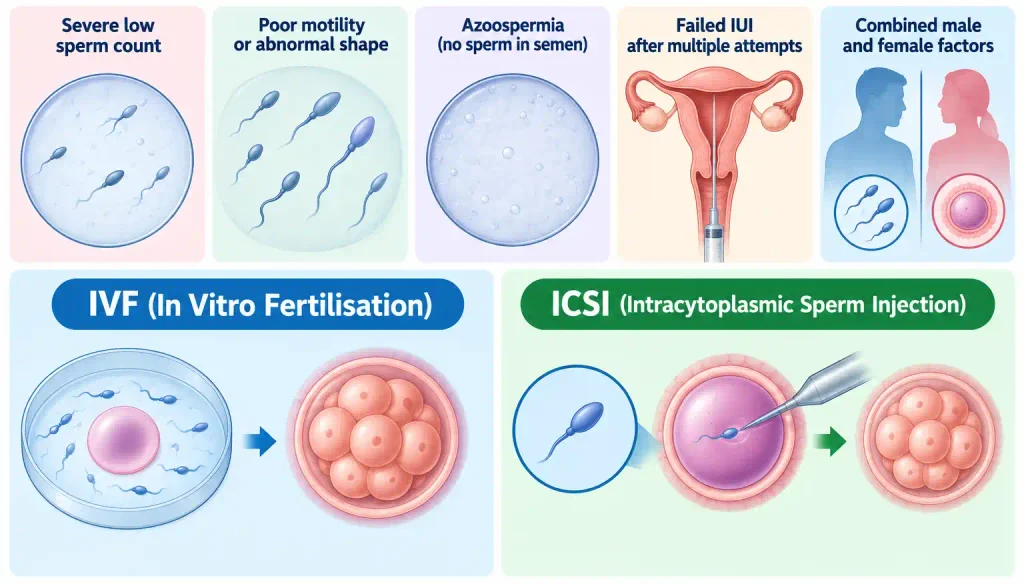
Some couples reach a point where IUI and lifestyle changes have been tried, or the report doesn’t leave room for them to work. That point usually looks like: severe oligospermia (below 5 million/mL), very poor motility or morphology despite a reasonable count, azoospermia needing surgical sperm retrieval, failed IUI after about 3 attempts, or combined male and female factors.
This is where IVF with ICSI becomes genuinely useful. In standard IVF, sperm and eggs are combined in a lab dish and fertilisation happens on its own. With ICSI (Intracytoplasmic Sperm Injection), an embryologist selects a single healthy sperm and injects it directly into the egg. Even a handful of sperm, sometimes one usable sperm per egg, can achieve fertilisation. For azoospermia, sperm retrieved through TESA can be used the same way. ICSI has genuinely changed outcomes for men who, a generation ago, would have been told biological fatherhood wasn’t possible.
Setting the Record Straight: Common Myths
1. A low count always means complete infertility. False. Most men with a low count still have some functioning sperm; the question is which treatment gets those sperm to an egg.
2. If pregnancy happens naturally, the “problem” wasn’t real. Not necessarily. Even a low count usually has some fertile sperm, conception is less likely per cycle, not impossible.
3. IVF or ICSI can be used to choose the baby’s gender. This myth needs a direct answer. Under India’s PCPNDT Act, sex selection before or after fertilisation is strictly illegal, regardless of technique or reason. Reputable clinics, including iSHA, do not offer or facilitate gender selection in any form. Any clinic suggesting otherwise is acting outside the law and outside safe medical practice.
4. Male infertility treatment takes years. Most plans show meaningful change, or a clear next step, within 3-6 months, one to two sperm production cycles.
Real Situations From This Region
A mechanic from Silvassa came in with his wife after eighteen months of trying, convinced the problem was hers. His report showed a moderate reduction linked largely to tobacco use and long hours in vehicle heat. Six months of lifestyle change and targeted medicine brought his numbers up enough for a natural conception.
A couple from Daman had a very different report: a severe reduction with almost no motile sperm. No lifestyle fix would have closed that gap. They moved to IVF with ICSI within a few months and are now expecting. Neither story is unusual. What varies is severity, not whether a path forward exists.
Male Infertility Testing Across South Gujarat
Vapi, Daman, Silvassa, Valsad, Umargam, and the wider Dadra and Nagar Haveli region have long dealt with a gap: proper andrology testing usually meant a trip to Mumbai, Surat, or Ahmedabad, adding cost, time off work, and stress to an already hard situation.
That gap doesn’t need to exist anymore. Couples from these areas can access complete male fertility testing at iSHA, from the initial semen analysis and hormone panel through to IUI, IVF, and ICSI, all under one roof. Whether you’re coming for a first opinion or a second one, the full evaluation and treatment pathway is available without leaving the region.
A Final Thought
A low sperm count report can feel like it’s taken something away, some certainty about the family you imagined. What I’ve seen far more often is that it simply changes the route, not the destination. Some couples need a few months of lifestyle change. Some need IUI. Some need IVF with ICSI. Almost all of them, once they get evaluated properly instead of guessing in silence, find their way to a pregnancy. That number on the page is a starting point for treatment, not a final answer about your family.
Frequently Asked Questions
1. Can we still have a baby if my husband has a low sperm count?
In most cases, yes. A low count reduces the odds per cycle rather than eliminating them, and treatment from lifestyle changes to IUI or IVF with ICSI helps most couples conceive once the severity and cause are identified.
2. How low is too low for sperm count to get pregnant naturally?
Natural conception becomes significantly harder below roughly 5-10 million per millilitre, especially with reduced motility. Above that range, many couples still conceive naturally, sometimes with a longer timeline.
3. Does a low sperm count mean my husband is infertile?
Not automatically. Infertility means not conceiving after a year of regular, unprotected intercourse, and many men with a low count still have sperm capable of achieving pregnancy, especially with treatment.
4. What are the most common causes of low sperm count in men?
Smoking, alcohol, obesity, chronic stress, heat exposure, varicocele, hormonal imbalance, past infections, and certain medicines are the most frequent causes, often more than one at once.
5. Can low sperm count improve with medicines, lifestyle changes, or treatment?
Yes, for many men. Correcting hormonal imbalance, treating infections, quitting smoking, managing weight, and reducing heat exposure can meaningfully improve parameters over 3-6 months in cases that aren’t severe.
6. What should we do first if my husband has a low sperm count?
Book a joint consultation, repeat the semen analysis if it’s not recent, and discuss both partners’ fertility together rather than treating it as one person’s issue.
7. What tests should my husband have if his sperm count is low?
A repeat semen analysis, a hormone panel, a physical exam for conditions like varicocele, and depending on findings, scrotal ultrasound or genetic testing to identify the cause.
8. Should the wife also undergo fertility tests if her husband has low sperm count?
Yes, in nearly all cases. Fertility involves both partners, and evaluating the wife’s ovulation, hormones, and reproductive anatomy helps build a plan that fits the couple’s actual situation.
9. Can we get pregnant naturally with a low sperm count, or do we need fertility treatment?
It depends on severity. Mild cases with a healthy wife often conceive naturally, sometimes with a longer timeline. Moderate cases may need medical support, and severe cases usually require IUI, IVF, or ICSI.
10. Can IUI work if my husband has a low sperm count?
Yes, for mild to moderate cases, particularly when motility isn’t badly affected and the wife’s tubes are healthy. For severe reduction, IUI success rates drop, and IVF is usually recommended instead.
11. When is IVF or ICSI recommended for low sperm count?
IVF with ICSI is typically recommended for severe oligospermia, very poor motility or morphology, azoospermia needing surgical retrieval, or after a few unsuccessful IUI attempts.
12. What is ICSI, and how can it help with very low sperm count?
ICSI involves injecting a single selected sperm directly into an egg in the lab. It allows fertilisation to happen even with extremely few sperm, making biological fatherhood possible for many men who would otherwise struggle.
13. What happens if no sperm are found in the semen (azoospermia)?
Azoospermia needs evaluation to determine whether it’s obstructive (a blockage) or non-obstructive (a production issue). Procedures like TESA can often retrieve sperm directly from testicular tissue for use with ICSI.
14. Can couples from Vapi, Daman, Silvassa and nearby areas get treatment for male infertility at iSHA?
Yes. Complete male fertility testing and treatment, including semen analysis, hormone evaluation, IUI, and IVF with ICSI, is available locally at iSHA, so couples don’t need to travel to a bigger city.
15. Can IVF or ICSI be used to choose the baby’s gender in India?
No. Sex selection before or during fertility treatment is strictly illegal under the PCPNDT Act, regardless of technique. Reputable clinics, including iSHA, do not offer or facilitate gender selection in any form.