
Few moments in a fertility journey feel as heavy as the one where a semen report says “no sperm seen.” Most couples walk in expecting a treatable sperm count problem and walk out with a word they have never heard before. The good news is that no sperm in semen rarely means no sperm anywhere in the body. In many men, sperm are still being produced inside the testes and simply cannot reach the ejaculate.
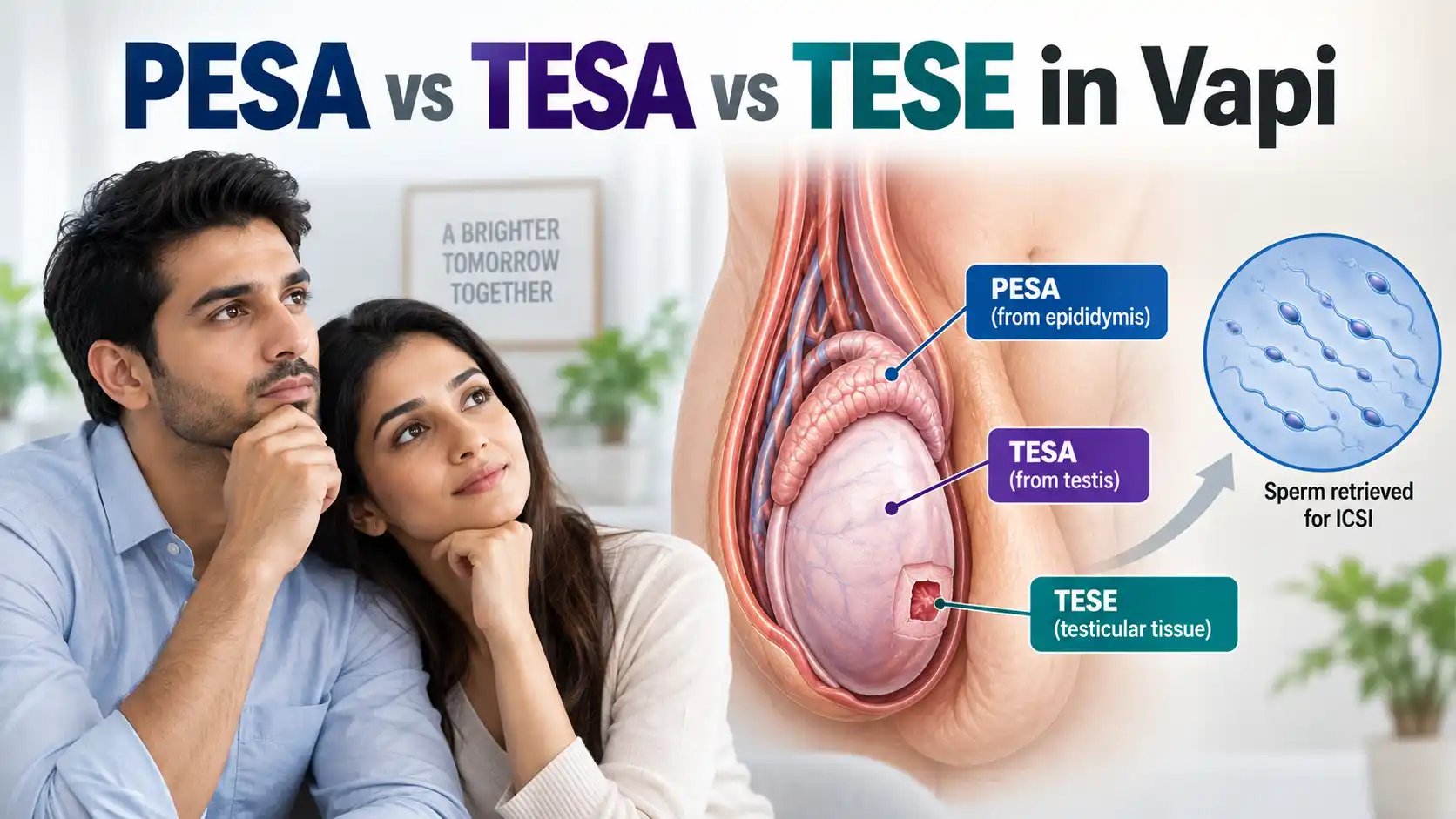
That is where surgical sperm retrieval comes in. When couples ask about PESA vs TESA vs TESE in Vapi, what they really want to know is simple: which procedure will actually find sperm for us, and how do doctors decide? The choice is not random and it is not a matter of preference. It follows the cause of the blockage or the production failure, the hormone profile, the examination findings, and what the lab needs on the day of egg collection.
Key Takeaways
- Azoospermia, or zero sperm in semen, affects roughly 1% of all men and around 10 to 15% of men with infertility.
- The core split is obstructive (production is fine, the plumbing is blocked) versus non-obstructive (production itself is reduced). This single distinction drives almost the entire decision.
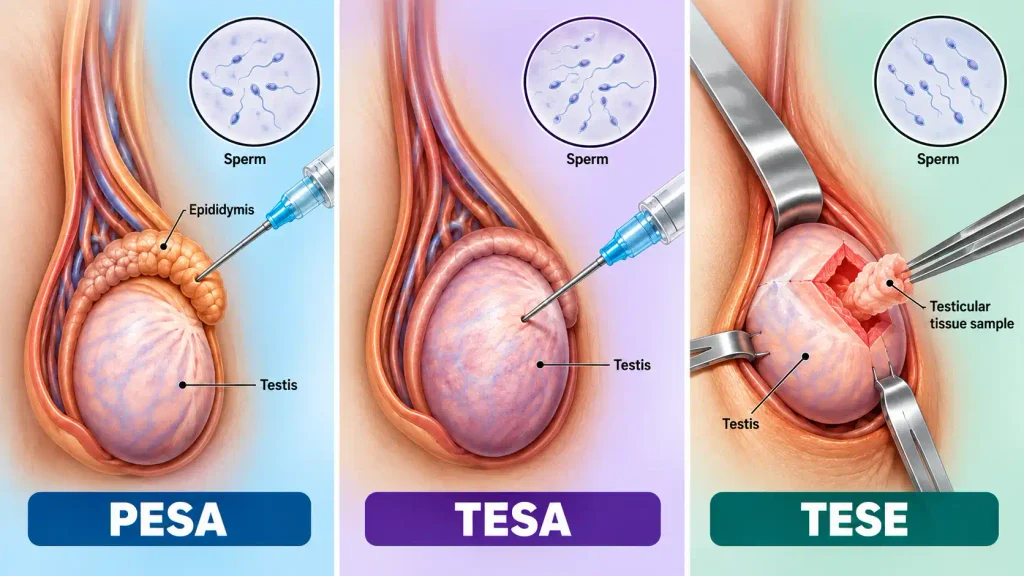
- PESA draws sperm from the epididymis with a fine needle. It suits obstructive cases and is the least invasive option.
- TESA takes a small sample directly from the testis with a needle. It is used when PESA fails or when the epididymis is not accessible.
- TESE is an open surgical biopsy of testicular tissue. It gives the highest chance of finding sperm in difficult, non-obstructive cases.
- In obstructive azoospermia, sperm are found in the large majority of attempts. In non-obstructive azoospermia, microsurgical TESE recovers sperm in roughly half of men.
- Sperm retrieved by any of these methods is used with ICSI, where a single sperm is injected into an egg. Retrieval alone is not a treatment; it is one half of a plan.
- A full workup, including hormones, genetic tests and a scrotal scan, should be completed before the method is chosen.
Why the Procedure Choice Matters More Than the Procedure Itself
Picking the wrong retrieval method wastes the one thing fertility treatment cannot replace: tissue and time. Every needle pass and every biopsy causes a small amount of scarring. A poorly planned attempt can reduce the yield of a later, better-planned one.
So the real question is never “which procedure is best.” It is “which procedure matches this man’s biology.”
“When I explain PESA, TESA and TESE to a couple, I tell them we are not choosing a favourite. We are matching the technique to the reason sperm is missing. Get that reason right and the procedure almost chooses itself.” Dr. Kaushal Patel
The Two Questions That Decide Everything
Before any needle is planned, two questions are answered.
First question: is sperm being produced?
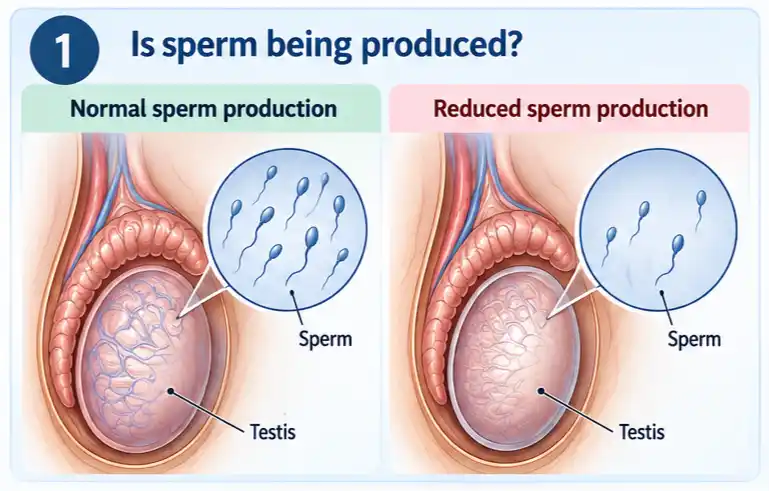
Testicular size, FSH levels, and testosterone give a strong signal. Normal-sized testes with normal FSH usually mean production is healthy. Small, soft testes with a high FSH point towards a production problem.
Second question: can the sperm get out?
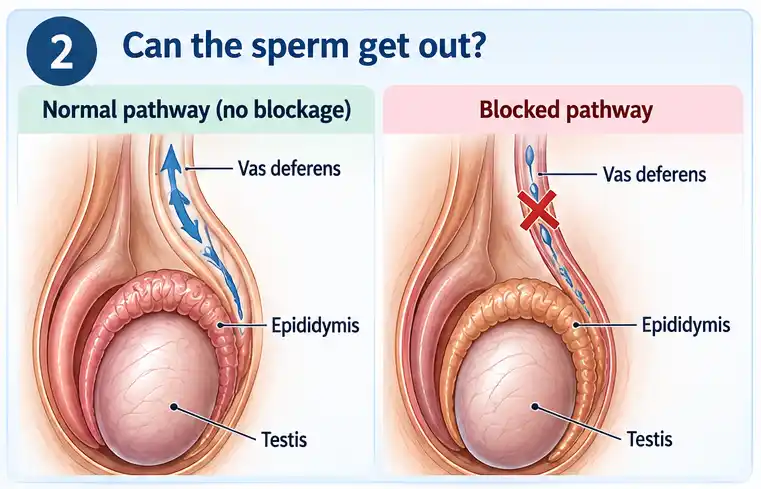
A blocked or absent vas deferens, a previous vasectomy, an old infection, or scarring from surgery can trap perfectly healthy sperm. A scrotal ultrasound and clinical examination usually answer this.
The answers sort every patient into one of two groups.
| Finding | Obstructive azoospermia | Non-obstructive azoospermia |
|---|---|---|
| Sperm production | Normal | Reduced or patchy |
| Testicular size | Usually normal | Often small |
| FSH level | Usually normal | Usually raised |
| Common causes | Vasectomy, infection, absent vas, surgical scarring | Genetic causes, undescended testes, chemotherapy, varicocele damage |
| Chance of finding sperm | Very high | Variable, roughly half |
| Usual first choice | PESA | TESE or micro-TESE |
PESA: Percutaneous Epididymal Sperm Aspiration
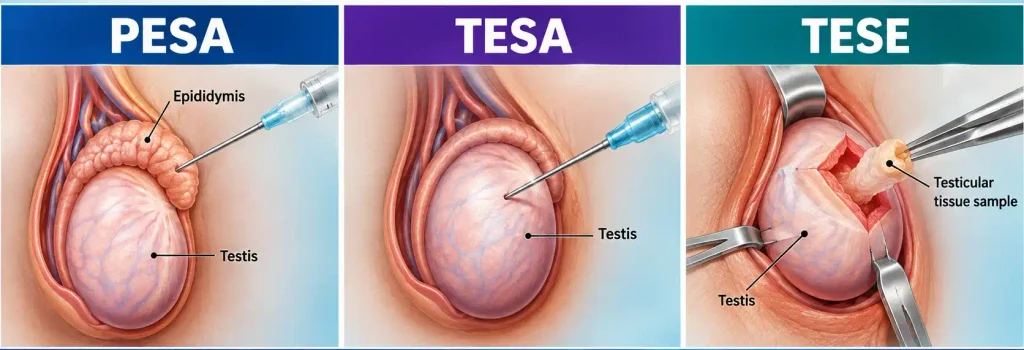
PESA means drawing fluid from the epididymis, the coiled tube sitting behind the testis where sperm mature and wait.
1. How it works
A fine needle is passed through the scrotal skin into the epididymis under local anaesthesia or short sedation. Fluid is aspirated and checked immediately under a microscope. If motile sperm appear, the procedure is over, often within fifteen minutes.
2. Who it suits
PESA treatment in Vapi is offered mainly to men with obstructive azoospermia, where sperm are made normally but blocked on the way out. Post-vasectomy cases and blockages after infection respond particularly well.
3. Strengths and limits
- No incision, no stitches, and same-day discharge in most cases.
- Sperm quality is usually good because they have already matured in the epididymis.
- Yield can be low or absent if the epididymis is scarred, shrunken, or congenitally missing.
- Repeated aspiration in the same site over time can cause fibrosis.
“PESA is the gentlest option we have, and for a man with a simple blockage it is often all that is needed. But gentleness is not a reason to choose it when the biology points elsewhere.” Dr. Kaushal Patel
TESA: Testicular Sperm Aspiration
TESA moves one step deeper. Instead of the epididymis, the needle goes into the testis itself.
1. How it works
Under local anaesthesia, a needle attached to a syringe is inserted into the testicular tissue and gentle suction pulls out a small amount of seminiferous tubule material. The embryologist searches that sample for sperm straight away.
2. Who it suits
TESA treatment in Vapi is generally used when:
- PESA has failed or the epididymis cannot be reached.
- The blockage sits very close to the testis.
- The couple needs a quick, low-impact option on the same day as egg collection.
- Production is known to be reasonable, so only a small sample is needed.
3. Strengths and limits
- Still minimally invasive, with no formal incision.
- Useful as an immediate backup when PESA yields nothing.
- Sperm from the testis are often immotile or slow-moving, which is normal and does not prevent fertilisation with ICSI.
- In non-obstructive cases, a blind needle sample can easily miss the few pockets of active production.
That last point is the single most important limitation. Sperm production in a failing testis is patchy. A needle samples one small area. If that area is quiet, the result comes back empty even though sperm exist a few millimetres away.
TESE: Testicular Sperm Extraction
TESE is a proper surgical retrieval rather than an aspiration.
1. How it works
A small incision is made in the scrotum and the testis is exposed. One or more tiny pieces of testicular tissue are removed, then processed and examined by the embryology team. In micro-TESE, an operating microscope is used to identify the fuller, more opaque tubules that are most likely to contain sperm, which dramatically improves targeting while removing less tissue.
The procedure is usually performed under general or spinal anaesthesia and takes longer than a needle procedure.
2. Who it suits
TESE is the preferred route when:
- Azoospermia is non-obstructive, with raised FSH and small testes.
- Previous PESA or TESA attempts found nothing.
- A genetic cause such as Y-chromosome microdeletion or Klinefelter syndrome is present.
- The team needs the best possible chance in a single attempt.
3. Strengths and limits
- Highest retrieval rate in difficult cases, because far more tissue is sampled and examined.
- Micro-TESE allows targeted sampling and better preservation of healthy tissue.
- Requires anaesthesia, stitches, and a longer recovery.
- Slightly higher risk of swelling, bruising, and temporary drops in testosterone.
“A man with non-obstructive azoospermia deserves the method with the best odds, not the method with the smallest needle. Doing a thorough retrieval once is kinder than three hopeful attempts that find nothing.” Dr. Kaushal Patel
Side-by-Side Comparison
| Feature | PESA | TESA | TESE |
|---|---|---|---|
| Full name | Epididymal sperm aspiration | Testicular sperm aspiration | Testicular sperm extraction |
| Tissue targeted | Epididymis | Testis, needle sample | Testis, surgical biopsy |
| Anaesthesia | Local or sedation | Local or sedation | General or spinal |
| Incision | None | None | Small scrotal incision |
| Typical duration | 10 to 20 minutes | 15 to 30 minutes | 45 to 90 minutes |
| Best suited to | Obstructive azoospermia | Obstructive cases, PESA backup | Non-obstructive azoospermia |
| Sperm maturity | Mature, often motile | Immature, often immotile | Immature, often immotile |
| Recovery | 1 to 2 days | 2 to 3 days | 5 to 7 days |
| Repeatability | Good, limited by scarring | Good | Limited, tissue-sparing matters |
Where ICSI Fits In
Every discussion about PESA vs TESA vs TESE in Vapi ends in the same place: the embryology laboratory. Retrieval is only useful if the laboratory can do something with what it finds. Surgically retrieved sperm are too few and often too slow to fertilise an egg on their own. So every one of these procedures is paired with ICSI, where the embryologist selects a single sperm and injects it directly into a mature egg.
Timing matters. Retrieval is either done fresh on the morning of egg collection, or done in advance with freezing of the sample. Freezing gives certainty before the female partner starts stimulation, which many couples find reassuring.
Sperm found through any of these routes can fertilise eggs at rates comparable to ejaculated sperm when ICSI is used, and the NHS describes ICSI as a standard option for severe male factor cases.
What Happens If No Sperm Is Found
This is the fear nobody says out loud, so it deserves an honest answer.
If PESA finds nothing, TESA can often be attempted in the same sitting. If TESA finds nothing, TESE becomes the next logical step, either immediately or as a planned second procedure. A failed needle attempt does not close the door on surgical extraction. It often makes the case for it.
If a thorough micro-TESE also finds no sperm, the conversation shifts. Options then include donor sperm, adoption, or in selected men a period of hormonal treatment before a repeat attempt. That discussion is handled gently and without pressure, with the couple deciding the pace.
Tests Done Before the Method Is Chosen
A responsible sperm retrieval plan is built on evidence, not assumption. The usual workup includes:
- Two separate semen analyses with centrifuged pellet examination, because a handful of sperm sometimes appears on a careful second look.
- Hormone profile, mainly FSH, LH, testosterone and prolactin.
- Scrotal ultrasound to assess testicular volume, epididymal fullness, and varicocele.
- Karyotype and Y-chromosome microdeletion testing when a production problem is suspected.
- Cystic fibrosis gene screening when the vas deferens is absent on examination.
These results are reviewed together. A man with normal FSH, normal-sized testes and a full epididymis is a strong PESA candidate. A man with high FSH and small testes is planned for TESE from the start, because a needle attempt would most likely waste an opportunity.
Pain, Recovery and Practical Concerns
Discomfort is far less than most men expect. Needle procedures feel like pressure rather than sharp pain, and mild soreness settles within two or three days with simple painkillers and scrotal support.
After TESE, expect bruising and swelling for about a week. Light work can usually resume in two to three days, while heavy lifting, cycling and intercourse are paused for around two weeks.
Reasonable precautions after any of the three:
- Wear supportive underwear for seven to ten days.
- Use ice packs for the first twenty-four hours.
- Keep the area dry until the wound heals, if stitches are present.
- Report increasing pain, fever, or a rapidly enlarging scrotum immediately.
Serious complications such as infection or significant bleeding are uncommon when the procedure is done in a proper operating environment with an embryologist on site.
Cost Considerations in Vapi
Cost depends on the method, the anaesthesia used, whether freezing is included, and whether the retrieval is combined with an IVF cycle. Needle procedures cost less than open or microsurgical extraction, largely because of theatre and anaesthesia time.
The more useful way to think about it is total cost per baby, not cost per procedure. A cheaper attempt that finds nothing, followed by a second procedure, usually costs more than the correct procedure done once. A written estimate should always be given before you consent.
How PESA vs TESA vs TESE in Vapi Is Decided at Isha Hospital
Every sperm retrieval case is discussed jointly by the fertility clinician and the embryology team before scheduling. The plan covers the primary method, the backup method, whether sperm will be frozen or used fresh, and how the female partner’s cycle is timed around it.
An embryologist is present in theatre for every retrieval. That matters, because searching a sample properly takes skill and patience, and a hurried search is a common reason for a falsely negative result.
For couples comparing PESA vs TESA vs TESE in Vapi, the honest summary is this: the least invasive procedure is the right one only when the biology supports it, and the most thorough procedure is worth it when it does not.
About the Author
Dr. Kaushal Patel is a fertility specialist at Isha Hospital, Vapi, with extensive experience in male factor infertility, surgical sperm retrieval and assisted reproduction. He works closely with the in-house embryology team on PESA, TESA and TESE cases, and has a particular interest in planning retrieval for men with non-obstructive azoospermia, where careful case selection makes the greatest difference.
“Azoospermia feels like an ending when a couple first hears it. In practice it is a starting point. My job is to find out whether sperm exist, choose the method most likely to reach them, and be straight with the couple about the odds at every step.” Dr. Kaushal Patel
Final Thought
Zero sperm in semen is a diagnosis, not a verdict. Weighing PESA vs TESA vs TESE in Vapi is really about matching one man’s biology to one technique. The three retrieval techniques exist because men are different, and the skill lies in matching the technique to the man rather than applying one method to everyone. Obstruction usually calls for a gentle aspiration. A production problem usually calls for a thorough, microscope-guided extraction. Everything in between is decided by hormones, examination and honest conversation.
If a semen report has shown no sperm, the next step is a full evaluation rather than a rushed procedure.
Discuss the appropriate sperm-retrieval option with the fertility team in Vapi. Book a consultation at Isha Hospital and bring all previous reports with you.
Frequently Asked Questions
1. What is the difference between PESA, TESA and TESE?
PESA takes sperm from the epididymis with a fine needle, TESA takes a needle sample from inside the testis, and TESE removes a small piece of testicular tissue through a surgical incision. They differ in depth, invasiveness and how much tissue is examined. PESA is the gentlest, TESE gives the highest chance of finding sperm in difficult cases.
2. How do doctors decide between PESA, TESA and TESE in Vapi?
The choice in PESA vs TESA vs TESE in Vapi rests on whether the problem is a blockage or a production failure, which is judged from FSH levels, testicular size, examination findings and a scrotal ultrasound. Genetic tests are added when production is suspected to be poor. The method with the best chance of success for that specific profile is chosen, along with a planned backup.
3. Is PESA or TESA better for obstructive azoospermia?
PESA is usually the first choice in obstructive azoospermia because epididymal sperm are already mature and often motile. TESA is used when PESA yields nothing, when the epididymis is scarred, or when it is congenitally absent. Both work well in blockage cases, and the switch between them can happen in the same sitting.
4. When is TESE preferred over PESA or TESA?
TESE is preferred when azoospermia is non-obstructive, when FSH is high and testes are small, or when earlier needle attempts found no sperm. It samples far more tissue, and micro-TESE allows the surgeon to target the tubules most likely to contain sperm. It is also chosen when a genetic cause is known.
5. Can PESA, TESA or TESE be used for non-obstructive azoospermia?
TESE, particularly micro-TESE, is the appropriate option for non-obstructive azoospermia. PESA is rarely useful because the epididymis holds no sperm when production has failed, and TESA often misses the small pockets of active production. Choosing a needle method here frequently leads to an avoidable negative result.
6. Which sperm retrieval procedure has the highest chance of finding sperm?
Micro-TESE has the highest success rate in men with impaired sperm production, recovering sperm in roughly half of cases. In men with a simple blockage, PESA performs extremely well and is far less invasive. The highest chance always depends on the diagnosis rather than the technique alone.
7. Is PESA less invasive than TESA or TESE?
Yes. PESA uses a fine needle through the skin with no incision and usually only local anaesthesia. TESA is also needle-based but enters the testis, while TESE involves a small surgical cut and a longer recovery period.
8. Are PESA, TESA and TESE painful procedures?
Anaesthesia means the procedure itself is not painful. Most men describe pressure during needle procedures and mild soreness afterwards, comparable to a sports injury. Discomfort after TESE lasts a little longer and is managed well with simple painkillers and scrotal support.
9. How long does recovery take after PESA, TESA or TESE?
Most men return to routine activity within one to three days after PESA or TESA. After TESE, expect around five to seven days of soreness and swelling, with heavy lifting and intercourse avoided for about two weeks. Supportive underwear and ice packs speed up comfort in all three.
10. Can sperm retrieved through PESA, TESA or TESE be used for ICSI?
Yes, and ICSI is essential for all of them. Retrieved sperm are too few and often immotile, so the embryologist injects a single selected sperm directly into each mature egg. Fertilisation rates with this approach are comparable to those using ejaculated sperm.
11. What happens if PESA or TESA does not retrieve sperm?
The team can usually move to the next step in the same sitting, from PESA to TESA, or plan a TESE shortly afterwards. A negative needle result does not mean sperm are absent, only that the sampled area was quiet. The retrieval plan is then revised with the additional information gained.
12. Can TESE be performed after unsuccessful PESA or TESA?
Yes, and it is a common sequence. Previous needle attempts cause minor scarring but rarely prevent a successful extraction later. When possible, micro-TESE is chosen for the repeat attempt because it targets tissue more precisely.
13. What tests are needed before choosing a sperm retrieval procedure?
Two centrifuged semen analyses, hormone tests including FSH, LH and testosterone, and a scrotal ultrasound are standard. Karyotype and Y-chromosome microdeletion testing are added when production failure is suspected, and cystic fibrosis screening when the vas deferens is absent. These results together decide the method.
14. How much does PESA, TESA or TESE treatment cost in Vapi?
Needle procedures cost less than surgical extraction because they need less theatre and anaesthesia time, and the final figure also depends on freezing and whether an IVF cycle runs alongside. A written estimate is provided before consent. Comparing total cost to reach a pregnancy is more useful than comparing single procedure prices.
15. Where can I discuss PESA, TESA and TESE sperm retrieval options in Vapi?
The fertility team at Isha Hospital, Vapi reviews sperm retrieval cases jointly with the embryology team before any procedure is scheduled. Bring your semen analysis reports, hormone results and any previous scans to the first visit. A consultation can be booked directly through the hospital.