

A semen report can change a couple’s whole week. The count reads 0.4 million. Or the remark simply says “no sperm seen.” Most men read that line and assume the door has shut.
It has not.
Severe male infertility in Vapi is one of the least understood problems we deal with. A near-zero count tells us how many sperm reached the semen. It does not tell us if the testicles are making sperm at all. Those are two very different questions. Only proper testing can tell them apart.
What follows is the path a couple should expect after that report. Which tests matter. What each result changes. And which treatments become real once the cause is clear.
Key Takeaways
- Infertility is common. Around 17.5% of adults, roughly one in six, face it.
- Azoospermia means no sperm in the semen. It affects about 1% of all men. Among men tested for infertility, the figure is 10% to 15%.
- One report is never enough. The label is fair only after two samples are spun down and checked as a pellet.
- Zero sperm has two very different meanings. Either the path is blocked, or the testis makes too few sperm. About 60% of cases are the second type.
- Sperm are still found in many men with non-obstructive azoospermia. Micro-TESE sperm retrieval rates of approximately 43% to 63% have been reported.
- A handful of sperm is enough for ICSI. Numbers that fail for natural conception or IUI can still work here.
- Hormonal testing and genetic testing do more than name the problem. They change the plan and the odds.
- Donor sperm is one choice among many. It should never be the first thing offered before tests are done.
When a Low Count Turns Serious
Labs in India follow WHO values. The lower limit for sperm count is 16 million per ml. Falling below it does not always mean you need treatment.
The picture changes as the count drops. A very low sperm count, under about 5 million per ml, makes a natural pregnancy unlikely. IUI is a poor bet too. That is where the word “severe” starts to fit.
“Patients often ask me if a count of one million is better than zero. In the clinic, both sit in the same bracket. What matters far more is why the count is low, because that is what shapes the treatment.” Dr. Kaushal Patel
Reports use different words for different states. Those words matter.
| What the report says | What it usually means | What normally follows |
|---|---|---|
| Count under 16 million per ml | Mild to moderate drop | Repeat test, look for a cause |
| Count under 5 million per ml | Very low sperm count | Hormone tests, gene tests, plan towards ICSI |
| None on the slide, a few after spinning | Cryptozoospermia | Sperm may still be usable, often frozen |
| None even in the spun pellet, twice | Azoospermia | Full male work-up before any treatment |
Was your report based on one sample? Was the gap since the last ejaculation left blank? Then treat it as half a story. Sperm output shifts month to month. A fever or recent illness can pull a count down for a while.
Blocked, or Not Being Made?
Every plan for male factor infertility rests on one fork in the road. Either sperm are made and cannot get out, or the testis makes far too few.
Men in the first group tend to have normal sized testicles and normal hormones. The sperm sit behind a block. Men in the second group show the opposite: smaller testicles and a high FSH.
| Feature | Blocked path (obstructive) | Poor production (non-obstructive) |
|---|---|---|
| Sperm made in the testis | Usually normal | Low, patchy or none |
| Testicle size | Usually normal | Often small or soft |
| FSH level | Usually normal | Often high |
| Common causes | Vasectomy, hernia or scrotal surgery, infection, missing vas deferens | Gene faults, undescended testis, mumps after puberty, chemotherapy |
| Odds of finding sperm | Very high | Mixed, often around half |
| Usual route | PESA or TESA, sometimes repair surgery | TESE or micro-TESE, sometimes hormones first |
This split is not just theory. In severe male infertility in Vapi, it decides which step is booked. It sets how long the man stays in the theatre. It shapes what the couple are told about their odds. Getting it wrong wastes time and money.
Tests That Should Come First
The work-up for severe male infertility in Vapi follows a set order. Skipping steps to reach IVF faster tends to cost more later.
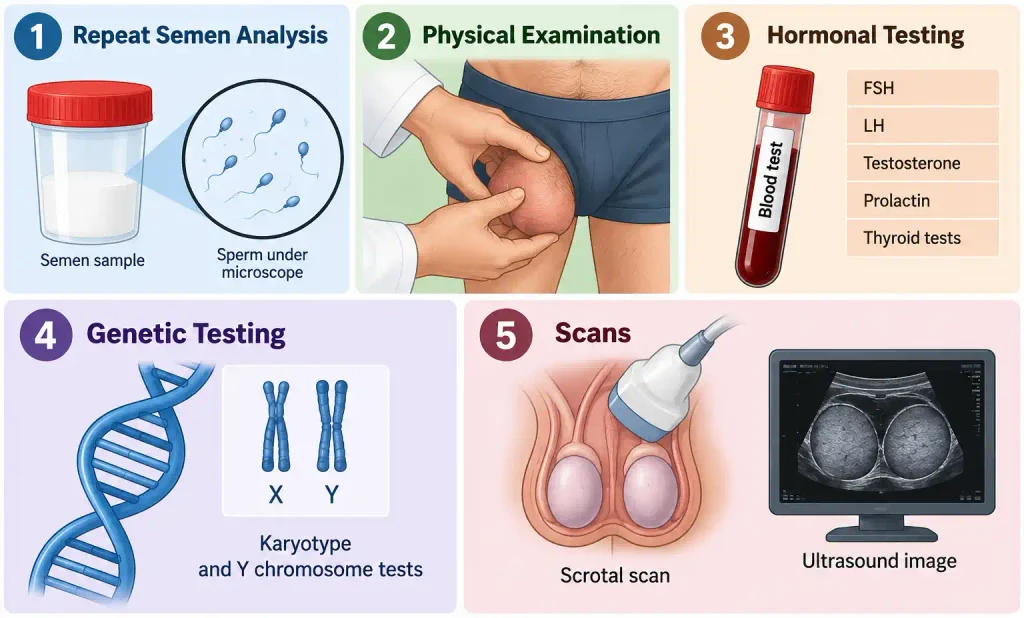
1. Repeat the semen analysis, properly
Two samples, a few weeks apart. Leave a gap of two to five days before each one. The lab must spin the sample. It must then check the pellet before writing “azoospermia.” Many men labelled that way turn out to have a few sperm.
2. Examine, do not assume
A scrotal exam takes two minutes. It answers several questions at once. Size of each testicle, the vas deferens on both sides, a full epididymis, a varicocele: all can be felt by hand. If the vas cannot be felt, the cause is likely genetic.
3. Hormonal testing
The core panel is FSH, LH, testosterone and prolactin. Thyroid tests are added if symptoms point that way. These numbers tell us where the fault sits.
- Low FSH with low testosterone often responds well to injections
- High FSH with small testicles points to testicular failure
- High prolactin needs its own work-up first
- Normal hormones with normal testicles hint at a block
4. Genetic testing
Karyotype and Y chromosome tests are advised for men under 5 million per ml. They are advised for every man with azoospermia. CFTR gene tests are added when the vas deferens is missing.
“Genetic testing is not about finding fresh worries. It tells us how likely a retrieval is to work. It also lets us give the couple honest advice before surgery rather than after.” Dr. Kaushal Patel
Scans
A scrotal scan confirms testicle size and picks up a varicocele. A rectal scan is kept for men with low semen volume, where a duct block is likely.
Treatment Options Once the Cause Is Clear
Care for severe male infertility in Vapi falls into four broad routes. The right one rests on what the tests found.
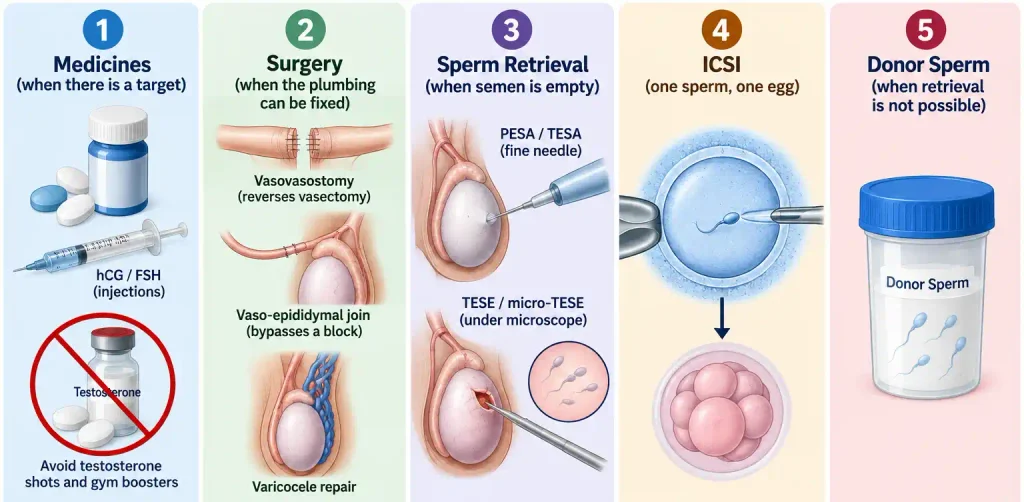
1. Medicines, when there is a target
Hormone therapy works well in one group. That means men with low pituitary output, high prolactin, untreated thyroid disease or an active infection. Shots of hCG, sometimes with FSH, can lift the count over six to nine months.
What tablets cannot do is undo testicular failure. Nothing can restart sperm making once the testis is damaged.
One warning deserves weight. Testosterone shots, gym boosters and some strength products shut down sperm making. The effect can last a year or more. Men trying for a baby should stop them and tell their doctor.
2. Surgery, when the plumbing can be fixed
Microsurgery suits some blocks. A vasovasostomy can reverse a vasectomy. A vaso-epididymal join can bypass a block in the epididymis. A duct block can be opened with a scope.
Varicocele repair is an option when a large varicocele sits alongside poor semen quality. Gains are slow and not certain. So the partner’s age always feeds into that call.
3. Sperm retrieval
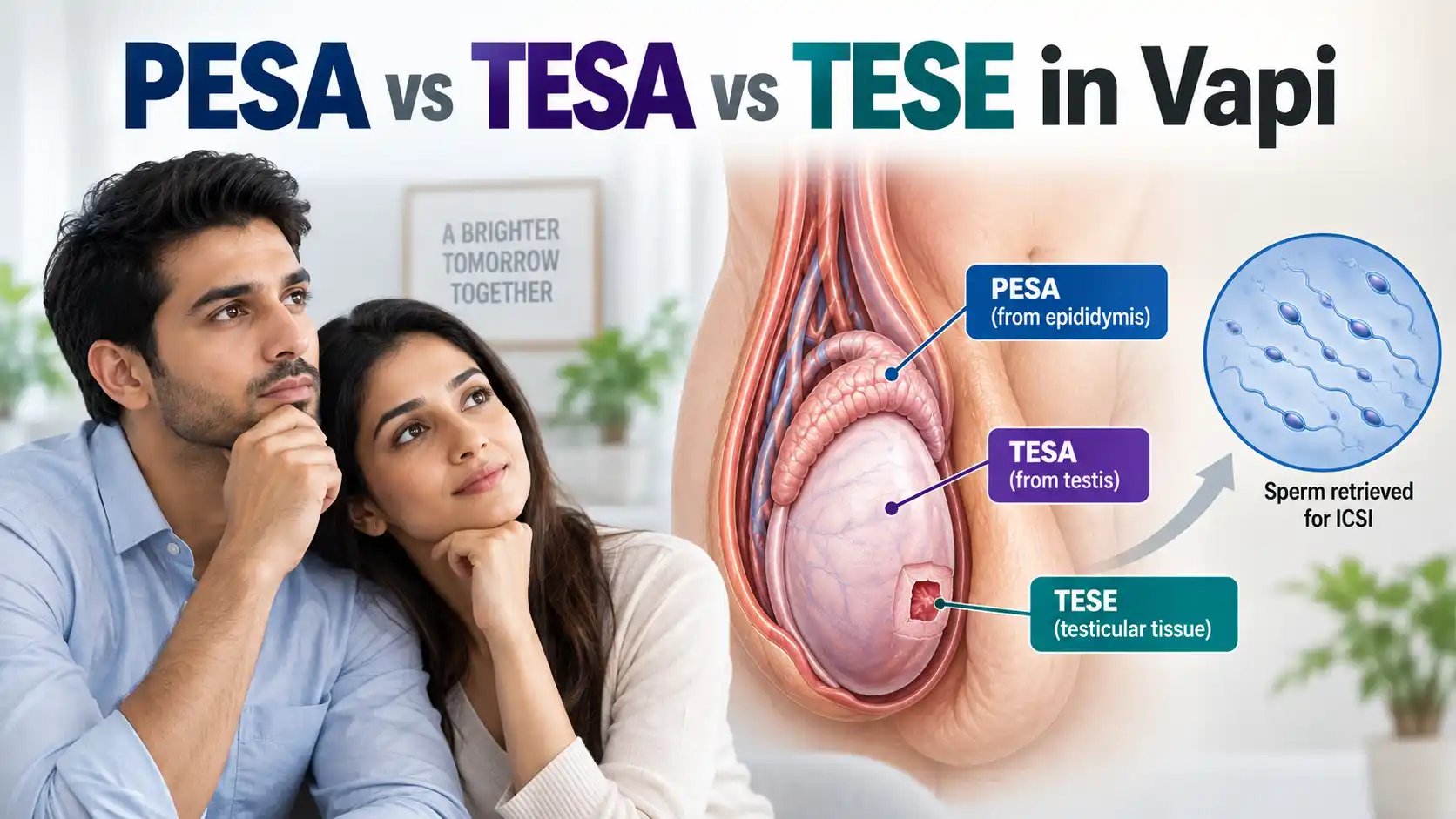
Azoospermia treatment almost always includes a retrieval step once the semen stays empty. Sperm are then taken straight from the source. PESA and TESA use a fine needle. They suit blocked cases, where sperm are easy to find.
TESE and micro-TESE open the testis and search tissue under a microscope. That is what poor production cases need. Micro-TESE takes longer and needs an operating microscope. It removes less tissue and finds sperm more often. For a man with zero sperm count, it is often the deciding step.
4. ICSI
Retrieved sperm do not go into plain IVF. They go to ICSI, where one sperm is injected into each mature egg. Sperm motility and sperm morphology are judged at high power at that moment. So ten or twenty usable cells can still lead to a pregnancy.
“I tell couples to stop counting millions and start counting eggs. If we can find even a few living sperm, the number that matters is the number of eggs we collect.” Dr. Kaushal Patel
5. Donor sperm
Donor sperm becomes a real option once a careful retrieval finds nothing. It also fits when gene results show that a retrieval will likely fail. Third party options should be talked through calmly. They should never be pushed before tests are done.
Timing, Freezing and a Plan for the Day
Couples are rarely warned about the schedule. In severe male infertility in Vapi, his step and the egg pickup must fit together. There are two ways to do that.
Sperm can be taken early and frozen. Or they can be taken on the same day as the egg pickup. Each route has trade-offs worth knowing before you sign.
| Approach | Main plus | Main minus |
|---|---|---|
| Retrieve early, freeze | No shocks on egg pickup day | Thawing may cut the number of usable sperm |
| Retrieve on the same day | Fresh sperm, no thaw loss | If nothing is found, choices are rushed |
For blocked cases, same-day retrieval is usually safe. Sperm are nearly always there. For poor production cases, many of us prefer an earlier retrieval with freezing. It spares the couple a choice made in a corridor.
Ask for the backup plan in writing. What happens if no sperm are found? Will the eggs be frozen? Has donor consent been discussed? Those answers should exist before the injections start.
Her Tests Still Matter
Severe male infertility in Vapi pulls all the focus to one partner. That is a mistake. ICSI results lean heavily on egg number and egg quality.
A basic female work-up should run alongside the male one, not after it. AMH, a follicle count and a check of the womb take little time. They can shift the whole plan. Couples reading about low sperm count and pregnancy often find the final call rests on her results too.
What to Ask Before Starting Treatment for Severe Male Infertility in Vapi
A short set of questions tells you a lot. A good andrologist in Vapi will welcome them.
- Which retrieval method is planned for my type of azoospermia, and why?
- Who performs it, and how many do they do each year?
- Will an operating microscope be used if micro-TESE is needed?
- Will sperm be frozen, and how many vials can be stored?
- What happens on the day if no sperm are found?
- What do our gene results mean for any children we have?
An IVF centre in Vapi that answers these clearly gives you more useful detail than any success figure on a website.
Final Thought
A report showing nil or near-nil sperm is scary. But it is only a snapshot of the semen. It says nothing firm about the testicles until the work-up is done.
Most men with severe male infertility in Vapi have a cause that can be named, and many have sperm that can be found. Some need only hormone fixes. Others need a retrieval. A few choose a different path after honest counselling. What none of them need is a decision taken before the tests are read. Book a male fertility evaluation in Vapi to find the cause and talk through the treatment options that truly apply to you.
Frequently Asked Questions
1. What tests are needed before starting treatment for severe male infertility in Vapi?
A repeat semen analysis with spinning comes first. Add a scrotal exam and blood tests for FSH, LH, testosterone and prolactin. A scrotal scan checks the size of each testicle. Gene tests are added when the count is very low or absent. Together these results show whether medicines, surgery or sperm retrieval make sense.
2. Can sperm be retrieved directly from the testicles when there is zero sperm in the semen?
Yes, in a large share of men. When the path is blocked, sperm often wait in the epididymis or testis. They can be picked up with PESA or TESA. When the testis makes too few, TESE or micro-TESE is used to hunt for small pockets of live tissue.
3. When is sperm retrieval considered for men with azoospermia?
Retrieval is planned once two samples confirm no sperm. Tests must also show if the cause is a block or poor production. For a block, it is often the quickest route to a pregnancy. For poor production, it follows once hormone causes are treated or ruled out.
4. When is genetic testing recommended for severe male infertility?
Karyotype and Y chromosome tests are advised for counts under about 5 million per ml. They are advised for every man with azoospermia. CFTR gene tests are added when the vas deferens cannot be felt. Results shape the odds of finding sperm. They also shape the advice given about future children.
5. Can hormonal testing identify the cause of very low or zero sperm count?
Often, yes. A low FSH with low testosterone points to a pituitary problem. That often responds well to shots over a few months. A high FSH with small testicles suggests the testis itself is struggling. That moves the plan towards retrieval rather than tablets.
6. Can ICSI help when the sperm count is extremely low?
ICSI was built for exactly this case. One sperm is injected into each mature egg. So numbers that would never work for IUI or plain IVF can still work here. The embryologist checks movement and shape to pick the best cells.
7. Can ICSI be performed using surgically retrieved sperm?
Yes. Sperm taken by PESA, TESA, TESE or micro-TESE are used for ICSI just like sperm from semen. They often move slowly or not at all. So the lab uses set tests to confirm which ones are alive.
8. Does sperm motility or morphology affect the choice of treatment?
They do. Poor sperm motility and odd sperm morphology with a very low sperm count rule out IUI. They point towards ICSI. Sperm that do not move at all also prompt a vitality test. Dead sperm and living still sperm need other handling.
9. Can medicines improve sperm production in severe male infertility?
Medicines help when there is a clear target. That means low pituitary hormones, high prolactin, untreated thyroid disease or an infection. In those men, hormone therapy can lift the count over six to nine months. When the testis itself has failed, no tablet can restart sperm making. Retrieval then becomes the real route.
10. When is surgery considered for severe male infertility?
Surgery is an option for a blocked or cut vas deferens, and for a duct block. It also suits some men with a large varicocele and poor semen quality. Microsurgery can bring sperm back into the semen. Much depends on where the block sits, how long it has been there and the partner’s age.
11. Does severe male infertility always require IVF or ICSI?
No. A treatable hormone cause or a fixable block can sometimes bring sperm back into the semen. That allows a natural pregnancy or IUI. ICSI is needed when sperm can only be taken by surgery, or when the count stays very low despite treatment.
12. Can a blocked sperm pathway be treated without IVF?
Sometimes. Microsurgery such as a vasovasostomy or a vaso-epididymal join can reopen the path. Sperm may return to the semen within a few months. Success rests on where the block sits and on the surgeon’s skill. Many couples freeze retrieved sperm at the same sitting as a backup.
13. When is donor sperm considered for severe male infertility?
Donor sperm comes up when a careful retrieval finds nothing. It also fits when gene results, such as complete AZFa or AZFb deletions, show that a retrieval will likely fail. Some couples simply decide against more surgery. It should be offered as one choice among many, after the work-up, and talking it through should come before consent.
14. When should a couple see an andrologist in Vapi for severe male infertility?
Any report with a count under 5 million per ml needs a specialist review. So does a report with no sperm at all. Another round of the same tablets will not help. Go sooner if there is a history of undescended testis, scrotal surgery, injury, mumps after puberty or cancer care. Waiting rarely lifts these numbers on its own.
15. What should couples ask an IVF centre in Vapi before starting male infertility treatment?
Before starting male infertility treatment in Vapi, ask which retrieval method is planned and why. Ask who performs it. Ask if sperm will be frozen, and what happens if none are found on the day. Also ask how his step will be timed with the egg pickup. Clear answers tell you more than any success figure on a brochure.