

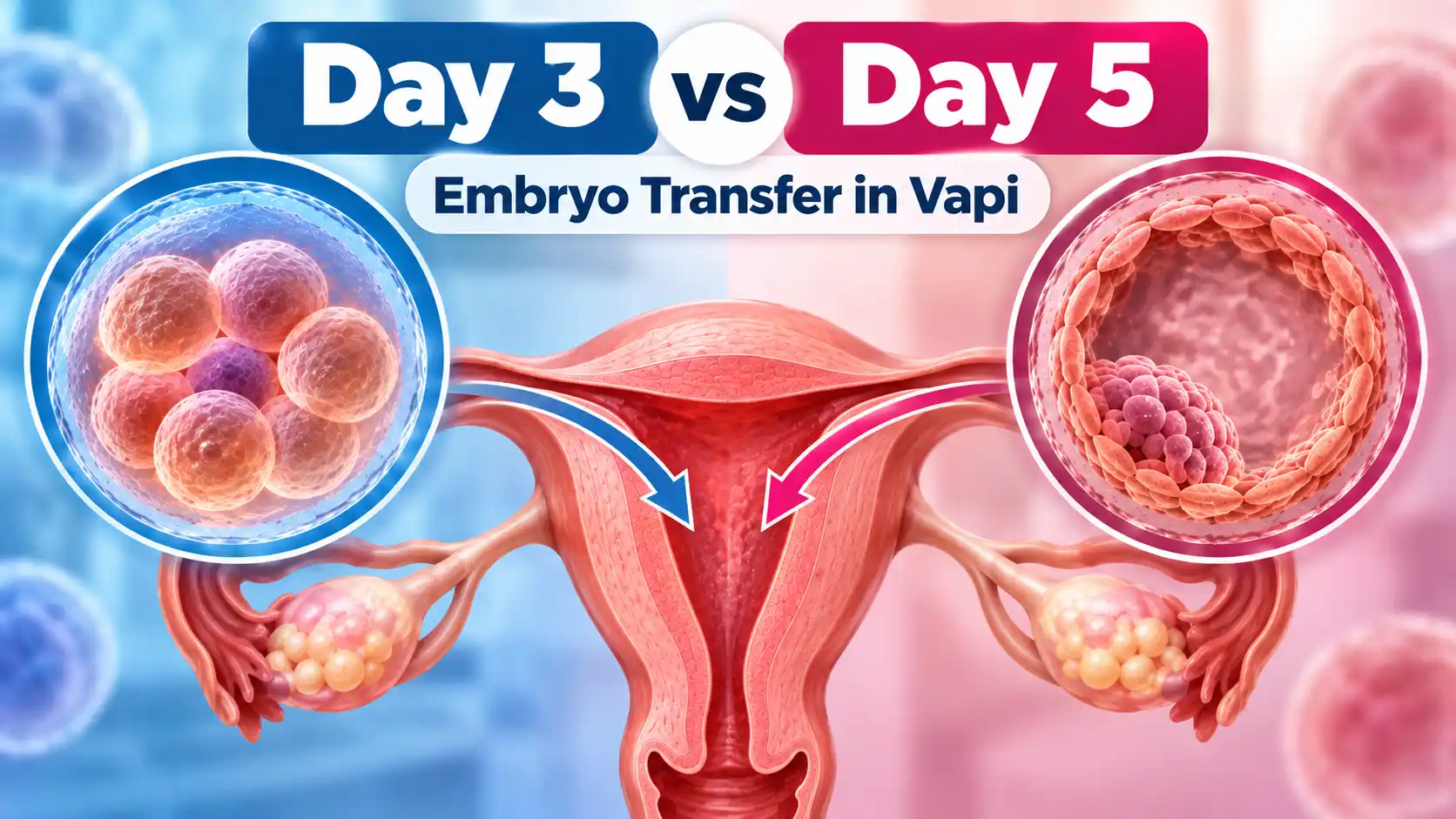
Waiting for an embryo update can feel hard. On Day 3, you may hear that several embryos are growing. Should the team transfer one now or wait until Day 5?
The choice between Day 3 vs Day 5 embryo transfer is not a simple contest. A Day 5 embryo has passed more growth steps in the lab, which can help with embryo selection. Yet waiting may leave some patients with no embryo ready for transfer. The best plan depends on the whole cycle, not the calendar alone.
At an IVF centre in Vapi, the team should review embryo number and quality, age, past care, the womb lining, and lab results. The aim is not Day 5 at any cost. It is a safe plan with a fair chance of a healthy birth.
Key Takeaways
- A Day 3 embryo is usually at the cleavage stage. A Day 5 embryo is usually a blastocyst with distinct groups of cells.
- Day 5 culture gives the lab more time to watch embryo growth. This can support better embryo selection when several good embryos are available.
- Cochrane evidence indicates Day 5 or Day 6 transfer may slightly raise live birth odds in good-prognosis patients, with less certain benefit for others.
- A 2024 PubMed trial of 992 good-prognosis women found 74.8% cumulative live birth with single blastocyst transfer versus 66.3% with single cleavage-stage transfer, plus higher spontaneous preterm birth after blastocyst transfer.
- A Day 3 transfer may be considered when only a small number of embryos are developing or when past embryos have not reached the blastocyst stage.
- Embryo grade helps the team compare embryos at the same stage. It cannot prove that an embryo will implant or lead to a healthy baby.
The Biology Behind Embryo Development
After successful fertilization, a single cell begins dividing rapidly inside a temperature-controlled incubator. By the third day, it becomes a cleavage-stage embryo containing about six to eight individual cells. This early developmental stage relies entirely on maternal energy stores provided by the egg.
Around the fifth day, the embryo transforms into a highly structured blastocyst. A healthy blastocyst contains over one hundred cells and features a distinct fluid-filled cavity. The embryo must successfully activate its own internal genetics to reach this advanced stage of growth.
“We monitor embryo development closely because the transition from the third to the fifth day reveals vital information about genetic health. The embryos that successfully reach the blastocyst stage prove they have strong biological potential.” Dr. Kaushal Patel
What Changes Between Day 3 and Day 5?
After IVF or ICSI, the embryology team checks whether an egg has fertilised. The embryo then divides while it grows in a controlled incubator. Doctors count the day of fertilisation as Day 1.
Day 3: The Cleavage Stage
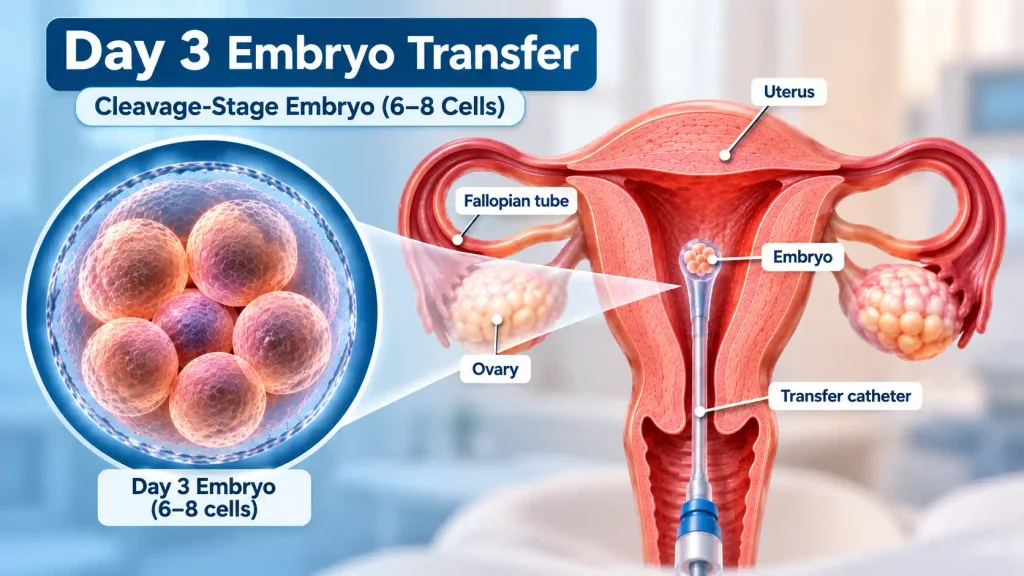
By Day 3, a growing embryo often has about six to eight cells. It is called a cleavage-stage embryo because one fertilised cell has divided several times.
The embryologist may assess:
- the number of cells
- whether the cells are similar in size
- the amount of fragmentation
- the pace and pattern of division
A Day 3 embryo transfer places the chosen embryo into the uterus at this stage. The embryo must then keep developing toward the morula and blastocyst stages before implantation can begin.
Day 5: The Blastocyst Stage
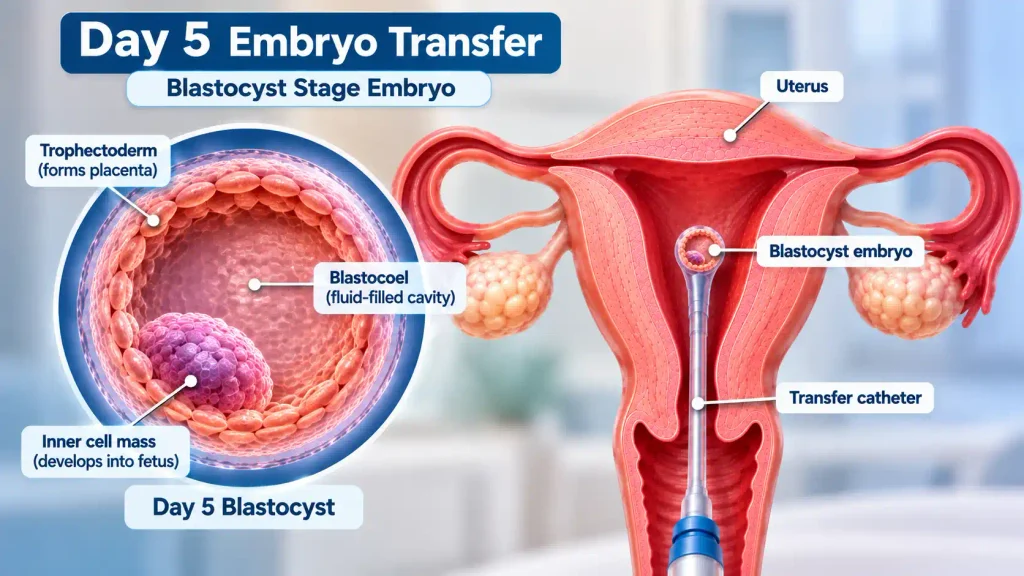
By Day 5, some embryos form a fluid-filled structure called a blastocyst. It has an inner cell mass, which may develop into the fetus, and outer cells called the trophectoderm, which help form the placenta.
A Day 5 embryo transfer, also called a blastocyst transfer, gives the lab two extra days to observe growth. Some embryos that look similar on Day 3 develop very differently by Day 5. That extra information can make it easier to choose one embryo for transfer.
Not every healthy embryo reaches this stage on Day 5. Some become blastocysts on Day 6. Others stop growing. Timing alone does not show chromosome status or guarantee implantation.
“Day 5 gives us more information, not a guarantee. We still need to look at the full embryo cohort, the woman’s health, and how the lining has developed before we advise a transfer plan.” Dr. Kaushal Patel
Day 3 vs Day 5 Embryo Transfer: Side-by-Side Comparison
| Point | Day 3 transfer | Day 5 transfer |
|---|---|---|
| Embryo stage | Cleavage stage | Blastocyst stage |
| Usual development | About 6 to 8 cells | Many cells with an inner cell mass and trophectoderm |
| Time in culture | Shorter | Two more days of observation |
| Embryo selection | Based on early cell growth and form | Based on continued growth and blastocyst form |
| Main possible benefit | May allow transfer when few embryos are available | May improve selection when several embryos are growing |
| Main concern | Less is known about which embryo will keep growing | Some cycles may have no embryo ready to transfer |
| Genetic testing | Usually not the preferred stage for biopsy | Common stage for embryo biopsy when testing is planned |
| Best suited to | Selected cycles with few embryos or relevant past history | Often considered in good-prognosis cycles with several suitable embryos |
This Day 3 vs Day 5 embryo transfer table shows why one rule cannot fit every patient. A strong plan uses embryo data from the current cycle and lessons from any earlier cycle.
Is Day 5 Always Better Than Day 3?
No. Day 5 often has a higher implantation rate per embryo transferred because embryos that reach the blastocyst stage have passed more development checks. This does not mean that extended culture makes each embryo stronger.
Part of the higher rate comes from selection. Embryos that stop growing before Day 5 are no longer in the transfer group. The remaining group is smaller and has shown more development in the lab.
Results need context. A rate per transfer is not the same as a rate per egg collection. Ask about:
- live birth per started cycle
- live birth per transfer
- cumulative live birth from fresh and frozen embryos
- the chance of having no embryo to transfer
- the number of embryos suitable for freezing
Evidence favors blastocyst-stage transfer for some women with a good outlook. The balance may differ when few embryos are present. Group averages are not personal forecasts.
When Might Doctors Recommend a Day 3 Embryo Transfer?
In Day 3 vs Day 5 embryo transfer planning, Day 3 may suit a small embryo group. If only one or two embryos are developing, waiting may offer little extra help with embryo selection because there are few embryos to compare.
Doctors may also consider Day 3 when:
- an earlier cycle produced no blastocysts
- several embryos stopped between Day 3 and Day 5 in the past
- embryo development is slow or uneven
- the lab and clinical team judge that an earlier transfer is suitable
- the patient understands the benefits, limits, and alternatives
This choice does not mean the embryo is poor. It means more culture may not add enough useful facts. A Day 3 transfer also cannot rescue an embryo that is unable to develop.
“When only a few embryos are growing, waiting is not automatically the wiser choice. I explain what we know, what we cannot predict, and whether Day 5 culture is likely to change the decision.” Dr. Kaushal Patel
When Might Doctors Recommend a Day 5 Embryo Transfer?
In Day 3 vs Day 5 embryo transfer planning, Day 5 is often considered when several good embryos are growing. Continued culture helps the embryologist see which ones form blastocysts and how they are graded at that stage.
It may be considered when:
- several normally fertilised eggs have produced growing embryos
- more than one embryo looks suitable on Day 3
- single embryo transfer is planned
- blastocyst biopsy for genetic testing is part of the plan
- past treatment suggests extended culture could improve selection
- the laboratory has strong, audited blastocyst culture results
Possible Benefits of Blastocyst Transfer
The main gain is better selection. The team can see which embryos kept growing after Day 3. This may support the transfer of one embryo and help limit the risk linked with multiple embryo transfer.
Blastocysts can also be frozen for later use. When embryo genetic testing is medically planned, the biopsy is usually taken from trophectoderm cells at the blastocyst stage. Patients can read more about PGT-A testing and discuss whether it is truly indicated.
What If Embryos Stop Developing Before Day 5?
This is often the hardest part of longer culture. If no embryo is fit for transfer, the cycle may end without one. Growth can stop due to chromosome errors, egg or sperm factors, or early cell problems. It is not the patient’s fault.
The team should review:
- the number of mature eggs
- fertilisation results
- development on each day
- the point at which growth slowed
- egg and sperm factors
- stimulation and trigger details
- lab quality controls
- findings from earlier cycles
One failed culture does not always predict the next cycle, but it should shape the next plan. The reasons behind that arrest are worth understanding on their own, which is why we cover why embryos stop growing before blastocyst separately.
How Embryo Grading Affects the Decision
Embryo grading is a visual assessment. It helps embryologists rank embryos at the same stage, but it is not a pass-or-fail test.
1. Grading a Day 3 Embryo
At the cleavage stage, the team looks at cell number, symmetry, fragmentation, and signs of healthy division. A top grade may suggest better potential, but it cannot show whether the embryo has the correct number of chromosomes.
2. Grading a Day 5 Blastocyst
A blastocyst grade usually describes expansion, the inner cell mass, and the trophectoderm. Different labs may use slightly different systems. A lower-graded blastocyst can still lead to a healthy birth, while a high-graded one may not implant.
Grade must be read with age, growth pattern, health history, and embryo count. Egg health also affects early growth. Read more about egg quality.
Does Transfer Day Affect Implantation and Pregnancy Chances?
It can affect the odds per transfer, but it is only one part of IVF success. Implantation requires a developing embryo, a receptive uterine lining, correct timing, and a smooth transfer.
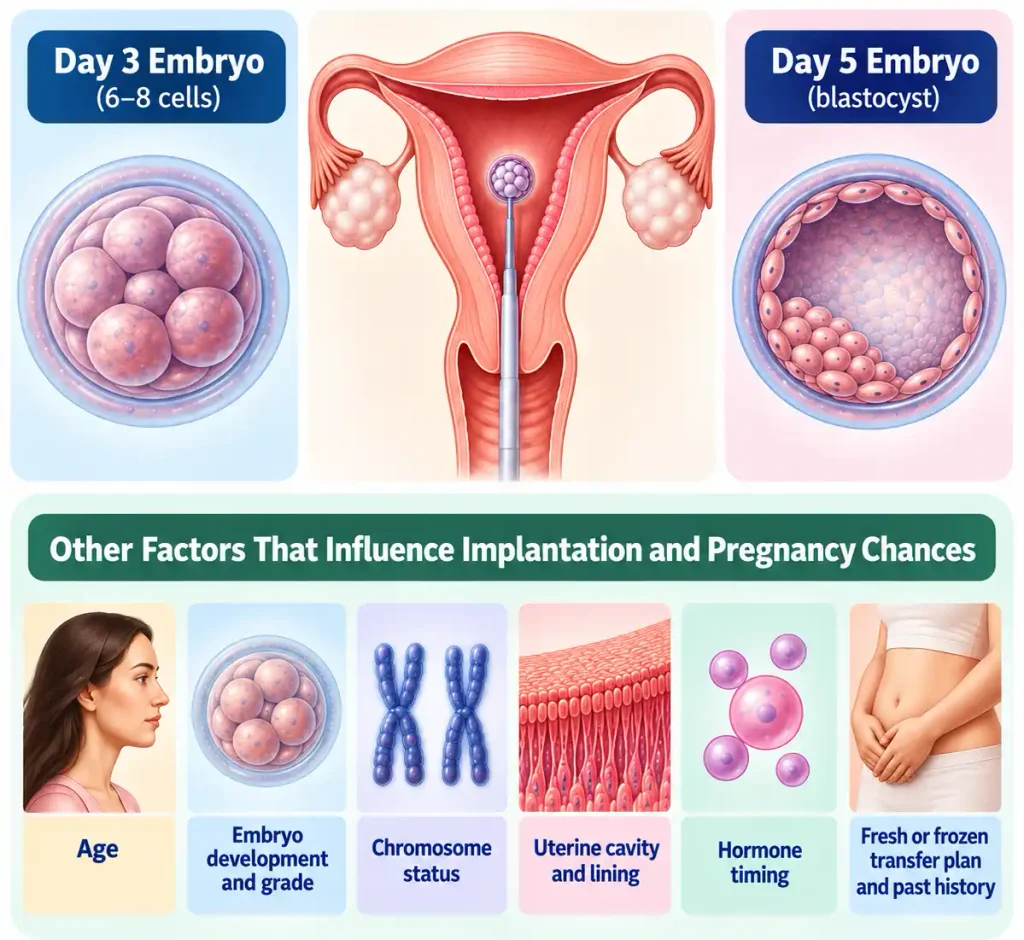
Factors that may matter include:
- the woman’s age
- embryo development and grade
- chromosome status when testing is indicated
- the uterine cavity and lining
- hormone timing
- fresh or frozen transfer plan
- past pregnancy and transfer history
- the skill and methods of the lab and clinical team
A thin or poorly timed lining may lead the team to freeze embryos and plan a later transfer. More detail is available in the hospital’s information on uterine lining.
A higher implantation rate does not ensure a live birth. Ask for results by age and whether rates are per cycle, transfer, or embryo.
Fresh Transfer, Frozen Transfer, and the Role of Timing
Day 3 and Day 5 describe embryo age. Fresh and frozen describe when the embryo is placed in the uterus.
A fresh transfer occurs in the egg collection cycle. A frozen transfer occurs later. The team may freeze embryos if hormone levels are high, the lining is not ready, testing is planned, or ovarian over-response is a concern.
The plan may be a fresh transfer or culture to blastocyst, freeze, and transfer later. For more context, review IVF and ICSI. The plan should fit the response to care, not a fixed package.
How an IVF Centre in Vapi Decides the Transfer Day
For embryo transfer in Vapi, a sound decision should be shared by the fertility doctor, embryologist, and patient. It may change as the cycle develops.
1. Before Egg Collection
The team reviews age, ovarian reserve, sperm findings, diagnosis, prior cycles, and whether genetic testing has a valid medical role. At this point, Day 3 or Day 5 may be a provisional plan rather than a promise.
2. After Fertilisation
The number of normally fertilised eggs gives the first useful clue. The lab then tracks the pace and pattern of embryo growth.
3. On Day 3
The team reviews how many embryos are still developing and how they look. If several suitable embryos remain, culture to Day 5 may improve selection. If very few remain, an earlier transfer may be discussed.
4. Before Transfer
The doctor checks the uterine lining, hormone plan, symptoms, and any reason to postpone a fresh transfer. The embryologist confirms which embryo is suitable and explains its stage and grade.
For people considering IVF treatment Vapi, ask if the lab audits fertilisation, blastocyst growth, thaw survival, implantation, and live birth. Clear facts matter more than a broad success claim.
“The right transfer day is the day that fits the patient’s cycle. The same reasoning is applied at every branch of our IVF centre in Gujarat.” Dr. Kaushal Patel
About the Author
Dr. Kaushal Patel is a fertility specialist at iSHA Women’s Hospital and IVF Centre in Vapi. He reviews both partners’ reports, embryo growth, past care, and personal goals before advising a transfer plan.
Medical content cannot replace a visit with your doctor. Advice may change after egg collection as new facts become clear.
Final Thought
The question is not simply which day wins. It is which plan gives your embryos a fair chance while keeping the risks and uncertainty clear.
For Day 3 vs Day 5 embryo transfer, the most useful recommendation is based on your age, embryo cohort, past cycles, uterine readiness, and the lab’s experience. Discuss embryo-transfer options with an IVF specialist in Vapi based on your individual cycle. Careful planning and expert guidance will help you navigate this complex journey with confidence and peace of mind.
Frequently Asked Questions
1. What is the difference between Day 3 and Day 5 embryo transfer?
A Day 3 transfer uses a cleavage-stage embryo, often with six to eight cells. A Day 5 transfer uses a blastocyst that has developed distinct inner and outer cell groups, giving the lab more information for selection.
2. Is Day 5 embryo transfer better than Day 3 embryo transfer?
Day 5 may offer a higher chance per transfer in selected patients, especially when several embryos are available. It is not better for every patient because some cycles may have no embryo suitable for transfer after extended culture.
3. How do doctors decide between Day 3 and Day 5 embryo transfer?
They consider age, embryo number, embryo development, past IVF results, uterine readiness, and lab performance. The decision may change after the team sees how the embryos grow.
4. Does embryo grading affect the choice between Day 3 and Day 5 transfer?
Yes. Day 3 grading helps compare cleavage-stage embryos, while Day 5 grading adds information about blastocyst expansion and cell groups. Neither grading system can guarantee implantation or a healthy birth.
5. What happens if embryos stop developing before Day 5?
There may be no embryo available for transfer or freezing. The doctor and embryologist should review the growth timeline, egg and sperm factors, cycle details, and lab findings before planning another attempt.
6. Does Day 5 blastocyst transfer have a higher implantation rate than Day 3 transfer?
Often, yes, per embryo transferred, because reaching the blastocyst stage helps select embryos that have continued to develop. Personal chances still depend on age, embryo health, the uterine lining, and the clinic’s patient group.
7. Are fewer embryos available for transfer on Day 5?
Usually, yes. Some cleavage-stage embryos stop developing before becoming blastocysts, so the Day 5 group is often smaller. This is expected biological selection, but it can also mean no transfer in some cycles.
8. Can a Day 3 embryo develop into a blastocyst after transfer?
Yes. A transferred cleavage-stage embryo must continue growing inside the uterus before it can implant. Transfer does not ensure that it will reach the blastocyst stage.
9. When might doctors recommend Day 3 embryo transfer?
It may be considered when few embryos are available, previous embryos did not reach Day 5, or extended culture is unlikely to improve selection. The reason should be based on the individual cycle.
10. Is Day 5 blastocyst transfer suitable for every IVF patient?
No. It is often useful for patients with several suitable embryos, but it may not be the best choice when the embryo number is low or past development has stopped before Day 5.
11. How does embryo selection differ between Day 3 and Day 5 transfer?
On Day 3, selection relies on cell number, symmetry, fragmentation, and growth pace. On Day 5, the team can also assess blastocyst formation, expansion, inner cell mass, and trophectoderm.
12. Can Day 3 vs Day 5 embryo transfer affect IVF pregnancy chances?
Yes, transfer stage may change the chance per transfer and the risk of having no transfer. It is only one factor among age, embryo health, uterine readiness, transfer technique, and past history.
13. What is a cleavage-stage embryo, and how is it different from a blastocyst?
A cleavage-stage embryo is an early embryo made of several dividing cells, usually assessed around Day 3. A blastocyst is a later stage with a fluid cavity and cells starting to take on different roles.
14. How does an IVF centre in Vapi decide the right embryo transfer day?
The team should review the current embryo cohort, patient age, past response, uterine lining, and lab results. The patient should receive a clear reason for the choice and a backup plan if growth changes.
15. What should I ask my IVF specialist in Vapi before choosing Day 3 vs Day 5 embryo transfer?
Ask how many embryos are growing, what their grades mean, and how likely they are to reach Day 5. Also ask about the chance of no transfer, whether a frozen plan is safer, and how the clinic reports live birth outcomes.