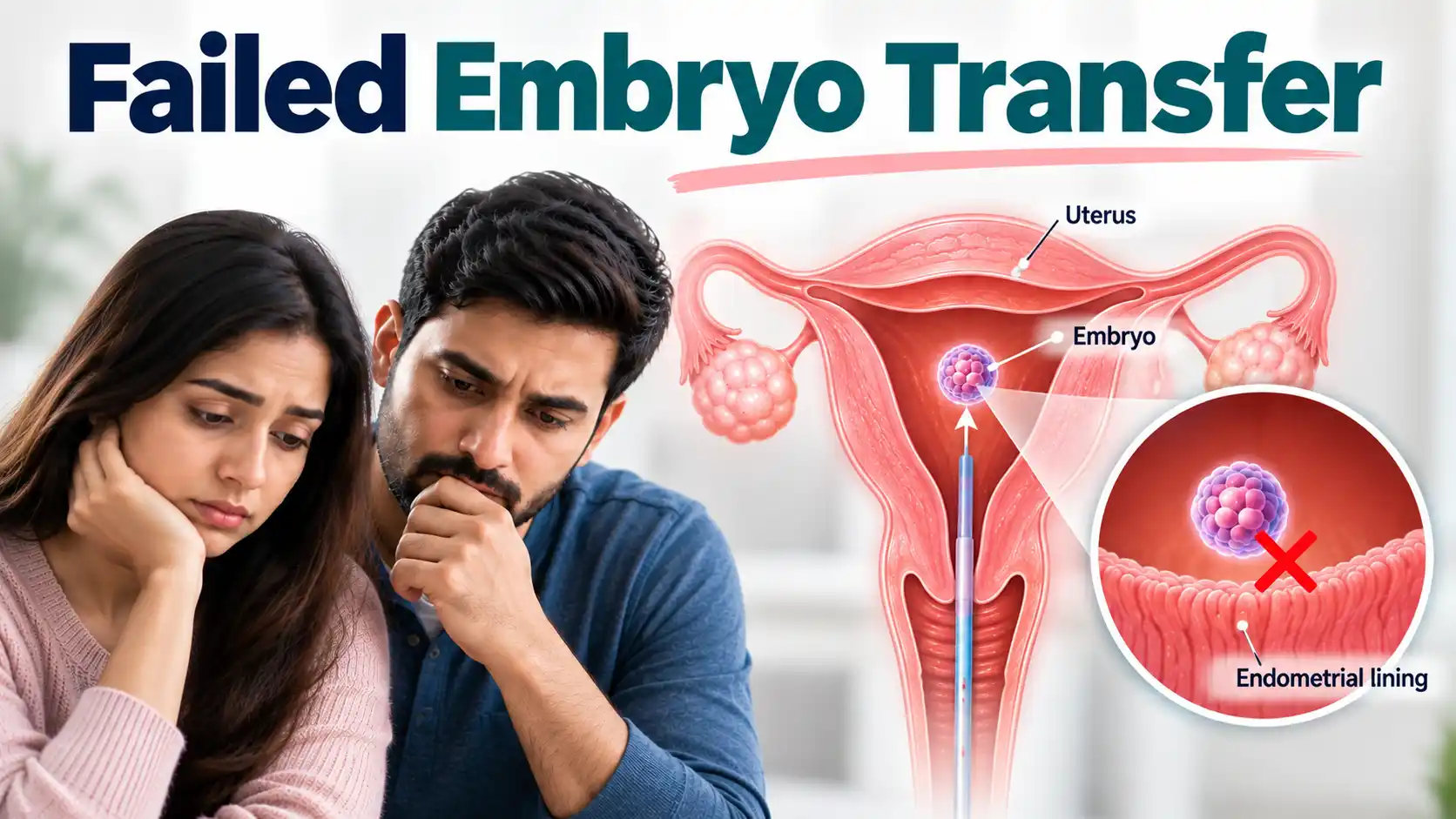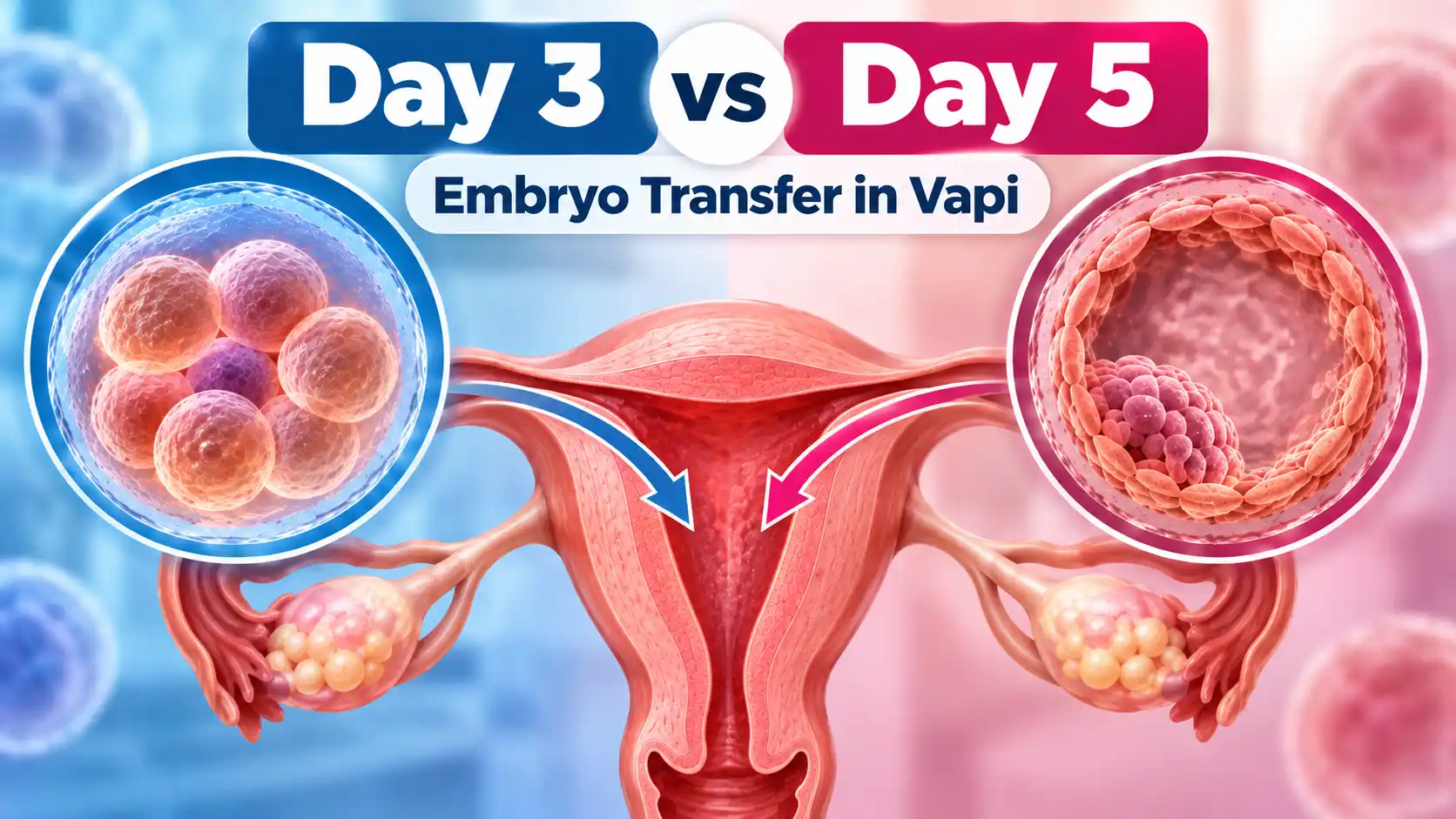

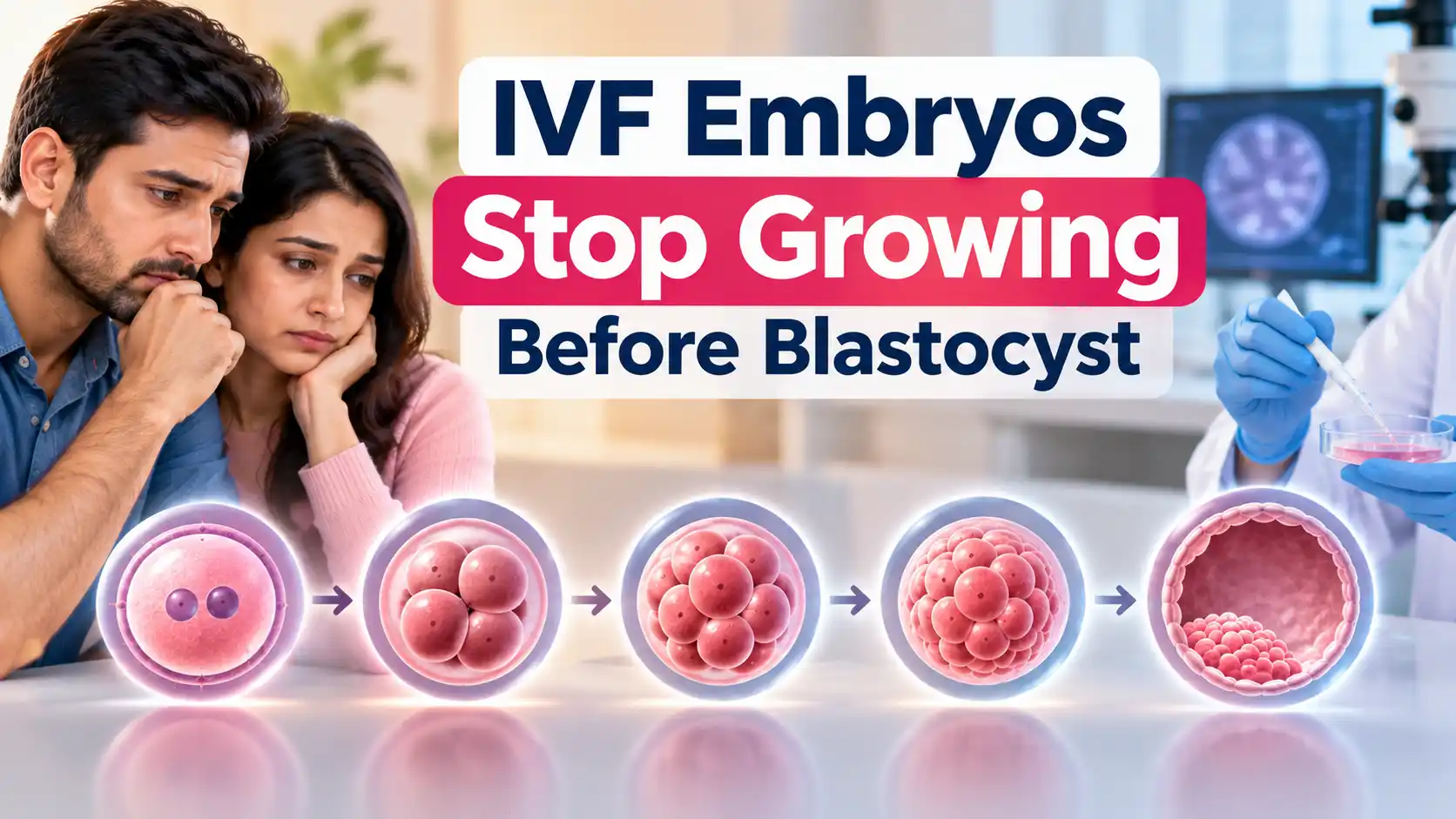
The call from the embryology lab can be the hardest part of a fertility cycle. Your eggs were collected. Fertilisation happened. Then, days later, you hear that the embryos are not growing as hoped.
When an IVF embryo stops growing before it reaches the blastocyst stage, most couples ask the same two questions. Did we do something wrong? And can anything change next time?
The honest answer to the first is almost always no. Embryo development failure is rarely caused by anything you did, ate, or worried about. It is usually decided by the biology of the egg and sperm long before the cycle started.
The answer to the second question is more hopeful. Once we understand why the embryos stopped, we can often change something real in the next attempt.
What follows is the same explanation I give patients in my clinic room in Vapi.
Key Takeaways
- Only about half of normally fertilised human embryos reach the blastocyst stage in the lab. The rest stop at the cleavage, morula, or early blastocyst stage.
- Chromosome problems are the leading reason an IVF embryo stops growing. In one large study, 94% of arrested embryos carried chromosome abnormalities.
- A blastocyst normally forms about five to six days after fertilisation and contains 80 to 100 cells.
- Day 3 and Day 4 are the most common points of arrest, because the embryo switches from the egg’s stored supplies to its own genetic instructions.
- Embryo grading describes appearance only. A top-graded Day 3 embryo can still arrest, and a modest one can still become a healthy baby.
- Poor embryo development in one cycle does not mean it will repeat. Egg quality, sperm quality, lab conditions, and the stimulation plan can all be reviewed and adjusted.
What “Stops Growing” Actually Means
Embryologists use the word arrest. When an IVF embryo stops growing, it has stopped dividing and will not restart. It is not sleeping or slow. It has reached the end of what its cells can do.
A slow embryo is different. Some reach blastocyst on Day 6 or Day 7 instead of Day 5. Those embryos are late, not stopped, and many go on to make healthy pregnancies.
The normal day by day timeline
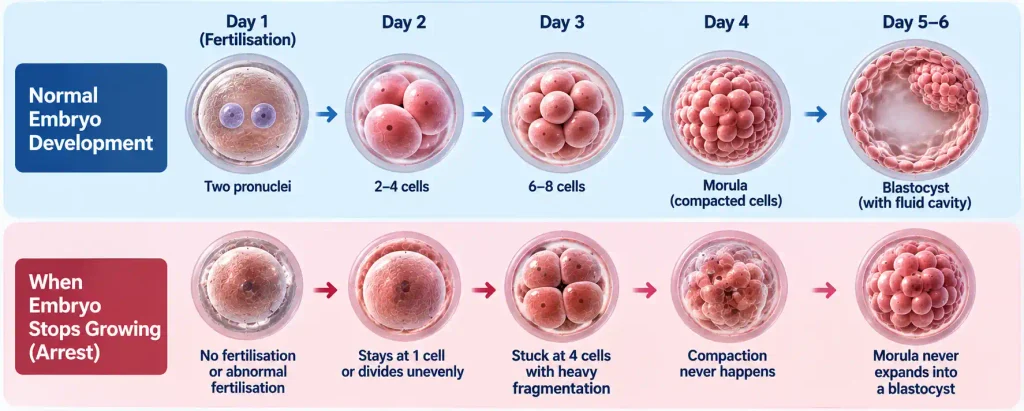
| Day after egg collection | What the embryo should be doing | What arrest looks like |
|---|---|---|
| Day 1 | Two clear pronuclei confirm fertilisation | No fertilisation, or abnormal fertilisation |
| Day 2 | Divides to 2 to 4 cells | Stays at 1 cell, or divides unevenly |
| Day 3 | Reaches 6 to 8 cells | Stuck at 4 cells, heavy fragmentation |
| Day 4 | Cells compact into a morula | Compaction never happens |
| Day 5 to 6 | Forms a blastocyst with a fluid cavity | Morula never expands into a blastocyst |
Most couples hear the difficult news on Day 3, Day 4, or Day 5, when the gap between expected and actual growth becomes obvious.
“Patients often tell me they feel their body failed them. It did not. The embryo carries its own instruction set from the moment of fertilisation, and the laboratory can only give it the best possible environment to read those instructions.” Dr. Kaushal Patel
Why an IVF Embryo Stops Growing
There is rarely one single villain. Usually two or three factors stack up, and each one points to a different next step.
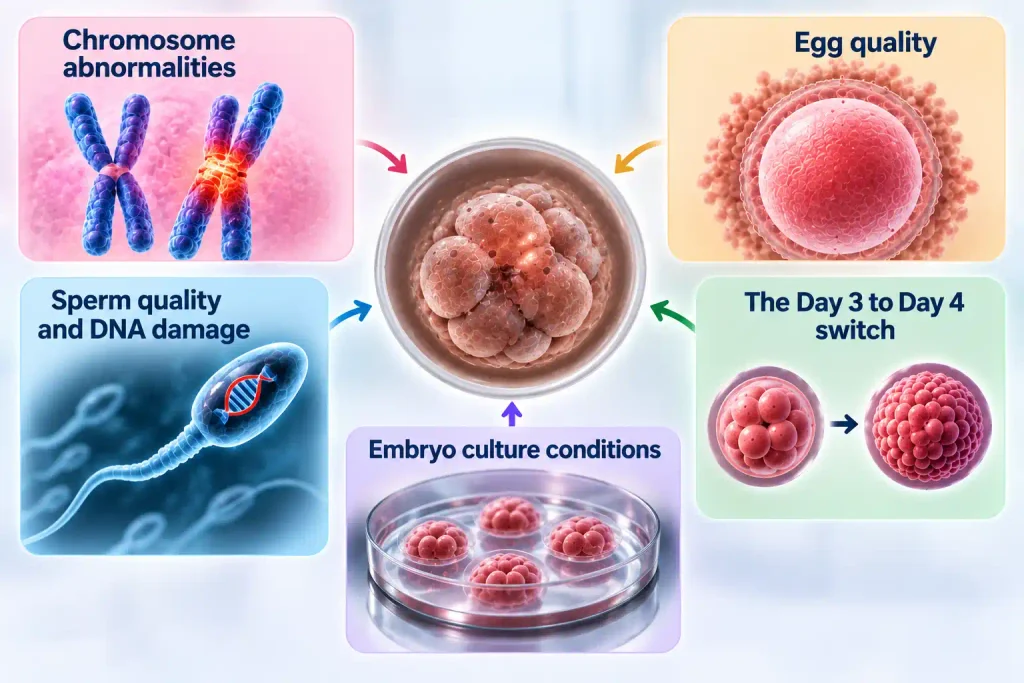
1. Chromosome abnormalities
Human embryos are remarkably error prone. When chromosomes are copied or divided incorrectly, the embryo may divide for a while, then stop once the errors become impossible to work around.
In a large study of arrested embryos, chromosome abnormalities were found in the overwhelming majority. These errors come from the egg, the sperm, or from mistakes in the first few cell divisions after fertilisation.
Chromosome errors rise with age, but they happen at every age. A woman of 28 can have an abnormal embryo, and a woman of 39 can have a perfectly normal one.
2. Egg quality
The egg supplies almost everything the early embryo needs: the mitochondria that make energy, the proteins that run the first divisions, and half the chromosomes.
When egg quality is reduced, the embryo can run out of usable energy before it builds a blastocyst. This is why the same lab and the same protocol give very different results from one woman to another.
Age is the strongest influence on egg quality, though low AMH, endometriosis, ovarian surgery, and smoking also play a role.
3. Sperm quality and sperm DNA damage
Sperm contributes more than chromosomes. It also brings the centriole, a structure that helps organise cell division.
A semen report can look normal while the DNA inside the sperm is fragmented. High fragmentation is linked with poor embryo development, especially after Day 3, when the paternal genes start being used.
This is why we look closely at male factors when embryos arrest repeatedly, even if the semen analysis was reassuring.
4. The Day 3 to Day 4 switch
Many couples describe the same pattern. The embryos looked excellent on Day 3, then collapsed by Day 5.
There is a clear biological reason. Until around the eight cell stage, the embryo runs on materials stored inside the egg. After that, it must activate its own genome and make its own proteins.
If the embryo’s own genetic instructions are faulty, it cannot make that handover. Development halts at the morula stage, right before blastocyst formation. Appearance on Day 3 tells us little about whether that switch will succeed.
5. Embryo culture conditions
Temperature, gas levels, air quality, culture media, and handling time all influence how many embryos reach blastocyst.
A good lab cannot rescue an embryo with serious chromosome errors, but a poor one can harm embryos that had real potential. That lab standard is the same across our network, including at our IVF centre in Daman.
What It Means When None of the Embryos Reach Blastocyst
Hearing that no embryo survived to transfer is devastating. It is also more common than most couples realise, and not a verdict on future cycles.
An embryo not reaching blastocyst across the whole batch usually points in one of three directions:
- A chance event. With small numbers of eggs, a run of abnormal embryos can happen purely by probability.
- An egg or sperm factor. If the pattern repeats across cycles, the cause is more likely to sit with gamete quality.
- A laboratory or protocol factor. Worth reviewing when fertilisation rates were good but development consistently stalled at the same stage.
One failed cycle is information, not a conclusion. If IVF embryos stop growing in the same way across two or three cycles, the plan needs to change rather than repeat.
“A cancelled transfer is painful, but it is not a wasted cycle. We learn how your eggs respond, how the sperm performs, and exactly where development stops. That map is what lets us treat the next cycle differently instead of simply hoping.” Dr. Kaushal Patel
Can an Arrested Embryo Start Growing Again?
No. Once an embryo has genuinely arrested, it does not recover. Embryologists keep watching for an extra day before making that call, precisely because slow embryos can catch up.
Extended culture to Day 6 or Day 7 is standard practice in good labs for this reason. Late blastocysts have lower implantation rates than Day 5 blastocysts, but they are still worth freezing and transferring.
Does Embryo Grading Predict Which Embryos Reach Blastocyst?
Grading is useful, but it is often misunderstood. It cannot tell you in advance whether an IVF embryo stops growing or sails through to Day 5. Grades describe only what the embryologist can see, such as cell number, symmetry, and fragmentation.
They do not reveal chromosomes. Research has shown that even top graded blastocysts carry a meaningful rate of chromosome abnormality, while lower graded ones are sometimes normal.
| What we can see | What it tells us | What it cannot tell us |
|---|---|---|
| Cell number and symmetry | How well division is progressing | Whether chromosomes are normal |
| Fragmentation | Cellular stress | Whether the embryo will implant |
| Blastocyst expansion and grade | Developmental momentum | Genetic health of the embryo |
| Time lapse growth pattern | Abnormal division events | A guaranteed outcome |
Genetic screening through PGT-A is the only way to check chromosome number directly, and only embryos that reach blastocyst can be tested. Since only blastocysts can be biopsied, PGT-A embryo testing is limited to the embryos that survive this stage in the first place.
How Doctors Find Out Why the Embryos Stopped
Finding out why an IVF embryo stops growing means reviewing the whole cycle, not just the final result. In my practice, the review covers several areas.
- The stimulation record. Dose, duration, hormone levels, and how synchronised the follicles were at trigger.
- Egg maturity data. How many eggs were mature, and how many fertilised normally.
- The embryology report. The exact day and stage of arrest for each embryo, which often points straight to the cause.
- Sperm assessment. A repeat semen analysis with DNA fragmentation testing where the pattern suggests a paternal factor.
- Medical background. Thyroid function, vitamin D, diabetes control, endometriosis, varicocele, and recent illness or fever.
- Genetic factors. Karyotype testing for both partners when arrest is repeated or there is a history of miscarriage.
Not every couple needs every test. The embryology report usually shows where to look first.
What Can Be Changed in the Next Cycle
The plan depends on what the review shows. These are the adjustments that most often make a real difference.
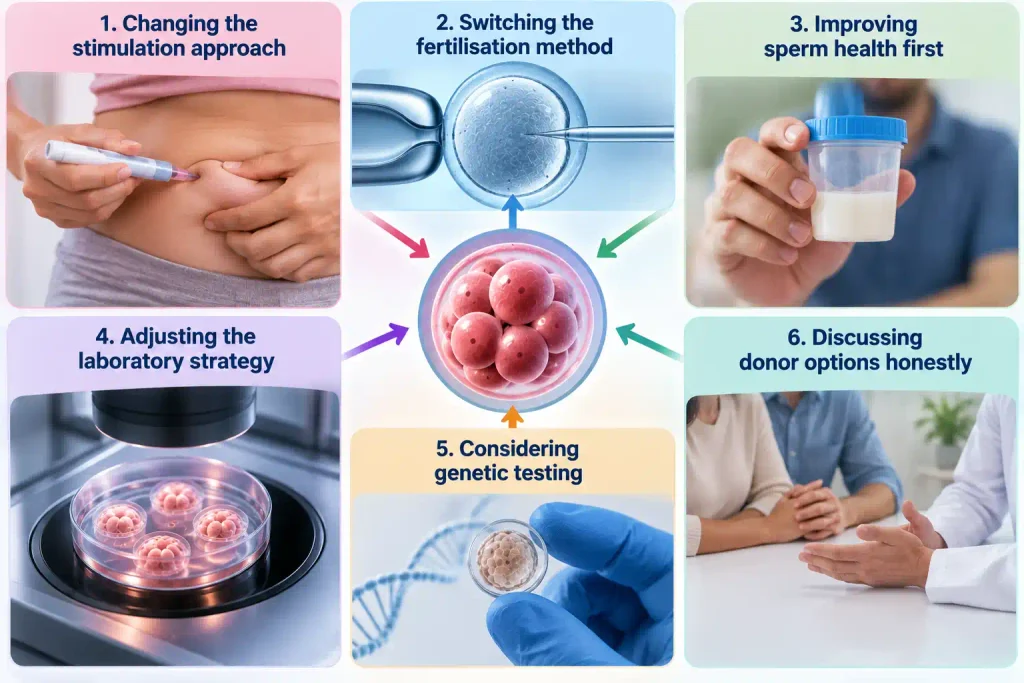
1. Changing the stimulation approach. A different protocol, a modified trigger, or a longer priming phase can improve egg maturity. More eggs is not always the goal. Better quality eggs usually is.
2. Switching the fertilisation method. Moving to ICSI, or using advanced sperm selection, helps when sperm factors are suspected.
3. Improving sperm health first. Sperm takes roughly three months to form. Treating infection, correcting a varicocele, stopping tobacco, and managing weight can lower DNA fragmentation within one cycle of sperm production.
4. Adjusting the laboratory strategy. Time lapse incubators, single step media, and reduced handling all help marginal embryos, as does culturing to Day 6 or Day 7 before giving up.
5. Considering genetic testing. Where enough blastocysts form, screening helps avoid transferring embryos that would not implant.
6. Discussing donor options honestly. After several cycles showing severe egg or sperm factors, donor gametes deserve a calm conversation rather than a last minute suggestion.
Reading about repeated IVF failure before your review appointment helps the discussion start from shared understanding.
“I never recommend repeating an identical cycle after poor embryo development. If nothing changes in the plan, there is little reason to expect the biology to behave differently.” Dr. Kaushal Patel
When to See an IVF Specialist in Vapi
Book a review appointment if any of the following applies to you.
- No embryos reached blastocyst in your last cycle
- Embryos arrested at the same stage across two or more cycles
- Fertilisation was good but development consistently stalled
- You are 35 or older and have had one cycle with poor embryo development
- You have a history of recurrent miscarriage alongside embryo arrest
- Your previous clinic repeated the same protocol without explaining why
Bring your embryology sheet, stimulation chart, semen analysis, and hormone reports. A specific report allows a specific answer.
Patients travelling from Valsad, Daman, and Silvassa often prefer to complete the review and testing in a single visit, and appointments can be planned that way.
Discuss embryo development and possible next steps with an iSHA fertility specialist in Vapi. Book a consultation to review your previous cycle in detail.
About the Author
Dr. Kaushal Patel is an IVF specialist and gynaecologist at iSHA Hospital, Vapi, with extensive experience in assisted reproduction, including IVF and ICSI, fertility preservation, and the management of repeated implantation failure. He has published in an international peer reviewed journal and works closely with the hospital’s embryology team on culture protocols and cycle review.
“The most useful thing I can offer a couple after a failed cycle is clarity. Once people understand why the embryos stopped, the fear usually settles, and we can make decisions together instead of out of panic.” Dr. Kaushal Patel
You can read more about Dr. Kaushal Patel and his clinical work.
Final Thought
Watching an IVF embryo stop growing is one of the loneliest experiences in fertility treatment, partly because it happens out of sight, and partly because there was nothing you could have done differently on the day.
What matters now is what you learn from it. Every arrested embryo leaves behind useful information about egg quality, sperm quality, and the point where development failed. Used properly, that information shapes a smarter next cycle rather than a repeat of the last one.
If your embryos did not develop as hoped, bring your reports and sit down with a specialist who will explain them line by line. Understanding usually comes before hope, and both are worth having.
Frequently Asked Questions
1. Why do IVF embryos stop growing before reaching the blastocyst stage?
Most IVF embryos stop growing because of chromosome abnormalities that make continued division impossible. Egg quality, sperm DNA damage, and culture conditions can add to the problem. Roughly half of fertilised embryos never reach blastocyst even in excellent laboratories.
2. Why did all my IVF embryos stop developing after fertilisation?
With a small number of eggs, a whole batch can be affected by chance alone. It can also indicate an egg or sperm factor, or a mismatch between your protocol and your ovarian response. The embryology report usually shows which explanation fits.
3. Can an IVF embryo that stops growing start developing again?
A genuinely arrested embryo will not restart. Some embryos are only slow and reach blastocyst on Day 6 or Day 7, which is why good labs keep culturing before making a final decision. Late blastocysts have somewhat lower success rates but can still result in healthy babies.
4. Why do IVF embryos stop growing around Day 3 or Day 4?
Around the eight cell stage, the embryo stops relying on the egg’s stored supplies and begins using its own genes. If those genetic instructions are faulty, development halts at exactly this handover point. Day 3 to Day 4 arrest is therefore very common and rarely reflects anything the patient did.
5. Can poor egg quality cause an IVF embryo to stop growing?
Yes, and it is one of the most frequent causes. The egg supplies the energy machinery and proteins the early embryo depends on, so reduced quality often shows up as arrest before blastocyst. Age is the strongest influence, though endometriosis, low ovarian reserve, and smoking also contribute.
6. Can sperm quality or sperm DNA damage cause poor embryo development?
Yes. Sperm DNA fragmentation can be high even when count, motility, and shape appear normal on a standard semen report. The effect usually appears after Day 3, once the paternal genes become active, which is why DNA fragmentation testing is worth considering after repeated arrest.
7. Can chromosome abnormalities cause an IVF embryo to stop growing?
Chromosome abnormalities are the leading cause. Errors can be inherited from the egg or sperm, or they can arise during the first divisions after fertilisation. Studies of arrested embryos have found abnormalities in the large majority of them.
8. Can embryos stop growing even when fertilisation was successful?
Yes, and this catches many couples off guard. Fertilisation only confirms that egg and sperm have combined correctly on Day 1. It says nothing about whether the embryo’s chromosomes are balanced or whether it can activate its own genome later.
9. What does it mean if none of the IVF embryos reach the blastocyst stage?
An embryo not reaching blastocyst across the entire batch means the cycle produced nothing suitable for transfer, though it does not automatically predict the same outcome next time. A single cycle with few eggs can fail through chance. A repeated pattern across cycles points more firmly towards an egg, sperm, or protocol issue that needs addressing.
10. Can embryo grading predict whether an embryo will reach blastocyst?
Grading gives a useful guide but not a reliable prediction, because it measures appearance and cannot see chromosomes. Excellent Day 3 embryos sometimes arrest, and average looking embryos sometimes become healthy blastocysts.
11. Can embryo culture conditions affect embryo development during IVF?
Yes. Temperature stability, gas concentration, air quality, culture media, and how often embryos are removed for checking all influence blastocyst rates. A strong laboratory cannot fix a chromosomally abnormal embryo, but it protects the ones that do have potential.
12. Why can good-quality embryos on Day 3 stop developing before blastocyst?
Day 3 appearance reflects divisions powered by the egg’s own reserves, not the embryo’s genetic competence. The real test comes when the embryo must switch to its own genome and build a blastocyst cavity. Many embryos that look ideal on Day 3 cannot complete that step.
13. How can doctors find out why IVF embryos stopped developing?
The investigation starts with the embryology report, which shows the exact stage each embryo reached. From there we review stimulation records, egg maturity, fertilisation rates, sperm DNA fragmentation, thyroid and metabolic health, and sometimes karyotype testing for both partners. The pattern of arrest usually directs which tests are genuinely needed.
14. What can be changed in the next IVF cycle after poor embryo development?
Options include a different stimulation protocol, ICSI or advanced sperm selection, three months of sperm health optimisation, time lapse culture, extended culture to Day 6 or Day 7, and genetic screening. The right combination depends on where the embryos stopped and why. Repeating an identical cycle is rarely the best plan.
15. When should I see an IVF specialist in Vapi after embryos stop growing?
Arrange a review as soon as you feel ready, and before starting another cycle. An earlier appointment allows time for sperm optimisation, thyroid or vitamin correction, and testing that takes several weeks. Bring your full records so the discussion can be specific.