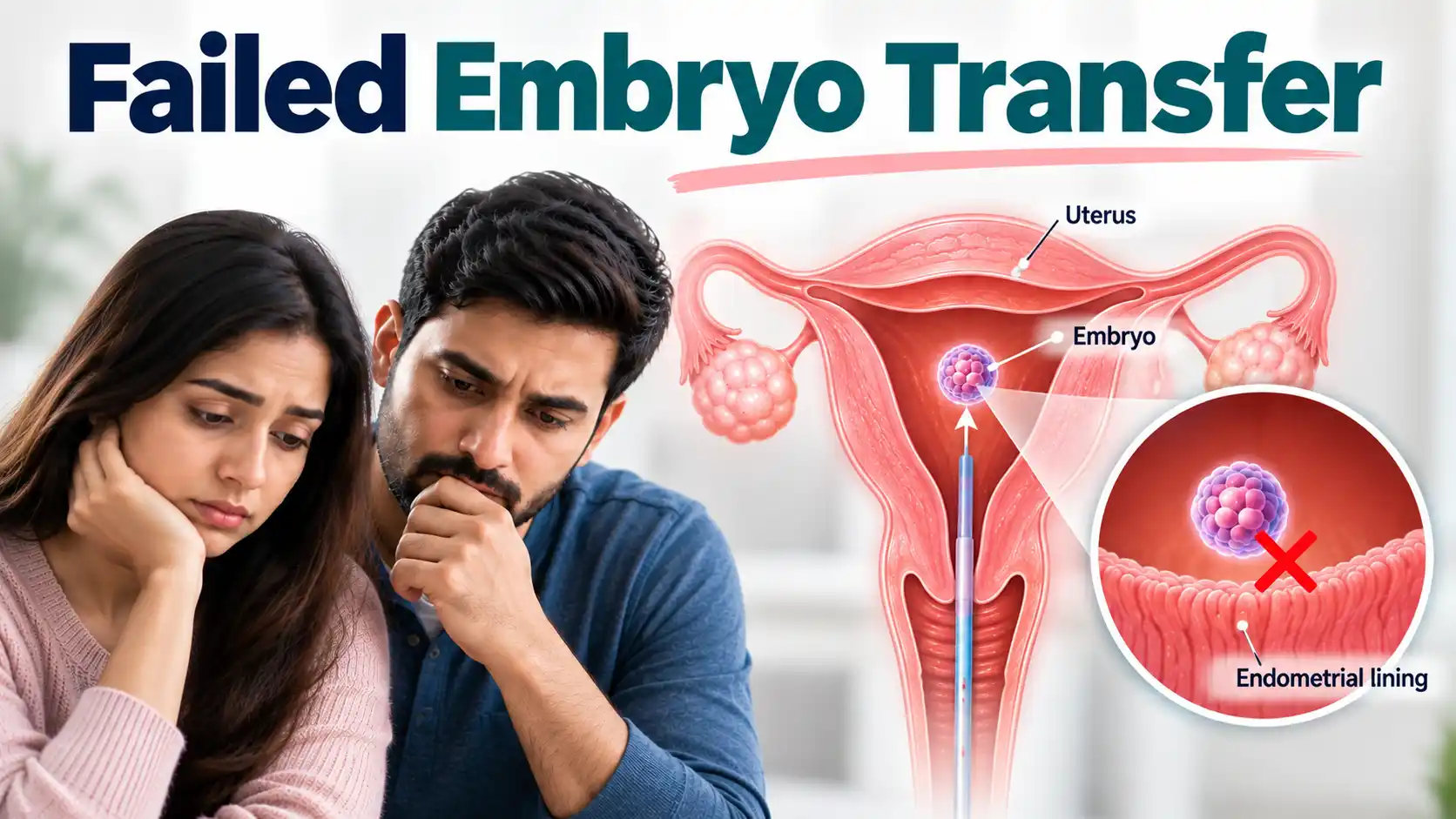

The second negative test is harder than the first. The first one feels like bad luck. The second one feels like a pattern, and the question changes. Couples stop asking will it work and start asking what is actually going wrong.
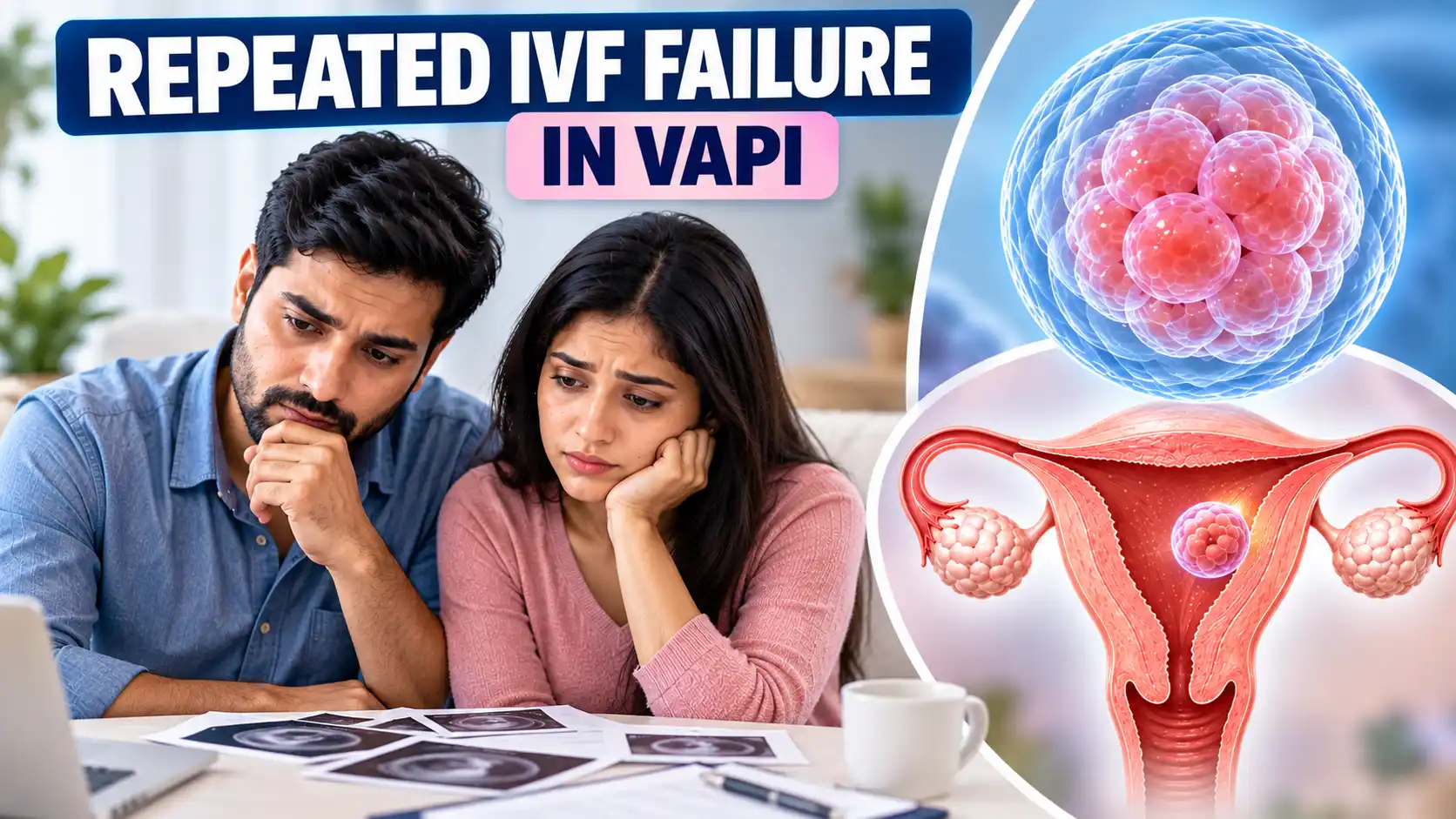
Repeated IVF failure in Vapi is one of the most common reasons couples come in for a second opinion. They arrive with a folder of reports, a few embryo photos, and no clear answer about what went wrong.
A failed cycle hurts. It is also data. The drug record, the fertilisation report, the embryo grades, the lining thickness and the transfer notes all point to a cause. Read together, they narrow the problem down to one or two areas. That is where the next cycle should differ.
Key Takeaways
- A single failed cycle is normal statistics, not a diagnosis. Success depends on age, cause, weight and lifestyle.
- Recurrent implantation failure has a working definition: no pregnancy after at least four good embryos across three or more cycles in a woman under 40.
- True implantation failure is rare. When three healthy, gene-tested embryos go into a normal womb, fewer than 5% of women fail.
- Most failures trace back to the embryo, not the womb. Gene errors in eggs rise sharply with age.
- Uterine factors such as polyps, fibroids, scar tissue and silent womb lining swelling can be treated once found.
- Sperm quality matters beyond the count. DNA damage can hold back an embryo even when the semen report looks fine.
- Two failed cycles is the right point for a full review, not a third copy of the same plan.
What Repeated IVF Failure in Vapi Really Means
Words matter here, because the label changes the plan. Many couples are told they have recurrent implantation failure after two negative cycles. Often that is too soon.
1. One failed cycle is not a diagnosis
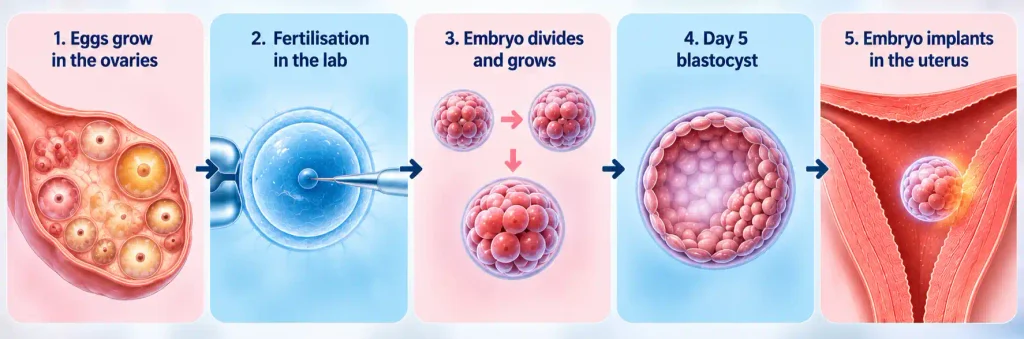
IVF works in stages. Eggs must grow, fertilise, divide, reach day 5, survive freezing and then implant. One cycle can stall at any of these points for reasons that never come back.
2. Counting embryos, not just cycles
A cycle where two poor-grade day-3 embryos were transferred is not the same as a cycle where a tested blastocyst was transferred. The usual rule for recurrent implantation failure counts good embryos across at least three transfers in women under 40.
So a woman with two cancelled cycles and one transfer of a single average embryo does not fit that rule. She has had a rough start, which needs a different talk.
“When a couple tells me IVF failed twice, my first job is to find out what exactly failed. Sometimes no embryo was ever formed, and that is an egg or sperm problem. Occasionally the search leads somewhere unexpected, which is why what an ovarian lump really means is worth understanding too.” Dr. Kaushal Patel
IVF Failure Reasons: Where Cycles Break Down
Five areas explain most cases of failed IVF treatment. A good review checks each one in turn.
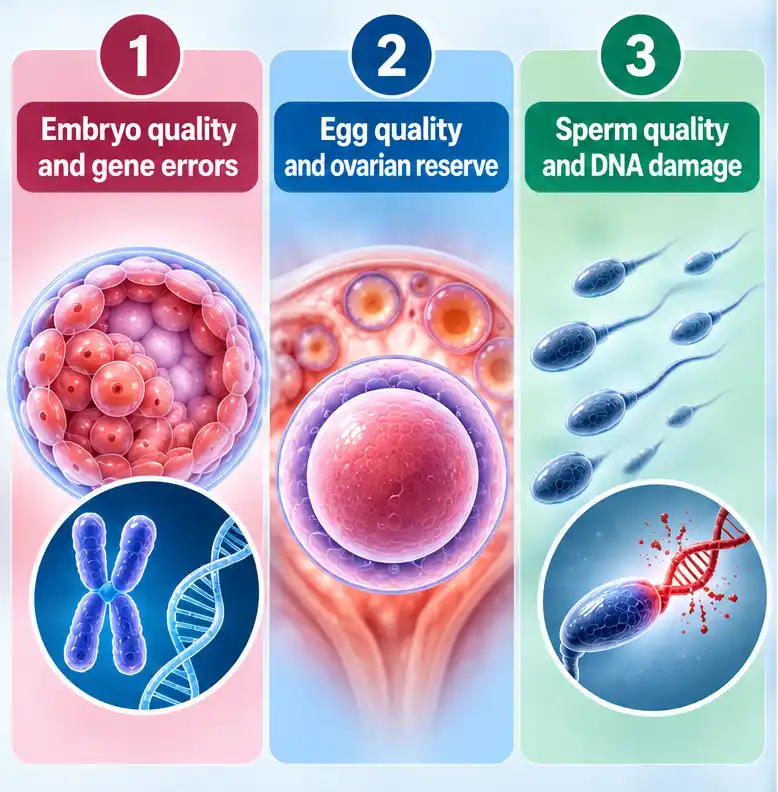
1. Embryo quality and gene errors
An embryo can look perfect under the microscope and still carry the wrong number of chromosomes. These embryos rarely implant. When they do, they often end in early loss.
Grading tells you how an embryo looks. It does not tell you what is inside. That gap explains many cases where “all looked fine” and the test was still negative.
2. Egg quality and ovarian reserve
Egg quality drives embryo quality more than any other factor. As a woman ages, the share of eggs with gene errors goes up.
Ovarian reserve is a separate thing. AMH and follicle counts tell you how many eggs you may get. They do not tell you how good those eggs are. A woman with low AMH can still have healthy eggs. A woman with high AMH can still have poor egg quality. Both numbers help, but neither one decides the result.
3. Sperm quality and DNA damage
Male factor is often checked once at the start and never again. That is a mistake after repeated failure.
- Fertilisation may look normal while the embryo stalls on day 3 or day 4.
- Sperm DNA damage can be high even with a normal count and movement.
- Fever, infection, varicocele, heat, smoking and tobacco all affect sperm over about three months.
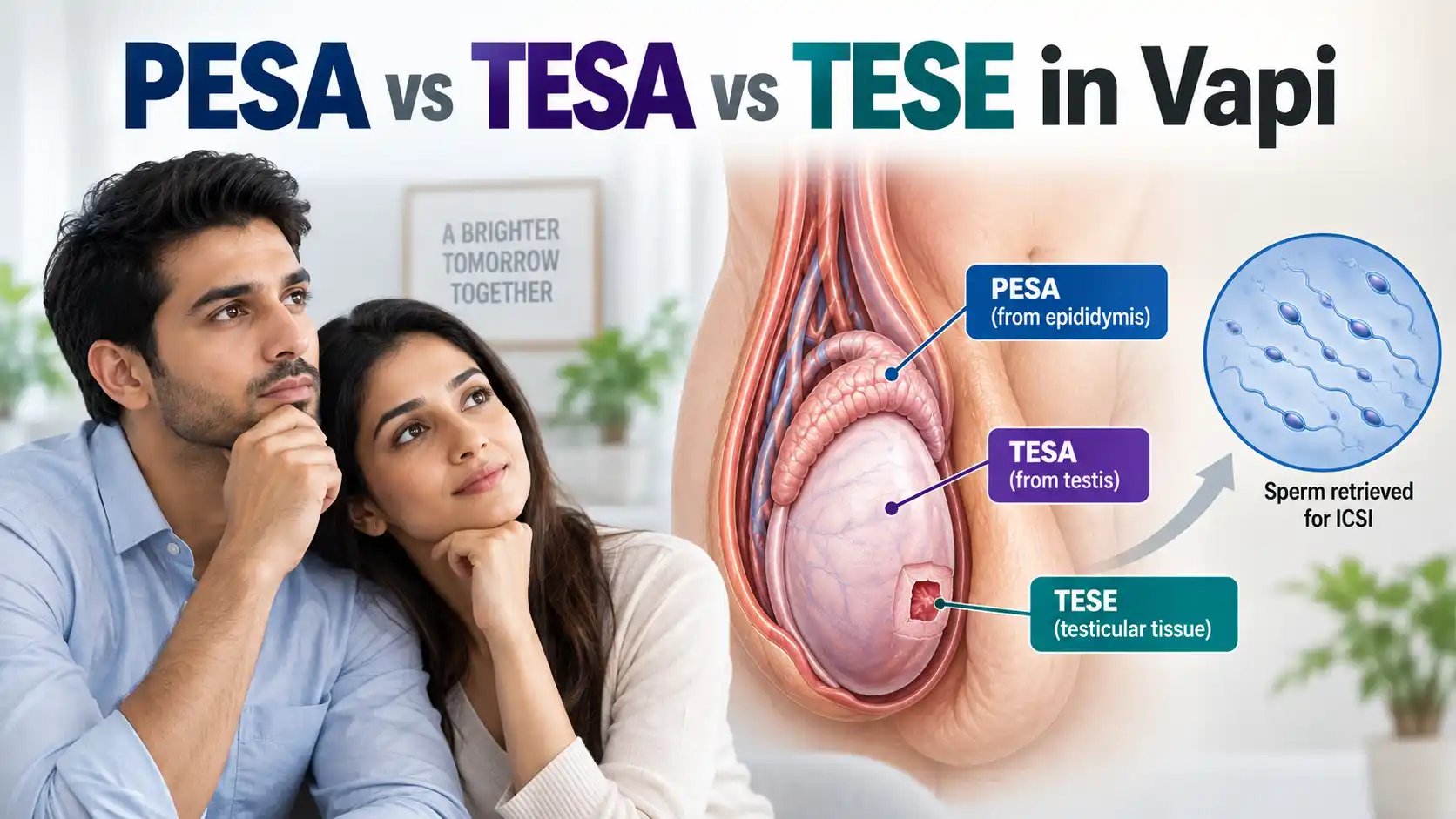
- Sperm taken by surgery can act in a different way in the lab.
Reviewing male factor infertility again after a failed cycle is quick, cheap and often useful.
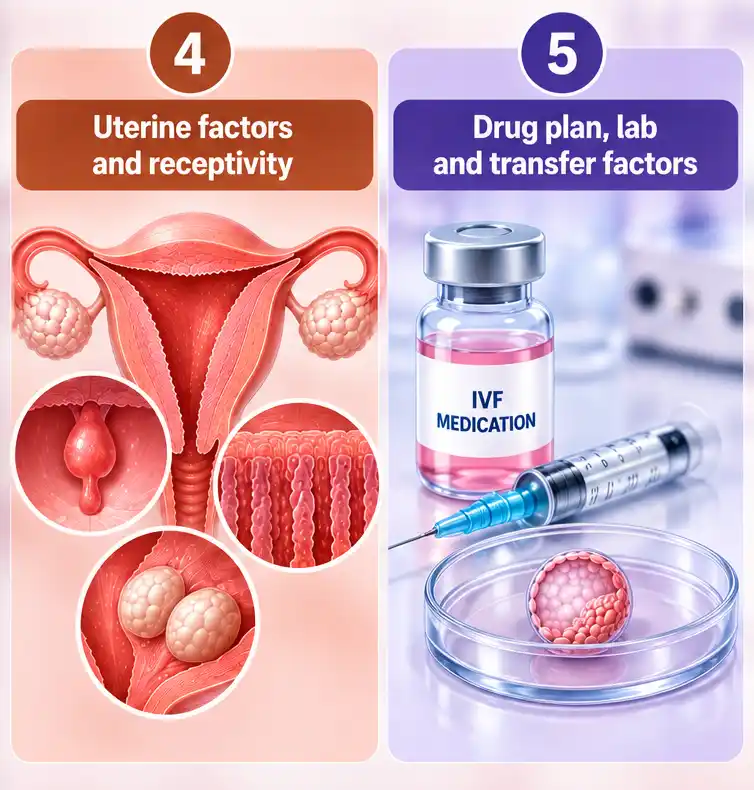
4. Uterine factors and endometrial receptivity
The womb has to be ready on the right day. A few problems get in the way quietly, with no pain or bleeding.
- Polyps and fibroids that push into the womb cavity
- Scar tissue inside the womb after an earlier procedure
- Chronic endometritis, a mild lining swelling with almost no signs
- Hydrosalpinx, where fluid from a blocked tube leaks into the womb
- A thin uterine lining that never gets thick enough
Scans alone miss a few of these. A simple hysteroscopy looks right inside the womb and can fix small problems in the same sitting.
5. Drug plan, lab and transfer factors
At times the biology is fine and the plan needs a tweak. A drug plan that gave four eggs may not be right to repeat. Those protocol decisions are made the same way across every branch of our IVF centre in Gujarat.
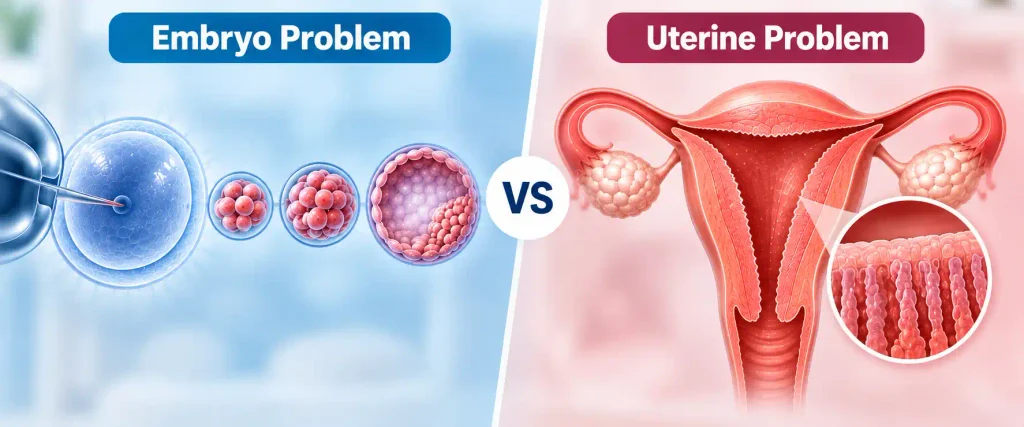
Embryo Problem or Uterine Problem? A Practical Comparison
Most couples want to know which side of the equation failed. The pattern in your reports usually gives a strong clue. In practice, repeated IVF failure in Vapi tends to fit one of the patterns below. Each one leads to a different next step.
| What you see in your reports | Points towards | Useful next step |
|---|---|---|
| Few eggs, poor fertilisation, embryos arresting before day 5 | Egg or sperm quality | Drug plan change, ICSI review, sperm DNA test, diet and lifestyle work |
| Good day 5 embryos, repeat negative tests, normal lining | Embryo genetics or receptivity | Gene testing of embryos, hysteroscopy, endometritis check |
| Positive test then early loss, more than once | Embryo genes, thyroid, clotting or uterine factors | Loss workup, thyroid and sugar tests, womb check |
| Lining under 7 mm, patchy or slow to grow | Endometrial factor | Hysteroscopy, scar check, new way to build the lining |
| Painful periods, past endometriosis, poor response | Pelvic disease affecting egg quality | Scans, surgery review, freeze-all plan |
On the uterine side, a thin uterine lining is the finding that most often explains an otherwise unexplained failure.
What to Do After Failed IVF: Start With a Proper Review
Before any new drug is given, the last cycle needs a slow, honest read. Bring every page, even the ones that look dull.
Questions worth asking at that review
- How many eggs were picked up, and how many were ripe?
- How many eggs fertilised, and was ICSI used?
- How many embryos reached day 5, and what grades did they get?
- Was the transfer fresh or frozen, and why?
- How thick was the lining on transfer day?
- Was the transfer easy or hard?
- Were any embryos frozen, and how do they look now?
If your clinic cannot answer these clearly, that alone is a reason to get a second view. Knowing the real numbers also helps, and our note on IVF success rates in Vapi sets out what to expect.
“I ask couples to bring the embryology sheet, not just the discharge summary. That one page tells me if we face an egg problem, a sperm problem or a womb problem. Couples who came to IVF after unsuccessful IUI should revisit what to do after a failed IUI, since the same reasoning applies.” Dr. Kaushal Patel
Tests Worth Doing After Repeated IVF Failure in Vapi
Tests should be picked with care. A long panel of costly immune tests rarely changes the plan, and many have weak proof behind them.
1. Usually worthwhile
- Thyroid, prolactin, vitamin D and a blood sugar test
- AMH and follicle count to re-check ovarian reserve
- Repeat semen test, with a DNA damage test where needed
- Hysteroscopy to look inside the womb
- A lining sample for chronic endometritis when the womb looks normal but transfers keep failing
- 3D or saline scan for fibroids, polyps or a septum
- A tube check if hydrosalpinx was never ruled out
2. Consider case by case
- Karyotype tests for both partners, mainly after repeat early losses
- Thrombophilia screening where a personal or family history exists
- Lining timing tests, which help a small, picked group
IVF Failure Treatment: What Should Change Next Time
Repeating the same cycle and hoping for a new answer is the most common mistake. At least one thing that matters should change.
Treatment for repeated IVF failure in Vapi is not one fixed package. It is a set of tweaks picked from four areas, based on what your own reports show.
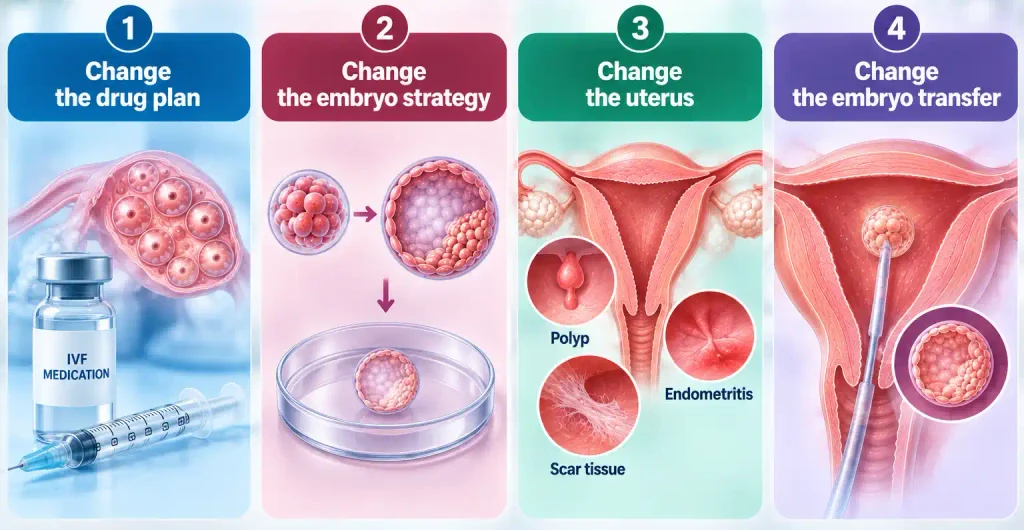
1. Change the drug plan
Dose, plan type, trigger choice and timing can all be changed. For women with low reserve, the goal shifts from more eggs to better eggs. That may mean pooling eggs over two cycles before any transfer.
2. Change the embryo strategy
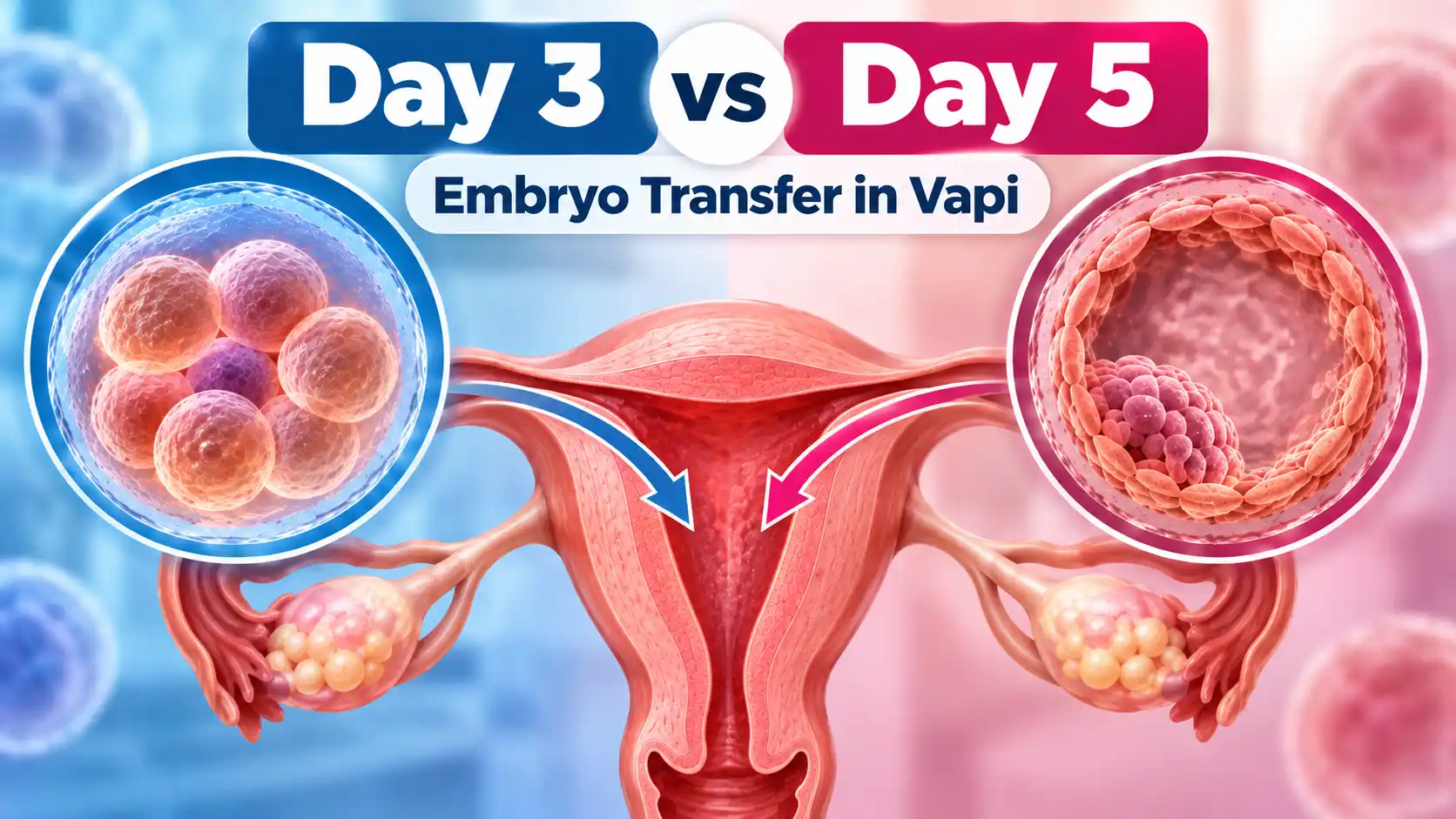
Growing embryos to day 5 gives a better pick than a day 3 transfer in most cases. Where age or repeat losses play a part, PGT-A testing checks embryos for the right number of chromosomes, so only normal ones go back. This does not make better embryos. It just avoids ones that were never going to work.
3. Change the uterus
Polyps get removed. Scar tissue gets released. Chronic endometritis is treated with a short course of the right antibiotic, then checked again. If endometriosis is present and severe, the plan may add hormone rest before transfer or a freeze-all step.
4. Change the embryo transfer itself
A frozen transfer in a calm, drug-free cycle often suits women who had high hormone levels. Progesterone support can be checked, measured and set for you. A trial run first avoids surprises with a tight cervix, so the embryo transfer stays quick and gentle.
“After a failed cycle, I never simply repeat the same plan. We change the part we have proof against, and we leave the rest alone. Changing everything at once is exactly what the common IVF myths encourage, which is why the advice is worth reading critically.” Dr. Kaushal Patel
The Part Nobody Puts in the Report
Repeated failure takes a toll that no blood test picks up. Couples speak of being worn out, tense talks at home, and quiet dread each time a cycle starts.
- Agree on how many tries feel fair before you start, then check in on that.
- Agree on who you will tell, so you are not handling other people’s hopes during the two-week wait.
- Ask for counselling early, not after the next negative test.
- Keep one visit just for questions, with no procedure tied to it.
Couples who plan this side of care cope better. They also choose more clearly when a hard call comes.
How Long Should You Wait Before Trying Again?
In body terms, most women are ready after one or two normal periods. If surgery was done, allow one full cycle to heal.
In feeling terms, the timing is yours. Rushing in while still grieving rarely helps. Waiting out of fear does not help either. Age is the one thing that does not pause, so long gaps cost more for women in their late thirties.
When a Different Path Deserves Discussion
Some talks are hard but needed. If a few well-built cycles have made no usable embryos, donor eggs or donor sperm may give a far better chance than one more try with your own.
Raising this early is not giving up. It gives couples time to think, to ask, and to choose without pressure. Many try again first, and that is a fair choice when the plan has truly changed.
About the Author
Dr. Kaushal Patel is a fertility specialist and gynaecologist in Vapi. His work centres on IVF, recurrent implantation failure and hard fertility cases. He has published in an international peer-reviewed journal and sees many couples who come back after failed treatment elsewhere.
His method is simple. Review the last cycle in detail. Test only what will change the plan. Explain the reasons in plain words before anything starts.
Final Thought
Repeated IVF failure in Vapi is rarely a dead end. It is a sign that something has not yet been found or fixed. Once you know which part broke down, the next cycle stops being a repeat and starts being a plan.
Bring your reports. Ask hard questions. Expect clear answers.
Ready for a clear answer? Book a fertility consultation in Vapi to review your past IVF results and talk about what should change next. Book an appointment with Dr. Kaushal Patel at Isha Care.
Frequently Asked Questions
1. Why does IVF fail repeatedly in Vapi?
The reasons are the same everywhere. Most cases mix embryo quality, egg or sperm factors, and womb problems that were never fully checked. What differs is which factor leads, and that only shows up when the old cycle records are read with care.
2. What are the most common IVF failure reasons after multiple failed cycles?
Gene errors in the embryo are the biggest single cause of repeated IVF failure in Vapi, and they grow more common as a woman ages. Womb problems such as polyps, scar tissue and silent lining swelling come next, then sperm DNA damage and drug plan issues.
3. What should I do after repeated IVF failure in Vapi?
Gather every report from your past cycles, including the embryology sheet, and book a review visit rather than a fast repeat cycle. The aim of that visit is to find which stage failed and what exact change will be made before you start again.
4. Can poor egg quality cause repeated IVF failure?
Yes, and it is one of the most common causes, mainly after the mid-thirties. Poor egg quality shows up as low fertilisation, embryos that stop growing before day 5, or good-looking embryos that keep failing to implant.
5. Can poor sperm quality contribute to IVF treatment failure?
Yes. Sperm gives half the embryo’s genes, and high DNA damage can hold back growth even when count and movement look normal. Repeating the semen test and adding a DNA damage test after a failed cycle is often worth it.
6. Can uterine factors cause implantation failure after IVF?
They can, and they are among the easiest causes to treat once found. Polyps, fibroids, scar tissue, a thin lining and chronic endometritis all block implantation, and most cause no signs at all.
7. What tests are recommended after repeated IVF failure in Vapi?
A tight set covers thyroid and blood sugar tests, AMH with follicle count, a repeat semen test, and a hysteroscopy to look inside the womb. Extra tests such as karyotype or a lining sample are added only when your case points that way.
8. Does repeated IVF failure mean I have recurrent implantation failure?
Not always, because the term has a set meaning. It needs at least four good embryos placed across three or more transfers in a woman under 40. Many couples given the label have not yet had enough good embryos put back to meet that bar.
9. Can embryo quality affect the chances of successful implantation?
Yes, though how it looks under the microscope only tells part of the story. An embryo can be graded excellent and still carry a gene error that stops implantation. Grading and gene testing answer different questions.
10. Should genetic testing be considered after repeated IVF failure?
It is worth a talk, mainly for women over 35, couples with repeat early losses, or those with a few failed transfers of good embryos. Checking the chromosome count helps you skip embryos that cannot work, though it does not make the embryos better.
11. Can endometriosis cause repeated IVF failure?
Endometriosis can hit egg quality, pelvic shape and the womb lining, and it is often first picked up during fertility tests. When it is severe, care may include surgery, hormone rest before transfer, or a freeze-all plan to let things settle.
12. What can be changed in the next embryo transfer after a failed cycle?
Common changes include moving from a fresh to a frozen transfer, changing how the lining is built, checking and tuning progesterone support, and placing a day 5 embryo instead of a day 3 one. A trial transfer beforehand also helps when the previous procedure was difficult.
13. How long should I wait before trying IVF again after a failed cycle?
Most women are ready in body terms after one or two normal periods, and a bit longer if surgery was done. The emotional timing matters just as much, though very long gaps do cost more for women in their late thirties.
14. What IVF failure treatment options are available after repeated unsuccessful cycles?
Options run from a new drug plan and a different way to fertilise, to keyhole repair of womb problems, care for lining swelling, gene screening of embryos, and transfer timing set for you. Where repeat cycles have made no usable embryos, donor options may be raised openly.
15. When should I see a fertility specialist after multiple failed cycles in Vapi?
Two failed cycles is a sound point to ask for a full review rather than a third copy of the same plan. Come sooner if no embryos formed, if the cycle was called off, or if nobody has told you clearly what went wrong.